The AI Productivity Paradox: How Behavioral Science and Automation are Redefining Corporate Leadership in India
4 min read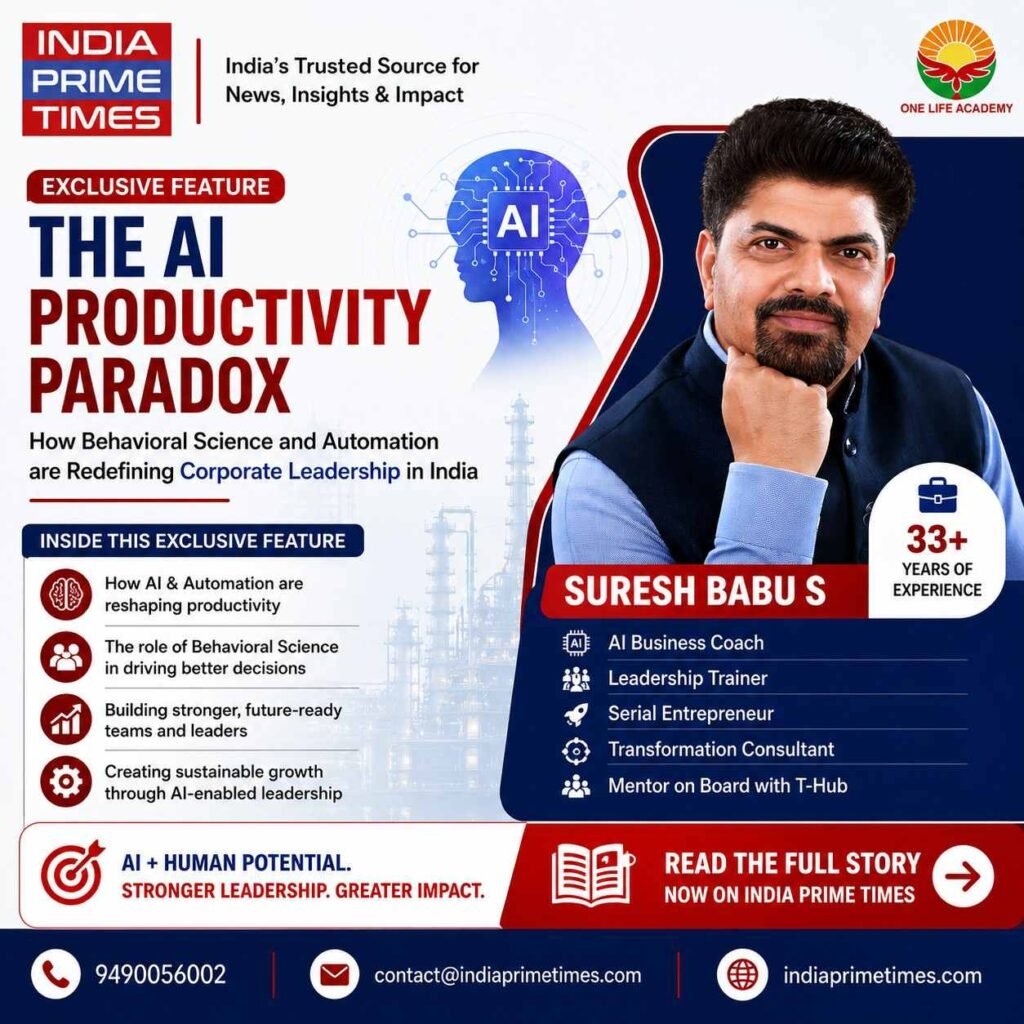
The modern corporate ecosystem is currently navigating one of the most disruptive transitional phases since the dawn of the internet. As AI (Artificial Intelligence) moves rapidly out of the realm of experimental tech and firmly into the boardroom, enterprise leaders are facing a dual crisis: the immense pressure to adopt AI technologies to stay competitive, and an unprecedented level of executive burnout. The traditional “hustle culture” of working longer hours is yielding diminishing returns, forcing a critical re-evaluation of what high-performance leadership actually looks like in the AI era.
Recently, the India Prime Times editorial team decided to investigate how top-tier organizations and forward-thinking entrepreneurs are managing this complex technological transition. During our deep dive into this shifting industry landscape, we had the distinct opportunity to meet and converse with Suresh Babu S, a seasoned AI Business Coach, Leadership Trainer, Serial Entrepreneur, Transformation Consultant, and a Mentor on Board with T-Hub.
Observing his methodology firsthand provided our team with a profound understanding of why some enterprises successfully integrate AI to achieve massive growth, while others stumble. During our sit-down conversation with him, a fundamental industry truth emerged: technology alone cannot fix a broken corporate culture or an inefficient workflow. True scalability in today’s dynamic business environment requires operating at the precise intersection of technological automation and deep human behavioral development.
The End of the > 48-Hour Workweek
For decades, the standard metric for dedication in the corporate world has been time spent at the desk. However, industry data increasingly shows that extended hours do not correlate with proportional business growth. During our interaction, Suresh Babu articulated a radically different approach to enterprise productivity. Known widely in industry circles as the “4-Day Work Week AI Coach,” his insights shed light on a growing movement among the C-suite.
The objective, as he explained, is no longer to squeeze more hours out of the day, but to systematically eliminate operational friction. By deploying targeted AI frameworks, entrepreneurs, CXOs, and executive teams are reclaiming upwards of 10 hours a week. This reclaimed time is then redirected from mundane operational tasks toward high-level strategic thinking. Through customized coaching and the implementation of Custom GPT solutions, leaders are learning to position themselves as subject matter experts, automating their workflows, and building scalable systems that allow for genuine business growth alongside personal freedom.
With over 33 years of professional experience, including pivotal leadership roles at global tech giants like Microsoft, and his ongoing role guiding emerging startups as a Mentor on Board with T-Hub, Suresh Babu brings a wealth of legacy infrastructure knowledge to the modern AI frontier. His transition from traditional project management to a mission-driven AI entrepreneur highlights a broader industry trend: the urgent move from legacy operations to agile, AI-powered enterprises.
Merging Silicon with Psychology: The One Life Academy Approach
Perhaps the most critical takeaway from our interaction with Suresh and his work at One Life Academy-a venture he founded 13 years ago-is the realization that AI transformation is fundamentally a people transformation.
A common pitfall across the industry is that companies invest millions in generative AI and enterprise software, only to face massive internal resistance from employees who fear redundancy, or from teams that lack the necessary cognitive frameworks to adapt. To combat this, the strategies deployed by One Life Academy integrate cutting-edge technological training with globally recognized behavioral frameworks.
Rather than just teaching a business leader how to prompt an AI model, the focus is on utilizing psychometric assessments like MBTI® (Myers-Briggs Type Indicator) and CliftonStrengths®. This dual-pronged approach ensures that as an organization adopts artificial intelligence, its human capital is simultaneously aligned for peak performance.
When a leader understands the innate cognitive strengths and communication styles of their team, AI can be delegated effectively to complement those human strengths, resulting in superior decision-making, tighter execution, and a massive-often 10X-boost in overall productivity. Our team noted that this empathetic, structured approach to change management is exactly what separates sustainable growth from fleeting technological fads.
The Rise of the AI-Empowered Community
Furthermore, the integration of AI is not happening in a vacuum. The complexities of this technology necessitate collaborative learning environments. Recognizing this, there has been a significant surge in specialized executive hubs designed to foster shared knowledge. A prime example is BACH (Biz, AI & ChatGPT Hub), a rapidly expanding community of entrepreneurs spearheaded by Suresh Babu.
Communities like BACH are becoming the new standard for professional networking. They serve as incubators where business owners can bypass the steep learning curve of AI by sharing practical, execution-driven use cases. In a landscape where AI is frequently perceived as overly complex, theoretical, or overwhelming, these communities simplify the technology, rendering it accessible and immediately actionable for businesses of all sizes.
Measurable Outcomes in a Shifting Economy
The impact of this holistic approach to business transformation is highly measurable, and the numbers reflect a massive shift in how corporate training is being consumed. Through his flagship initiatives, Suresh Babu has trained over 10,000 professionals, delivered upwards of 1,000 workshops across various industries, and provided one-on-one strategic coaching to over 100 CXOs and business leaders.
The India Prime Times team walked away from our conversation with a clear perspective on the future of corporate leadership. The organizations that will dominate the next decade will not be those that simply buy the most expensive enterprise AI licenses. Instead, the market leaders will be those who use AI to augment human intelligence, allowing their teams to work smarter, faster, and more effectively.
In a corporate world that often chases aggressive growth at any cost, the methodology we observed prioritizes something far more resilient. As the AI era continues to unfold, leaders like Suresh Babu S are proving that the ultimate goal of automation isn’t just a higher ROI-it is achieving growth with profound clarity, systemic balance, and a fundamentally better quality of life.