
10 Definitive Checklists for Legal Audits
8 min read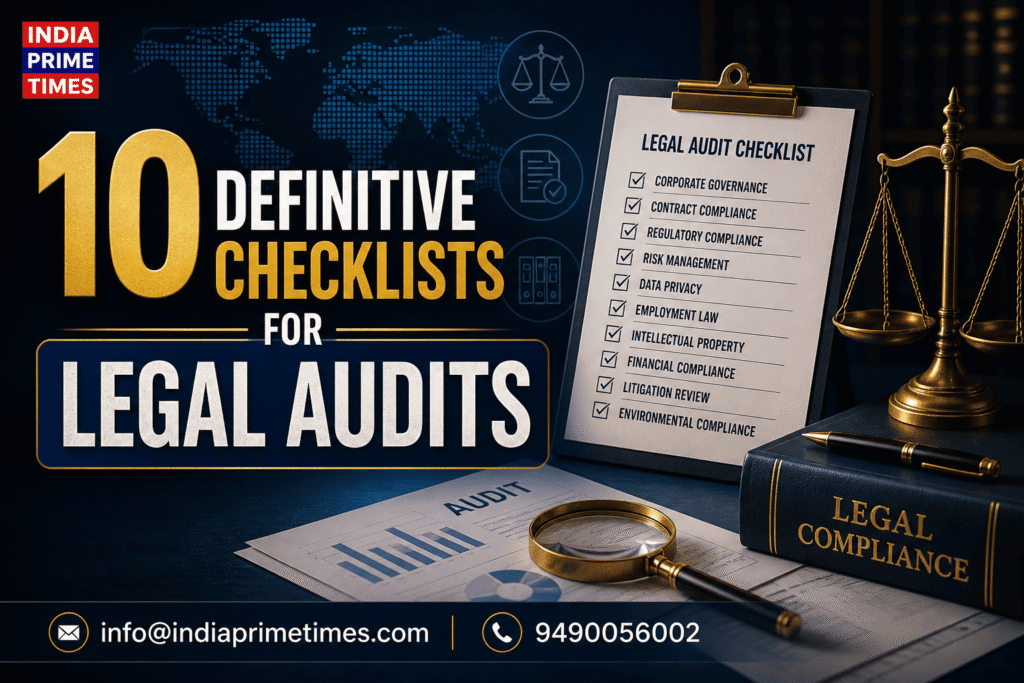
A legal audit is no longer something that happens to a business during a crisis or a transaction. In the current regulatory environment, where digital data obligations, tax compliance requirements, labour law reforms, and corporate governance standards are all simultaneously active, legal audits have become a routine operational discipline that distinguishes well-managed businesses from those that discover their vulnerabilities only when it is expensive to fix them.
The trigger points for legal audits have multiplied. A funding round. An M&A process. A regulatory inquiry. A labour dispute. A data breach. In each of these scenarios, the business that has maintained organized, current legal documentation moves through the process faster, at lower cost, and with less reputational exposure than the one that is assembling records under pressure.
For founders, executives, and compliance professionals, the practical question is not whether a legal audit will happen, it is whether the organization will be ready when it does.
These 10 definitive checklists for legal audits provide the organized framework that makes readiness achievable rather than aspirational.
1. Corporate Governance and Board Records Checklist
What it covers: The completeness and currency of foundational corporate documentation, certificate of incorporation, memorandum and articles of association, board and shareholder meeting minutes, share register, director appointment and resignation records, annual filings with the Registrar of Companies, and any shareholder agreements or investment documents.
Why it matters: Corporate governance documentation is the first set of records reviewed in virtually every legal due diligence exercise, funding rounds, M&A transactions, regulatory inquiries. Gaps or inconsistencies in these records create transaction delays, raise investor concerns, and in some cases represent direct regulatory compliance failures.
How to apply it: Assign specific ownership for corporate record maintenance. Review the completeness of board minutes for the past three years. Confirm that all required annual filings with MCA are current. Verify that the share register accurately reflects current shareholding, including any changes from ESOP exercises, secondary transfers, or investment rounds.
Example: A Mumbai-based SaaS startup discovered during Series A due diligence that board minutes for two key decisions, an IP assignment and a key executive appointment, had never been formally adopted. Reconstructing these records delayed closing by three weeks and required additional legal fees that could have been avoided with routine governance maintenance.
2. Contracts and Vendor Agreements Checklist
What it covers: A complete repository of material contracts, customer agreements, vendor and supplier contracts, SaaS and software licenses, partnership agreements, distribution arrangements, and any long-term commercial commitments, reviewed for currency, expiry, renewal obligations, and assignment restrictions.
Why it matters: Contract gaps, expired agreements being performed without renewal, assignment restrictions that affect a transaction, auto-renewal clauses missed, or material obligations not being met, are a consistent source of legal audit findings that create both operational risk and transaction complications.
How to apply it: Maintain a contract register with key terms, counterparty, commencement date, expiry, renewal mechanism, governing law, and key obligations. Review it quarterly. Flag contracts approaching expiry for renewal assessment. Identify contracts with change-of-control provisions before initiating any M&A or significant investment process.
Example: A technology company preparing for acquisition discovered that its largest customer agreement contained a change-of-control clause requiring customer consent to assignment, a provision that required a direct customer conversation before the transaction could close.
3. Employment and HR Compliance Checklist
What it covers: Employment agreements for all staff, POSH (Prevention of Sexual Harassment) policy and Internal Complaints Committee compliance, PF and ESI registration and contribution records, gratuity provisions, leave policy compliance, contractor and gig worker classification documentation, and compliance with applicable labour codes.
Why it matters: Employment compliance is one of the most actively enforced compliance areas for Indian businesses. POSH non-compliance carries both regulatory risk and reputational exposure. PF and ESI non-compliance generates financial liability. And with India’s consolidated labour codes being progressively implemented through state notifications, employment frameworks require ongoing monitoring.
How to apply it: Maintain executed employment agreements for all current employees. Verify PF and ESI contribution records are current and correctly calculated. Confirm POSH ICC constitution and annual report filing status. Review contractor classification documentation for significant third-party engagements.
Example: A Delhi-based retail chain was found during a regulatory inspection to have not constituted a POSH Internal Complaints Committee despite crossing the relevant employee threshold. The oversight was identified during the inspection rather than through proactive compliance monitoring.
4. Intellectual Property and Trademark Checklist
What it covers: Trademark registration status and renewal schedules, patent filing and maintenance records, copyright registrations for significant creative works, IP assignment agreements from employees and contractors, trade secret protection documentation, and any third-party IP licenses being used in the business.
Why it matters: IP assets are frequently among the most valuable assets in a business, and among the most poorly documented. Investors and acquirers specifically focus on IP ownership clarity during due diligence. Unassigned IP from contractors or founders, expired trademark registrations, and inadequate trade secret documentation are common findings.
How to apply it: Maintain a centralized IP register covering all trademarks, patents, and copyright registrations with renewal dates. Verify that IP assignment agreements are in place for all relevant employees and contractors. Review trademark registration status for all brand names and logos used commercially.
Example: A consumer goods startup discovered during investor due diligence that its product name had not been registered as a trademark in two key market states, and that a competitor had filed a conflicting application in one of them. The unregistered status created both vulnerability and delay in the investment process.
5. Data Privacy and Cybersecurity Compliance Checklist
What it covers: Privacy policy publication and accuracy, consent management mechanisms, data processing documentation, data breach response procedures, CERT-In compliance documentation, DPDP Act obligations assessment, and for businesses with international data flows, GDPR or equivalent compliance documentation.
Why it matters: India’s Digital Personal Data Protection Act 2023 and associated rules represent a significant new compliance obligation for businesses processing personal data. Simultaneously, CERT-In’s mandatory incident reporting requirements, including the six-hour reporting obligation for specified incidents, have created operational compliance demands that require proactive preparation.
How to apply it: Conduct a data mapping exercise to document what personal data is collected, how it is used, where it is stored, and who has access. Review privacy policy accuracy against current data practices. Confirm breach response procedures are documented and that CERT-In reporting contacts are identified and current.
6. Licenses, Permits, and Registrations Checklist
What it covers: All business licenses and permits required for operations, GST registration, Shops and Establishments registration, FSSAI licensing for food businesses, import/export code, professional licenses, environmental clearances, state-specific permits, and any sector-specific regulatory registrations.
Why it matters: Operating without required licenses creates both regulatory risk and business disruption. License renewal deadlines are frequently missed when they are not systematically tracked. And license gaps discovered during transactions or regulatory inspections can create significant complications.
How to apply it: Maintain a complete license register with issuance dates, expiry dates, renewal requirements, and the responsible owner for each license. Build automatic renewal reminders into your compliance calendar. Review the register when entering new business activities, new geographies, or new product categories.
7. Litigation, Disputes, and Legal Claims Checklist
What it covers: A complete register of current and historical litigation, regulatory proceedings, arbitrations, consumer complaints, employment disputes, and any formal legal notices received, including current status, legal counsel engaged, potential liability assessment, and provisions made.
Why it matters: Undisclosed litigation is one of the most consequential findings in legal due diligence. Investors and acquirers specifically search for litigation exposure, and failure to disclose known claims can create both transaction and legal liability. Maintaining a current litigation register is foundational governance practice.
How to apply it: Establish a litigation register maintained by the legal team with input from all business functions. Require that any legal notice received by any employee is immediately routed to the legal team for registration and assessment. Review and update the register quarterly.
8. Tax, Finance, and Statutory Filing Checklist
What it covers: Income tax return filing status, GST return compliance, TDS deduction and deposit compliance, advance tax payments, transfer pricing documentation for related-party transactions, ROC annual filing status, and financial statement preparation and audit status.
Why it matters: Tax and statutory filing compliance is a routine audit focus area with significant financial and reputational consequences for non-compliance. GST and TDS defaults generate interest and penalties that compound over time. And ROC filing lapses create corporate governance concerns that affect investor relationships.
How to apply it: Maintain a statutory compliance calendar covering all filing deadlines, GST returns, TDS deposits, income tax filings, advance tax payments, and ROC filings, with specific ownership and advance reminders for each. Review compliance status monthly.
9. Policies, Handbooks, and Internal Controls Checklist
What it covers: Employee handbook currency and completeness, code of conduct documentation, financial authorization and approval policies, expense and procurement policies, IT and data security policies, whistle-blower mechanisms, and conflict of interest disclosure procedures.
Why it matters: Internal policy documentation is both a governance requirement and a practical operational control. Policies that exist on paper but are not communicated, trained, or enforced provide limited legal protection. Governance audits and investor due diligence specifically assess whether policies are current, communicated, and followed.
How to apply it: Review all material policies for currency, particularly those addressing data protection, workplace conduct, and financial controls. Verify that new employees receive and acknowledge relevant policies during onboarding. Confirm that board-level policies have been formally adopted.
10. Cross-Border and Regulatory Compliance Checklist
What it covers: FEMA compliance for foreign investment, export control requirements, transfer pricing documentation, cross-border contract governing law and jurisdiction clauses, RBI reporting obligations for overseas payments and foreign currency transactions, and sector-specific regulatory compliance for any international operations.
Why it matters: Indian businesses with foreign investment, international customers, or cross-border operations face a layer of regulatory compliance that domestic-only frameworks do not address. FEMA violations can carry significant penalties, and inadequate transfer pricing documentation creates tax exposure.
How to apply it: Identify all cross-border regulatory obligations applicable to your specific business structure and activities. Confirm that FEMA reporting obligations, including annual return filings for foreign-invested entities, are current. Review cross-border contract terms for appropriate governing law, jurisdiction, and dispute resolution provisions.
Conclusion:
The 10 definitive checklists for legal audits covered in this guide provide the structured framework for building the kind of organizational documentation discipline that transforms legal audits from stressful reactive exercises into confident, well-prepared processes.
The investment in audit readiness is consistently modest compared to the cost of addressing gaps discovered under audit pressure, in legal fees, transaction delays, regulatory penalties, and reputational exposure. Build the checklists. Assign the ownership. Maintain the records. And consult qualified legal professionals for jurisdiction-specific guidance on the obligations specific to your business.
Contact India Prime Times
If you have hands-on experience with legal audits, regulatory compliance, corporate governance, or managing due diligence processes, your insights can help businesses avoid costly mistakes and stay audit-ready.
We welcome contributions from legal professionals, company secretaries, compliance officers, founders, and advisors who can share practical frameworks, real-world audit lessons, and actionable guidance that strengthens organizational readiness.
If you’re looking to publish your article on this platform or expand your reach across other leading platforms, feel free to connect with us.
📞 Phone: +91 9490056002
📧 Email: info@indiaprimetimes.com
💬 WhatsApp: https://wa.me/919490056002