
22 Killed as Russian Missiles Hammer Kyiv; Putin Exploits Ukraine’s Depleted Air Defenses Ahead of Critical NATO Summit
4 min read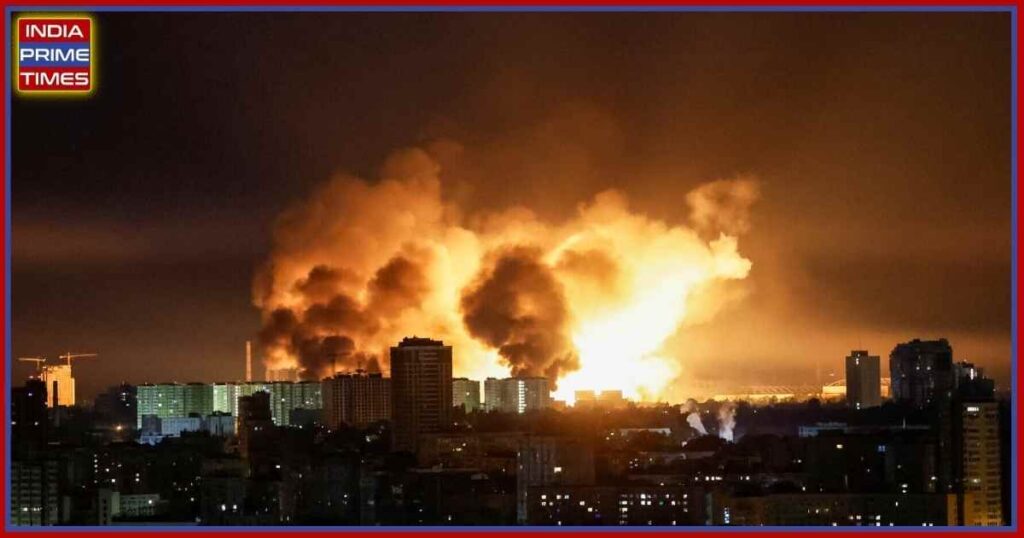
The war in Ukraine has taken a devastating and brutal turn as Russia unleashed its second massive bombardment on Kyiv in less than a week. In the early hours of Monday morning, waves of Russian ballistic missiles, cruise missiles, and strike drones pounded the Ukrainian capital and surrounding regions, killing at least 22 people and injuring 85 others.
The lethality of the attack underscores a terrifying new reality for Ukraine: its air defense systems, severely strained by global shortages, are failing. The Ukrainian Air Force admitted a “serious deficit” of interceptor missiles meant that all 29 Russian ballistic missiles fired overnight successfully bypassed the capital’s defense grid and struck their targets.
The Carnage in Kyiv: “Everything Was Falling Down”
Explosions lit up the night sky over Kyiv starting around 1:40 a.m. local time, driving thousands of terrified residents into underground metro shelters.
Residential neighborhoods bore the brunt of the assault. At least 15 civilians were killed directly within the capital, while seven more perished in the broader Kyiv region. Emergency rescue teams, aided by sniffer dogs and heavy cranes, worked desperately through the rubble of multi-story apartment blocks that had partially collapsed in the Podilskyi and Darnytskyi districts.
“These are residential buildings. Places where people slept and lived their ordinary lives,” said Tymur Tkachenko, head of Kyiv’s military administration.
Survivors recounted apocalyptic scenes. Khrystyna Piatetska, 20, described fleeing her apartment after the blast blew out her windows. “When we got downstairs, cars started exploding, and we came out from under the rubble straight into the fire,” she said.
In the suburb of Vyshneve, authorities evacuated over 600 residents due to the extreme risk of unexploded munitions littering the streets.
Why Is This Happening Now? The Patriot Missile Crisis
The timing and ferocity of the attack were fully anticipated. Just hours before the strikes, Ukrainian President Volodymyr Zelenskyy warned that Russian President Vladimir Putin was preparing a “massive strike” directly timed before a crucial NATO summit in Ankara, Turkey, which begins Tuesday.
However, Ukraine’s inability to stop the ballistic missiles marks a critical vulnerability. The country relies heavily on U.S.-made Patriot missile systems to shoot down hypersonic ballistic threats. Due to the ongoing war in the Middle East straining global manufacturing, Ukraine is suffering an acute shortage of Patriot interceptor missiles.
Ukraine’s Defense Minister Mykhailo Fedorov stated that Russia is deliberately exploiting this weakness. “Fewer such missiles are produced worldwide each month than the enemy fires at Ukraine in that same period,” he said.
President Zelenskyy took to the social media platform X (formerly Twitter) to issue a desperate plea to his Western allies: “As long as Patriot missiles remain in our allies’ stockpiles, Russia is only encouraged to keep ‘vanquishing’ residential buildings. The United States and Europe have enough strength to stop this terror.”
Ukraine’s Counter-Offensive: Striking Deep into Siberia
The Russian Defense Ministry claimed Monday’s strikes precisely targeted Ukrainian weapons factories, armored vehicle repair facilities, and energy infrastructure in retaliation for recent Ukrainian attacks on Russian soil.
While struggling to defend its skies, Ukraine has drastically expanded its offensive reach using advanced domestic drone technology. On Monday, Ukraine’s military confirmed it had successfully struck the Omsk oil refinery in western Siberia. Located nearly 2,500 kilometers (1,550 miles) from the Ukrainian border, it is the deepest strike into Russian territory since the war began.
The Omsk facility is Russia’s largest refinery, accounting for 12% of the nation’s total refining output. Energy analysts warn that sustained damage to the facility will severely exacerbate ongoing gasoline shortages and fuel rationing across Russia, putting immense domestic pressure on Putin.
Additionally, Ukrainian drone strikes triggered widespread blackouts in Russian-annexed Crimea, temporarily cutting power to the strategic port city of Sevastopol.
The Geopolitical Stage: Trump Steps In
As rescue operations continue in Kyiv, the geopolitical focus shifts to the NATO summit in Turkey. President Zelenskyy is scheduled to meet with U.S. President Donald Trump on the sidelines of the summit on Wednesday.
Trump, who held a 90-minute phone call with Putin over the weekend, has stated that a resolution to the four-year war is “getting closer than people realize.” White House officials confirmed that Trump plans to speak with Putin again following his meeting with Zelenskyy in an attempt to revive stalled peace negotiations.
As diplomacy resumes on the global stage, the citizens of Kyiv continue to pull their neighbors from the rubble, anxiously waiting for the air defense reinforcements that may determine their survival.
Get in Touch with India Prime Times
For any updates, queries, or to publish a news article, please reach out to our editorial desk:
- Contact Number: +91 9490056002
- Email ID: info@indiaprimetimes.com
- WhatsApp Us: https://wa.me/919490056002