
Historic Saffron Wave in Bengal: How the BJP Won Over the Women and Broke TMC’s ‘Lakshmir Bhandar’ Fortress
4 min read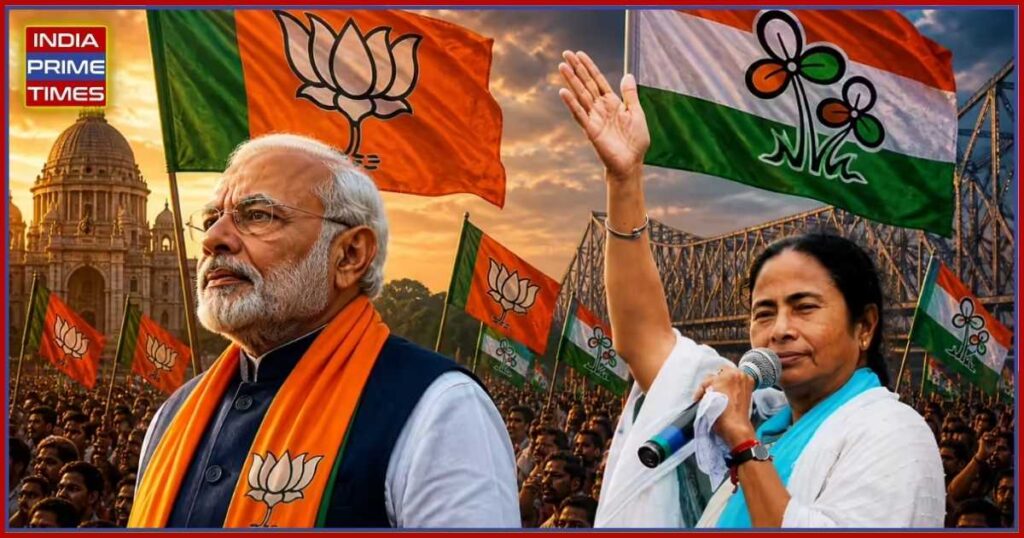
The much-debated question of who would capture the trust of the women of West Bengal in the 2026 assembly elections has been answered with a resounding mandate. In a historic and seismic political shift, the Bharatiya Janata Party (BJP) has crushed the ruling Trinamool Congress (TMC), sweeping to power with an overwhelming 208 of the state’s 294 seats.
The TMC, which had dominated the state’s political landscape for 15 years, has been reduced to just 79 seats. The magnitude of the defeat was cemented in Kolkata’s Bhabanipur, where Chief Minister Mamata Banerjee-long hailed as Bengal’s ‘daughter’-suffered a stunning personal defeat, losing to the BJP’s Suvendu Adhikari by a margin of over 15,000 votes.
At the heart of this saffron surge is a dramatic realignment of Bengal’s electorate, specifically the female voters who turned out in record numbers. This year, the women’s voter turnout stood at a staggering 93%-outpacing men by 2%-and fundamentally shifting the state’s power dynamics.
Here is an exclusive breakdown of how the BJP dismantled the TMC’s female fortress and secured its first-ever government in West Bengal.
The Battle of the ‘Bhandars’: Lakshmi vs. Annapurna
Women constitute nearly half of Bengal’s electorate and have historically been the backbone of Mamata Banerjee’s electoral successes. In 2021, the TMC secured roughly 50% of the women’s vote, propelled by the “daughter of Bengal” campaign and welfare initiatives like ‘Kanyashree’ and ‘Rupashree’. This was later consolidated with the ‘Lakshmir Bhandar’ scheme, which provided monthly financial assistance (recently increased to Rs 1,500 for the general category and Rs 1,700 for reserved categories).
However, the BJP successfully countered this with a far more aggressive welfare pitch: the ‘Annapurna Bhandar’ scheme. By promising a guaranteed monthly assistance of Rs 3,000 to every woman, the BJP made immediate and deep inroads into the TMC’s core support base.
Coupled with promises of free state bus travel, a 33% reservation for women in all government jobs, and massive financial packages for pregnant women and graduating students, the BJP presented an economic alternative that resonated heavily with rural and urban women alike.
Women’s Safety Trumps Doles: The RG Kar and Sandeshkhali Effect
While welfare schemes played a major role in wooing voters, the emotional and political tipping point for women in Bengal was undoubtedly the issue of safety. The TMC government found itself completely cornered following the horrific rape and murder of a doctor at Kolkata’s RG Kar Medical College and Hospital, as well as the deeply disturbing allegations of sexual abuse and land grabs by Trinamool strongmen in Sandeshkhali.
These incidents triggered massive outrage, drawing thousands of women onto the streets in sustained protests. The BJP capitalized on this palpable anger by heavily prioritizing women’s security in its manifesto, promising women-only “Durga Surokha Squads” for patrolling, dedicated female police stations in every block, and free self-defense training.
- Sending a Strong Message: In a highly strategic move, the BJP fielded women who were directly at the center of these tragedies. Ratna Debnath, the mother of the RG Kar victim, contested from the Panihati assembly segment and defeated the TMC’s Tirthankar Ghosh. Similarly, Rekha Patra, a survivor and the face of the Sandeshkhali protests, secured a massive victory in the Basirhat constituency. These candidatures turned localized anger into a statewide mandate against the TMC’s governance.
A Structural Shift: The Collapse of TMC’s Traditional Vote Banks
The election results also reveal a severe structural collapse of the TMC’s broader electoral coalition.
- SC and ST Consolidation: The BJP established near-total dominance in marginalized communities. In constituencies with over 30% Scheduled Caste (SC) populations, the BJP won over 82% of the seats. The sweep was even more absolute in Scheduled Tribe (ST) belts like Jangalmahal and North Bengal, where the BJP captured 96% of the constituencies with high ST demographics.
- The Muslim Vote Split: For years, the minority vote was a guaranteed bloc for the TMC. However, 2026 saw a significant fracture. In several Muslim-majority constituencies, anti-TMC votes did not consolidate exclusively behind Mamata Banerjee but were instead split among the Congress, the CPI(M), and newer regional factions like the Aam Janata Unnayan Party (AJUP) and the ISF. This fragmentation allowed the BJP to capitalize on consolidated Hindu votes in mixed and border districts, sweeping regions like Bankura, Purbo Medinipur, and Paschim Bardhaman entirely.
Ultimately, widespread allegations of corruption, ‘syndicate raj’, administrative failure, and a highly polarized voter base culminated in a perfect storm for the Trinamool Congress. As the BJP prepares to form its first government in West Bengal, it does so on the shoulders of an electorate that decisively chose a new ‘Annapurna’ over the incumbent ‘Lakshmi’.
Get in Touch with India Prime Times
For any updates, queries, or to publish a news article, please reach out to our editorial desk:
- Contact Number: +91 9490056002
- Email ID: info@indiaprimetimes.com
- WhatsApp Us: https://wa.me/919490056002