The Architecture of the Subconscious: How Applied Mind Science is Rewiring Human Performance Across India’s Educational and Corporate Sectors
4 min read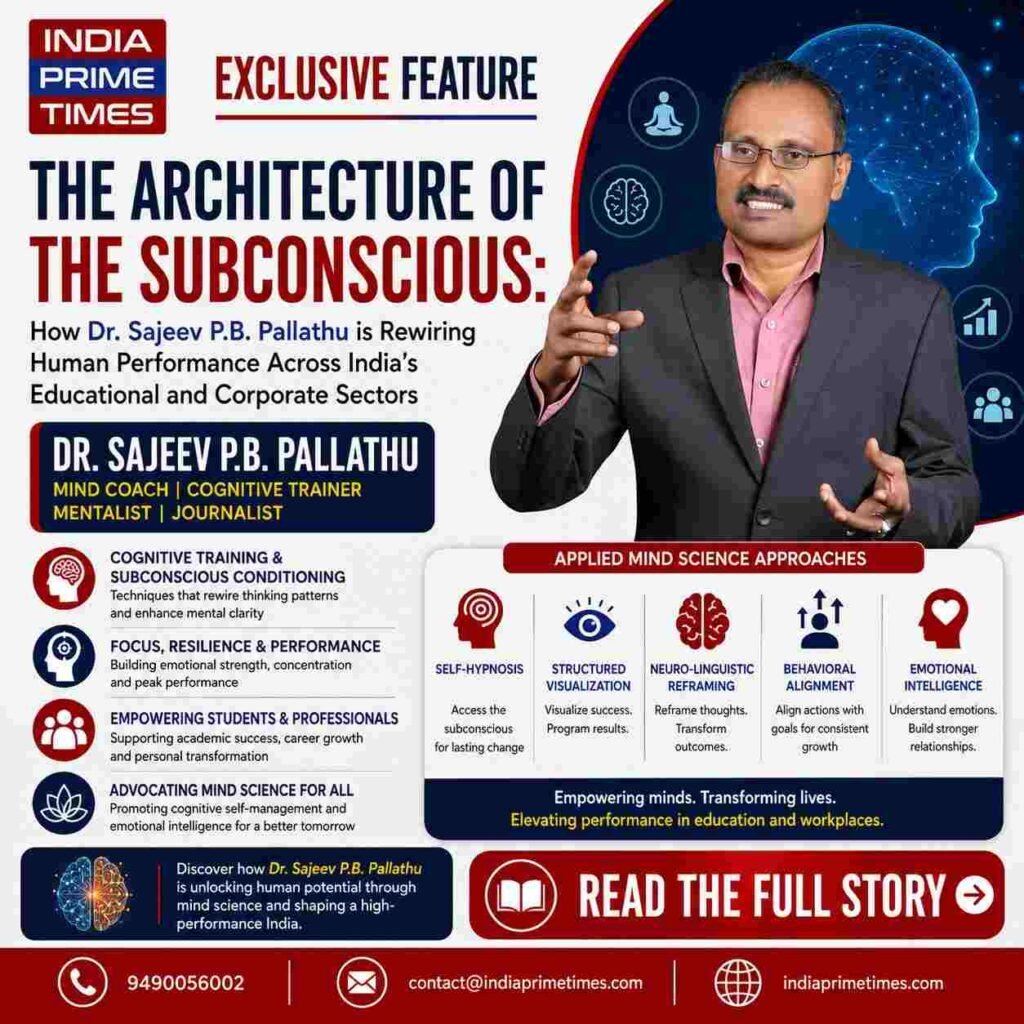
The global conversation surrounding productivity, human capital, and wellness is reaching an inflection point. For decades, academic institutions and corporate enterprises relied almost exclusively on standard motivational lectures and rigid operational regimens to drive performance. However, in an era marked by digital overload, chronic stress, and escalating burnout, the limitations of conventional motivation have become glaringly apparent. Today, an increasing number of organizational leaders, educators, and psychologists are turning toward empirical cognitive training, subconscious conditioning, and applied mental science as essential pillars of sustainable success.
To analyze how modern behavioral conditioning is being operationalized at the grassroots level, the India Prime Times editorial team recently focused its investigative coverage on the evolving mental health and executive performance sectors in Southern India.
During our on-ground coverage in Kerala, our team attended a live training session in Kottayam that demonstrated a radical departure from traditional seminars. Rather than delivering generic encouragement, the session utilized structured cognitive exercises, rapid behavioral conditioning, and interactive mentalism demonstrations to actively illustrate the mechanics of subconscious focus.
The precision, audience engagement, and tangible psychological impact of this methodology led our editorial desk to connect directly with the innovator behind it: Dr. Sajeev P.B. Pallathu, a distinguished mind coach, cognitive trainer, mentalist, and journalist hailing from Urulikunnam in Kottayam.
In our extensive conversation with Dr. Sajeev, our team explored the future of cognitive training, the scientific mechanics of belief restructuring, and why training the mind must become a mainstream educational priority.
Beyond Motivation: The Science of Cognitive Restructuring
During our interaction, Dr. Sajeev articulated a foundational premise that separates applied mind science from temporary enthusiasm: human potential is rarely limited by external opportunity; it is constrained by untrained thinking.
“The human brain processes tens of thousands of thoughts every single day, the vast majority of which default to repetitive, negative conditioning,” Dr. Sajeev explained to the India Prime Times team. “Traditional motivation attempts to push a tired conscious mind to work harder. True behavioral transformation, however, occurs only when you align the subconscious mind with clear, deliberate objectives. When the subconscious is trained to filter out anxiety and accept positive conditioning, performance becomes effortless and sustainable.”
Our editorial team observed how Dr. Sajeev translates these intricate psychological principles into accessible models. By systematically breaking down the layered architecture of human cognition-from the conscious and subconscious to the unconscious-he equips participants with practical tools such as self-hypnosis, structured visualization, and neuro-linguistic reframing.
Drawing parallels between ancient Indian philosophical knowledge and contemporary cognitive psychology, his work validates how historical contemplative traditions anticipated many of the neural reprogramming models recognized by modern science today.
Grassroots Impact: From Classrooms to Boardrooms
What makes Dr. Sajeev’s work particularly significant is its broad institutional footprint. Rather than confining mental performance techniques to elite athletic or executive retreats, his training modules are deployed across diverse social sectors:
- Accelerated Learning and Examination Anxiety Removal: Equipping school and college students with cognitive techniques to eliminate exam-related panic, enhance memory retention, and build academic confidence.
- Corporate Workforce Optimization: Assisting enterprises in managing occupational burnout, regulating workplace stress, and cultivating decisive executive mindsets.
- Community and Senior Citizen Engagement: Conducting community programs for resident associations, women’s forums, and senior citizen platforms focused on active cognitive health and emotional resilience.
Our team noted that his training framework operates under strict procedural discipline, aligned with ISO 9001:2015 quality process standards, bringing formal operational governance to the applied psychology and wellness sector.
Global Benchmarks and National Recognition
Dr. Sajeev’s systematic contributions to performance psychology and mentalism have garnered widespread international and national acclaim. Demonstrating his technical mastery on a global stage, he secured the 16th rank in an international hypnosis assessment featuring over 300 competitive participants worldwide.
His career is distinguished by an extraordinary record of public recognition, including:
- Seven World Records recognized across premier global forums, alongside formal recognition by the Asian Book of Records.
- Prestigious National Accolades: Recipient of the Global Icon Award and Nation Pride Award (Ministry of Corporate Affairs), the A.P.J. Abdul Kalam Bharatiya Ratna Samman, the Swami Vivekananda Prerana Samman, the Jaihind Puraskar 2025, and the Mahatma Gandhi Personality of the Year Award 2025.
- Public Service Alignments: Recognition connected to national initiatives, including the Pradhan Mantri Jan Arogya Yojana (Ayushman Bharat) and vision programs associated with NITI Aayog.
- Academic Affiliations: Certification under the Global Alliance of Psychology (Association of Indian Private Universities) and active engagement with the Global Alliance of Psychology and Social Sciences.
The Road Ahead: Institutionalizing Mental Education
As our conversation with Dr. Sajeev P.B. Pallathu concluded, the broader trajectory of human resource development in India came into clear focus. In a fast-moving economy driven by automation and intellectual capital, the ability to regulate emotional responses, sustain deep cognitive focus, and overcome psychological resistance is no longer optional.
Dr. Sajeev continues to advocate for the formal integration of cognitive self-management and emotional intelligence into primary and higher education curricula.
For educators, industry observers, and corporate leaders, the methodologies championed by Dr. Sajeev offer a compelling roadmap. By merging empirical cognitive science with practical, real-world tools, pioneers in applied mind science are demonstrating that the true frontier of development lies within the uncharted potential of the human mind.