Engineering Intelligence: Turning Industrial Data into Better Decisions
6 min read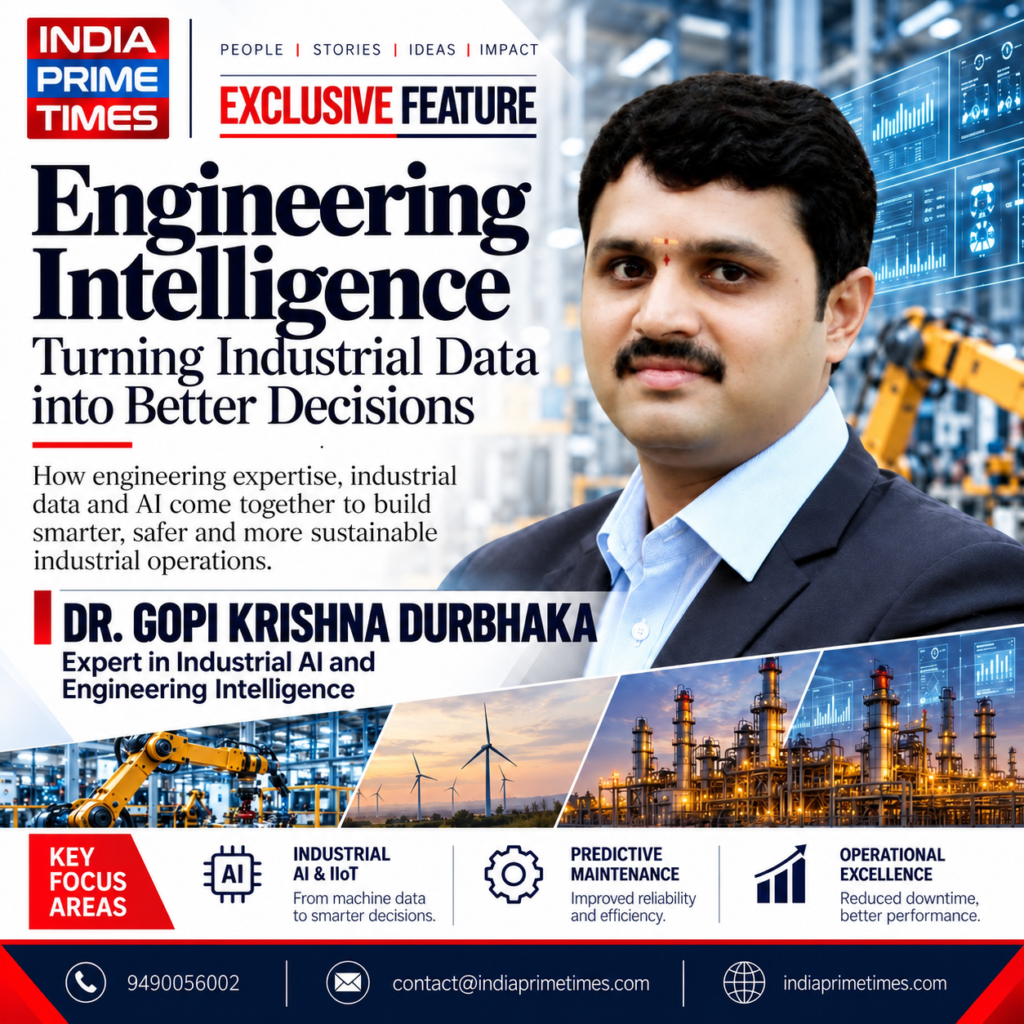
A turbine does not announce its fatigue. A gearbox rarely sends a clean warning. More often, it leaves small traces: a change in vibration, a warmer bearing, a current draw that no longer matches load, or a hydraulic drift after repair. For years, plants recorded such behaviour in logs, alarms and the memory of experienced engineers. The difficulty was never only measurement. It was meaning.
Engineering Intelligence begins there-where data stops being a stream of numbers and becomes an answer to an engineering question. Not “What is the sensor saying?” but “What is the machine doing, why is it doing it, what is likely to happen next, and what should we do before cost, safety or output is affected?”
This is harder than applying AI to ordinary business software. Industrial systems obey physics: load, lubrication, heat, resonance, corrosion and degradation limits. A model that ignores that reality may find a pattern and still miss the point.
From instruments to understanding
The foundations were laid long before the current language of Generative AI and agents. Factories mechanized, electrified and automated. Programmable controllers, SCADA, DCS, embedded controllers and telemetry networks made remote equipment visible. Vibration analysers, historians and condition-monitoring practices added another layer: not only operate, but observe.
Dr. Gopi Krishna Durbhaka’s career tracks that progression. During an interaction with the India Prime Times editorial team, he described the shift from industrial monitoring toward Engineering Intelligence as an accumulation of disciplines. Early work around SCADA, DCS, embedded systems, GSM/GPRS-based monitoring and telemetry belonged to an era when the goal was to reach the machine and gather dependable signals. Later work in vibration analytics, Industrial IoT, machine learning, predictive maintenance, AIoT, Generative AI and AI agents shows how those signals can become diagnosis, prediction and decision support.
The chain he often uses – Sense → Understand → Predict → Optimize → Decide → Act → Learn – becomes useful only when each stage carries engineering context. Sensing must capture the right variables; understanding separates normal variation from incipient damage; prediction respects operating modes and uncertainty; optimization weighs production, safety, spares and energy; action enters work orders, operator guidance or automation. Learning completes the loop by feeding inspection results, maintenance outcomes and operating experience back into the system, provided that feedback is validated rather than absorbed blindly.
This matters greatly in India, where industry spans ageing process plants, export-oriented automotive and pharmaceutical facilities, power and renewable assets, steel, cement, textiles, electronics manufacturing and fast-growing semiconductor-related investments. Many organizations must improve reliability without replacing every machine. Engineering Intelligence offers a practical path: retrofitting better understanding onto existing assets while designing newer plants with stronger data, analytics and decision support from the start.
Prediction is not the destination
Maintenance shows the distinction. Reactive repair waits for failure. Preventive maintenance replaces parts on schedule. Condition-based maintenance responds to measured condition. Predictive maintenance estimates likely degradation. Prescriptive intelligence goes further: it weighs possible actions and their consequences.
A useful system should not merely say that a bearing may degrade within an operating window. It should ask whether the plant can derate safely, whether failure is gradual or sudden, whether parts and outage windows exist, and what production is lost if the asset stops. Prediction says what may happen. Prescription begins to determine what should be done.
Durbhaka’s research in vibration signal analysis, wind turbine diagnostics, gearbox fault diagnosis, hybrid LSTM models with swarm intelligence, and predictive maintenance of automotive brake pad degradation addresses a common problem: converting noisy physical signals into evidence for reliability decisions.
Why generic AI falls short
Industrial AI cannot be built from statistics alone. A model may learn that vibration rises every summer and confuse seasonal temperature with bearing damage. It may flag a compressor whenever product grade changes, learning the schedule rather than the machine’s condition. It may recommend an intervention that is analytically sensible but operationally impossible because the line cannot stop.
Conversely, engineering experience without data can miss slow changes spread across thousands of signals. No reliability engineer can manually inspect every trend in a large plant. AI widens perception; engineers supply causality, constraints and accountability. The productive relationship is machine-scale pattern recognition joined to human judgment about physical consequences.
Trust is built through usefulness. False alarms teach operators to ignore systems. Black-box recommendations make engineers cautious where safety is involved. A credible system should explain which signals drove the conclusion, what confidence is attached, what assumptions were made and what evidence would change the recommendation.
From pilots to production: the operational reality of industrial AI
Many industrial AI programmes struggle not at the modelling stage but in the transition from pilot to production. The challenge is to make intelligence reliable enough to trust, clear enough to explain, robust enough to scale and useful enough to become part of daily engineering work. In practice, this is difficult because industrial data is often scattered across historians, maintenance systems, quality records, ERP platforms, inspection reports and informal notes. Some older assets are barely instrumented, while newer systems generate more information than teams can place in context. At the same time, OT and IT environments frequently remain separated, using different standards, rhythms and definitions of what the data means.
Failure data presents another constraint: severe failures are rare because good maintenance is designed to prevent them. As a result, models may be trained on limited or unrepresentative examples and then tested under conditions that look cleaner than real plant operations. Even a technically sound model can lose credibility if it performs well in a demonstration but behaves differently during start-ups, shutdowns, maintenance states or abnormal operation. Add organisational issues such as data ownership, workflow integration, cybersecurity and model drift, and the real bottleneck becomes clear. The hardest problem is often not creating AI; it is making AI dependable inside an engineering environment. That requires people who understand both the control room and the algorithm, and organisations willing to treat trust, validation and operational fit as engineering requirements rather than afterthoughts.
What Engineering Intelligence may add
The next stage is likely to be less about one model and more about connected engineering knowledge. A future Engineering Intelligence system could join live sensor data, maintenance history, manuals, failure records and reliability models. It might help an engineer ask what changed before the pattern appeared, which components could produce it, and what evidence should be checked before action.
AI agents could add a more decisive layer of engineering decision support. Instead of only retrieving documents, they could assemble the relevant evidence, compare similar past events, check operating constraints, estimate the consequences of intervention or delay, and present ranked decision options for engineering review. In a bounded use case, an agent might recommend whether to inspect now, derate, adjust a setpoint or wait for the next outage window, while clearly showing the assumptions behind each option. Such support could reduce diagnosis time and improve consistency, but final authority should remain with engineers unless the system operates inside a tightly validated and safety-approved envelope.
Industry 5.0 discussions point toward human-centric, resilient and sustainable production, with worker wellbeing closer to the centre. In Engineering Intelligence, that means augmentation rather than replacement: systems that widen what engineers can see while leaving responsibility for judgment where it belongs.
The road ahead
Engineering Intelligence will prove its value where industry feels it most: in fewer unplanned outages, safer interventions, longer asset life, lower maintenance waste, better energy use and faster resolution of abnormal conditions. Its larger significance is the way it brings together engineering expertise, industrial data, AI and human decision-making into one working discipline. Plants that master this combination will not simply collect more information; they will act on it earlier, with greater confidence and with clearer accountability. That is the practical impact of Engineering Intelligence: physical systems that are understood more deeply, engineers who are supported more effectively, and industrial decisions that are stronger because machine insight and human judgment are finally working on the same problem.