
The Quiet Force in Global Executive Strategy: How Dr. Alok Kumar Bhargava is Redefining Leadership Through ‘Decision Stillness’
4 min read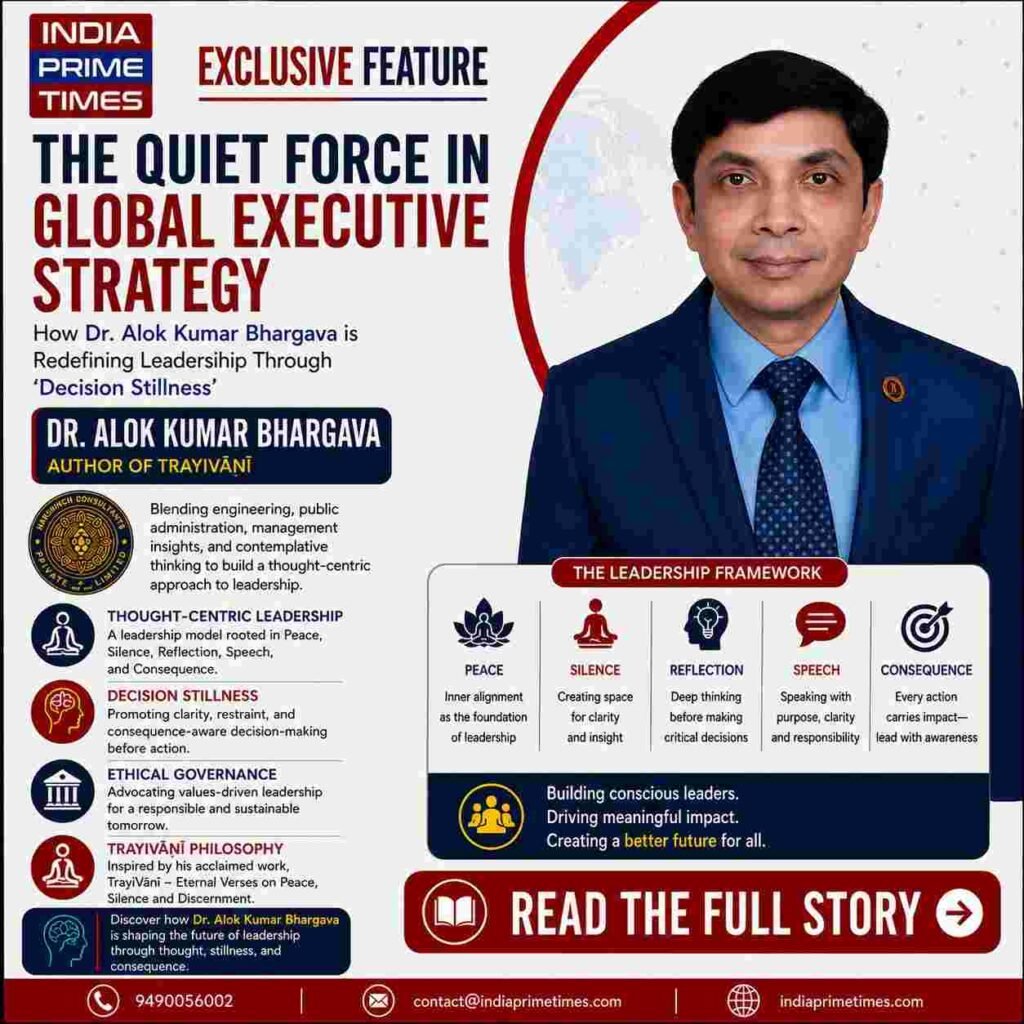
In today’s hyper-accelerated corporate and public governance landscape, executive leadership is frequently equated with relentless visibility, rapid-fire responses, and constant communication. Boardrooms and global markets operate under immense pressure, where silence is often misinterpreted as hesitation. However, a profound and counter-intuitive paradigm is currently emerging at the highest echelons of strategic thinking: the concept of leadership as disciplined cognition rather than continuous expression.
As multinational enterprises and public institutions grapple with the severe consequences of impulsive executive communication-ranging from reputational exposure to strategic misalignment-a new doctrine of “Thought-Centric Leadership” is taking center stage.
To explore this shifting dynamic, the India Prime Times editorial team recently dedicated its coverage to the evolution of modern executive governance. During our research into institutional accountability, our team had the distinct privilege to meet and engage in a deep, thought-provoking conversation with Dr. Alok Kumar Bhargava, a visionary scholar, civil engineer, public administrator, and contemplative thinker.
Experiencing his work firsthand provided our editorial desk with a profound understanding of why his leadership philosophy is rapidly transitioning into a global intellectual movement. Rather than preaching abstract wisdom, Dr. Bhargava engineers ethical thought into a highly functional leadership architecture.
Bridging Engineering Precision with Philosophical Depth
What distinguishes Dr. Bhargava within the global C-suite discourse is his extraordinary multidisciplinary foundation. He does not approach philosophy as mere poetry; he approaches it with the structural rigor of an engineer.
A graduate in Civil Engineering from BCE, Patna, with a Master of Computer Applications from SMU, Sikkim, and a Doctorate in Management Studies from NIM, Mumbai, his professional career has been forged in the demanding world of large-scale infrastructure and public administration. This robust technical background is further augmented by premier global academic exposure, including executive education at INSEAD, Singapore, and the Leadership Programme at ICLIF, Kuala Lumpur.
“Leadership does not begin when one speaks-it begins when one discerns what is worth saying,” Dr. Bhargava shared during our interaction. Our team immediately noted how his decades of navigating complex public systems have culminated in a model that challenges conventional, reactive executive behavior.
TrayiVāṇī: The Architecture of Conscious Leadership
The cornerstone of Dr. Bhargava’s global influence is his highly acclaimed literary and philosophical work, TrayiVāṇī – Eternal Verses on Peace, Silence and Discernment. Widely described by readers and scholars as an “Aadhunik Geeta” (a modern Gita), the book provides a highly disciplined framework for human conduct and public reasoning in a distracted, reactive contemporary world.
The core proposition of TrayiVāṇī is structured around an Eternal Triad:
- Peace (Śānti): Establishing internal stability. Meaningful action only arises when a leader is inwardly ordered, morally aligned, and patient.
- Silence (Mauna): Refining raw reaction into considered thought. Speech without prior reflection is viewed not as freedom, but as cognitive leakage-making silence a purification tool.
- Discernment (Viveka): Recognizing that language is not decorative, but formative. Every utterance is causal and begins shaping consequences and institutional destiny.
Dr. Bhargava engineers this philosophy into a precise, operational decision-making framework: Peace → Silence → Reflection → Speech → Consequence.
The Emergence of ‘Decision Stillness’
During our conversation, the most striking concept introduced by Dr. Bhargava was “Decision Stillness.” In volatile corporate and geopolitical environments, impulsiveness often dominates. Decision Stillness acts as a strategic calibration tool-a state where leaders deliberately pause to reflect before reacting or concluding.
By applying Decision Stillness, executives ensure that action follows clarity, communication follows consequence-awareness, and authority is expressed through restraint. Silence, in this context, is not an absence of thought; it is the ultimate expression of strategic power and ethical governance.
Global Resonance and Institutional Impact
Dr. Bhargava’s advocacy for Spiritual Humanism, Universal Dharma, and Human Values has clearly transcended regional boundaries. Since its official launch at the New Delhi World Book Fair in January 2026 at Bharat Mandapam, TrayiVāṇī has been translated into multiple international languages, including English, French, Russian, and Mandarin Chinese.
His profound impact on 21st-century leadership has garnered exceptional global recognition. He was recently honored with the Global Laureate Prize for Philosophy, Ethics & Civilization, and TrayiVāṇī was awarded “Human Values Book of the Year” at the Insights Excellence Awards during the National Prestige Awards 2026. Furthermore, he has been ranked among “India’s Top 10 Inspiring Authors” and featured across leading global publications such as the Washington Post Magazine, London Herald, and The CEO Magazine.
To institutionalize this philosophy, his work is actively disseminated through the Trayivani Foundation (www.trayivani.in), engaging a massive global community via digital platforms and discussions.
The New Doctrine of Executive Accountability
As our time with Dr. Alok Kumar Bhargava concluded, the India Prime Times team walked away with a fundamentally altered perspective on modern authority. In an era accelerating toward noise, performative visibility, and instant reactions, Dr. Bhargava stands as a quiet, defining force.
He offers the global enterprise and administrative sectors a much-needed recalibration: Leadership effectiveness is not defined by the frequency of communication, but by the depth of thought that precedes it.
For C-suite executives, policymakers, and future leaders, Dr. Bhargava’s framework delivers a timeless executive insight: the future of leadership will not be defined by how quickly decisions are made, but by how deeply they are understood before they are expressed.