The Architecture of Self-Mastery: From Rural Roots to Aerospace Leadership, Pompayya H.M. on Building the Inner Engine
7 min read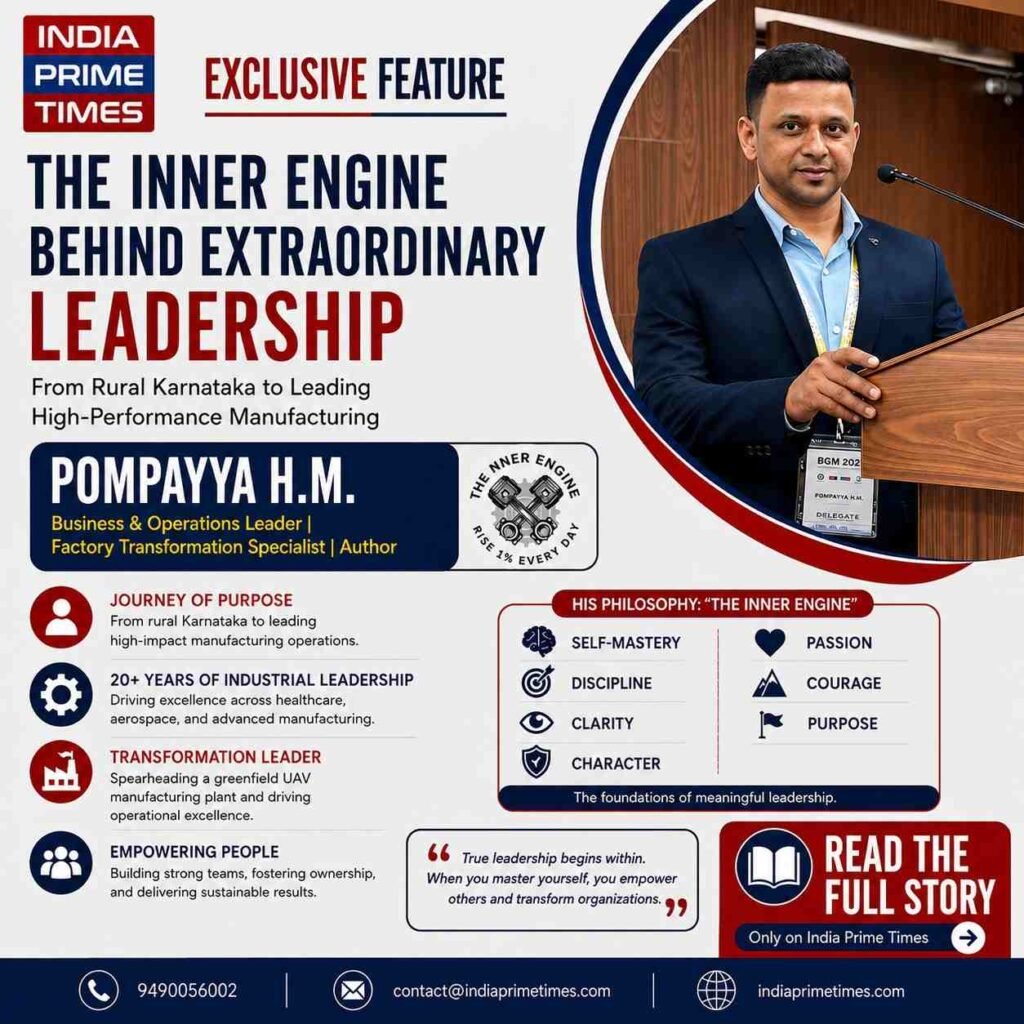
Pompayya H.M. | Associate Vice President – Operations & BU Head | UAV & Aerospace, Bharat Forge
In a world increasingly obsessed with speed, scale and visible success, one question is becoming increasingly important: What happens inside a person when nobody is watching?
Organisations can build sophisticated systems. Technology can accelerate decisions. Artificial intelligence can transform the way businesses operate. But when pressure arrives, it is still human beings who must make decisions, face uncertainty, recover from setbacks and inspire others to keep moving.
This is where the journey of Pompayya H.M., an operations and business leader in aerospace and advanced manufacturing, offers an interesting perspective. His career has taken him from rural Karnataka and the challenges of limited opportunity to more than two decades across healthcare, aerospace, manufacturing and operational leadership. Today, as Associate Vice President – Operations & Business Unit Head | UAV & Aerospace at Bharat Forge, he works at the intersection of manufacturing, technology, people and business transformation.
“Before you learn to lead an organisation, you have to learn to lead yourself.”
The road begins before the career
Pompayya’s leadership journey did not begin in a corporate boardroom. It began much earlier, in rural Karnataka.
Growing up with limited resources, even the journey to school could involve travelling by bullock cart across uneven roads and fields. Later, seven years at Jawahar Navodaya Vidyalaya, living away from family from a young age, brought another kind of education-discipline, independence, adaptability and the ability to manage oneself.
Those experiences would later become invisible assets in his professional life.
“When resources are limited, you learn to value opportunity. When the road is difficult, you learn to keep moving. And when you have to stand on your own, you begin discovering your inner strength.”
For young professionals, the lesson is simple: preparation begins before the opportunity arrives.
From getting an opportunity to creating one
Like many professionals beginning their careers, Pompayya experienced rejection and uncertainty. There were periods when finding the right opportunity was itself a challenge. He recalls approaching companies with his resume and facing rejection.
“Persistence often outlasts talent.”
As his career progressed, he moved through increasingly responsible roles across healthcare, aerospace and advanced manufacturing, including experiences with Philips Healthcare, GE HealthCare, Eaton Aerospace and Collins Aerospace and Bharat Forge.
His academic journey also evolved, with a Bachelor’s degree in Mechanical Engineering, an M.Tech in Manufacturing Management from BITS Pilani and an Executive Post Graduate Program from IIM Kozhikode.
But the most important learning, he says, did not come from degrees alone. It came from the factory floor.
The factory floor taught him something management books could not
Manufacturing is often viewed through machines, processes, quality, productivity and numbers. But after years of working in operations, Pompayya came to a different conclusion:
“Machines follow instructions. People don’t.”
A machine can be programmed. People must be understood. A process can be documented. People must be engaged. A target can be defined. People must find ownership in achieving it.
This gradually changed his understanding of leadership. Operational excellence, he realised, is ultimately human excellence. The best processes cannot compensate indefinitely for poor ownership. The best technology cannot replace trust. And the best strategy can fail if people do not believe in it.
That realisation became an important transition in his own leadership journey-from managing processes to developing people.
You are your own customer
Among the personal notes Pompayya wrote during his career was a deceptively simple idea: You are your own customer.
“Every day, we are building a product called ourselves.”
That product includes our knowledge, skills, habits, communication, relationships, reputation, discipline and character.
“If you were your own customer, would you invest in the person you are today?”
For young professionals, this can become a powerful career compass. Instead of asking only which company to join or what salary to target, the more important question becomes: What value am I becoming capable of creating?
A skill learned today can create an opportunity years later. A habit developed today can become discipline tomorrow. A reputation built slowly can become trust. And trust eventually becomes leadership.
Stop trying to beat everyone
Another principle from Pompayya’s career reflections is equally simple: You can only beat yourself.
He explains it through a simple progression: 70 → 75 → 80 → 85 → 90 → 95. If you are at 70, your immediate goal should not be to become frustrated by someone already at 95. Your first responsibility is to move from 70 to 75.
“You are often comparing your behind-the-scenes with someone else’s highlight reel.”
Real growth is quieter. It happens incrementally. Over time, those small improvements become extraordinary differences.
What comes out when life gets hot?
One of Pompayya’s leadership metaphors is surprisingly ordinary: a tea bag. A tea bag looks almost insignificant when it is sitting on a table. Put it into hot water, and its flavour begins to emerge.
“Pressure reveals what is inside.”
For Pompayya, the hot water represents difficult situations; the permeable paper represents openness to learning; the string represents humility; and the final cup represents teamwork.
“Learn it all. Don’t become a know-it-all.”
In a world where knowledge is changing rapidly, intellectual humility is becoming a competitive advantage. The strongest professional may not be the person who knows everything, but the person who is willing to say: I don’t know. Let me learn.
Firm in conviction. Flexible in approach.
Modern careers rarely follow a straight line. Industries change. Technology changes. Business models change. Jobs change. Artificial intelligence is accelerating that transformation.
“Be firm in conviction, but flexible in approach.”
Have clarity about what matters, but remain willing to change how you reach the destination. His preferred cycle is simple: Test → Learn → Adapt → Execute.
“Don’t become only job-ready. Become change-ready.”
From employee to asset
One of Pompayya’s strongest career principles is the distinction between doing a job and creating value.
A traditional employee mindset can sound like: “Tell me what to do.” A value-creating mindset sounds different: “Here is the problem. Here are the options. I recommend this.”
“Designation gives authority. Value earns influence.”
Organisations need people who identify problems, take ownership, make decisions and create outcomes. As professionals move higher in an organisation, leadership increasingly becomes about creating capability around oneself.
The problem that is ‘not my problem’
A simple mousetrap story illustrates another aspect of ownership. A mouse discovers a mousetrap in a farmhouse and warns the other animals. The chicken, goat and cow each believe it is not their problem. Eventually, the consequences reach far beyond the mouse.
“Problems don’t respect organisational boundaries.”
A quality issue can become a customer issue. A people issue can become an operational issue. An engineering issue can become a business issue.
“Don’t ask: Is this my problem? Ask: How can I help solve it?”
That is the difference between simply occupying a role and creating value within an organisation.
The first person a leader must lead
For Pompayya, leadership ultimately returns to one place: the self.
Self-awareness. Self-discipline. Self-management. Value creation. Influence. Leadership.
The sequence matters. A person who cannot manage their own commitments will struggle to manage a team. A person who cannot regulate their own reactions may struggle to handle conflict. A person who stops learning will eventually struggle to lead people who know more than they do.
“Leadership does not begin with managing people. It begins with managing yourself.”
The Inner Engine
These ideas eventually became the foundation for Pompayya’s book, The Inner Engine: Ignite Passion. Build Character. Elevate Your Leadership. Lead Yourself to Meaningful Success.
The philosophy is not about external motivation alone. Motivation rises and falls. Circumstances change. Recognition comes and goes. Titles change. But the internal qualities of a person determine how consistently they move forward.
For Pompayya, the Inner Engine is built through six qualities:
Mindset – how you interpret circumstances.
Discipline – what you do when motivation disappears.
Curiosity – your willingness to keep learning.
Courage – your willingness to act despite uncertainty.
Character – who you are when nobody is watching.
Consistency – your ability to keep moving over time.
A message for the next generation
For young professionals entering business schools today, Pompayya’s message is not to have everything figured out at 22. It is almost the opposite.
You don’t need to know exactly where you will be at 35. You need to start consciously building the person who can reach there.
Don’t chase only a designation. Build the capability that deserves the designation. Don’t chase only a salary. Build the ability to create value. Don’t be afraid of failure. Learn from it. Don’t try to know everything. Stay curious. Don’t measure your entire life against somebody else’s timeline. Build your own.
“Lead yourself before you expect others to follow you.”
The question that remains
Imagine it is ten years from today. It is 2036. You are sitting in a leadership meeting. People are depending on your decisions. Your designation is different. Your responsibilities are greater. Your achievements may be significant.
“What will people say about you when you leave the room?”
Will they say you were intelligent? Successful? Powerful? Or will they say: “Because of this person, I became better.”
For Pompayya, that is where leadership ultimately finds its meaning-not merely in the scale of what we achieve, but in the people we elevate along the way.
Build your Inner Engine
The corporate world will continue to change. Artificial intelligence will reshape jobs. Technology will transform industries. Business models will evolve. Organisations will grow and disappear.
“Wherever you go, you carry yourself with you.”
That is why the most important career investment may not always be the next certification, designation or salary increase. It may be the quiet work of building the person inside-the person who can remain steady under pressure, keep learning, take responsibility, create value and bring others forward.
“Build yourself. Create value. Own your career. Let your career follow.”
Publication-ready draft for India Prime Times / TheCconnect editorial review