
PM Modi’s Visit to Indonesia Seals Game-Changing Defence and Maritime Pacts
3 min read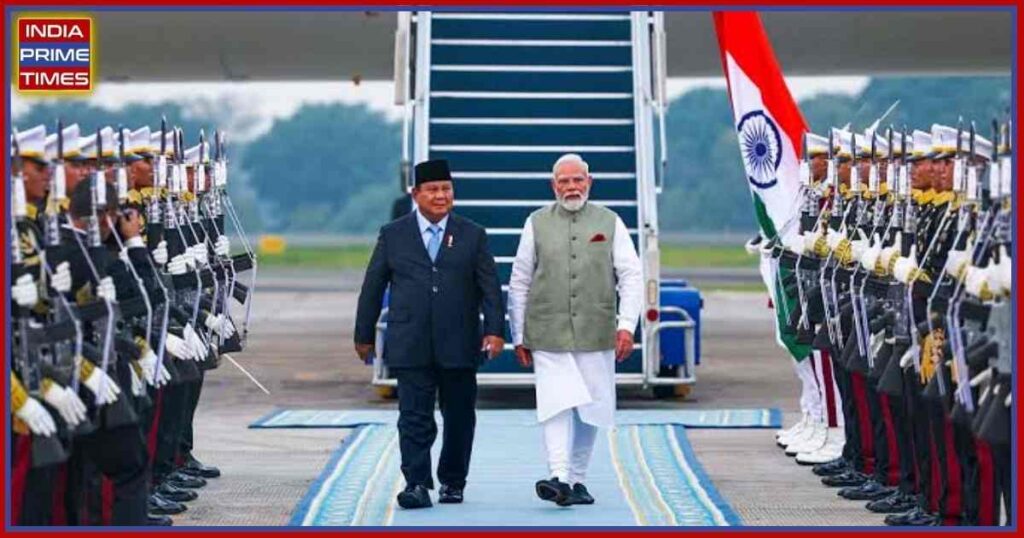
In a visit described by diplomatic experts as a watershed moment for India’s “Act East” policy, Prime Minister Narendra Modi concluded a highly successful bilateral summit with Indonesian President Prabowo Subianto on Wednesday.
The high-stakes visit to Jakarta culminated in 20 major agreements across defense, maritime security, digital technology, critical minerals, and education. Moving swiftly from dialogue to concrete implementation, the summit solidified Indonesia’s position as India’s most crucial strategic maritime partner in Southeast Asia.
To mark his pivotal role in elevating the Comprehensive Strategic Partnership between the two nations, PM Modi was conferred Indonesia’s highest civilian honor, the Bintang Adipurna of the Republic of Indonesia, by President Prabowo at the Istana Merdeka (Presidential Palace).
The Game Changer: BrahMos and Astra Missile Deals
The absolute centerpiece of the summit was defense, marking India’s aggressive emergence as a credible, advanced weapons supplier to Southeast Asia.
- The BrahMos Export: Indonesia has officially become the third Southeast Asian nation (after the Philippines and Vietnam) to sign a deal with India for the BrahMos supersonic cruise missile system.
- The Specifics: While the overarching framework has been signed, sources indicate Indonesia will initially purchase two batteries of the lethal missile system in a deal valued at approximately $200 million.
- Astra Integration: Furthermore, the two nations finalized an agreement for the Astra Mk-1 beyond-visual-range air-to-air missiles. State-run Bharat Dynamics Limited (BDL) will integrate these advanced weapons into Indonesia’s fleet of Su-30 fighter jets.
The decision by Jakarta to procure these systems was heavily influenced by their successful deployment by the Indian military during “Operation Sindoor” against Pakistan in 2025.
Securing the Chokepoints: Sabang Port Development
Beyond missiles, the most geographically consequential outcome of the summit was the formal agreement to partner on the integrated development of the strategically located Sabang Port in Indonesia’s Aceh province.
Situated at the northern tip of Sumatra, Sabang Port overlooks the entrance to the Strait of Malacca-one of the world’s most congested and vital maritime trade routes, heavily relied upon by China for its energy imports (often referred to as Beijing’s “Malacca Dilemma”).
Located just 700 kilometers (and only about 160 km from the upcoming Great Nicobar trans-shipment hub) from India’s Andaman and Nicobar Islands, this partnership will grant the Indian Navy sustained operational footholds and enhanced surveillance capabilities over this critical maritime chokepoint. The joint development will include ship-repair, shipbuilding, marine tourism facilities, and shore-based services to support offshore energy activities.
Economic Security: Critical Minerals and Technology
As global supply chains face unprecedented geopolitical disruptions, New Delhi and Jakarta recognized that economic resilience is now inseparable from national security.
- Critical Minerals: Indonesia holds some of the world’s largest reserves of nickel, essential for electric vehicles (EVs) and clean energy tech. India will heavily invest in the Indonesian manufacturing of steel, nickel, and rare earth permanent magnets to diversify supply chains away from excessive dependence on single sources.
- Digital Governance & AI: The two nations agreed to advance cooperation in artificial intelligence and space technology. India will also assist Indonesia in developing electronic voting machines and rolling out a Unified Payments Interface (UPI) system tailored for the archipelago.
- Education: In a major soft-power push, the leaders agreed to establish an offshore campus of the prestigious Indian Institute of Management (IIM) Bangalore in Jakarta.
A Shared Vision for the Indo-Pacific
Throughout the summit, the shared objective of maintaining a free, open, and rules-based Indo-Pacific was palpable. The agreements come amid rising concerns over China’s growing military assertiveness in the South China Sea.
While carefully avoiding direct mentions of China, PM Modi’s address to the Indonesian Parliament was pointed: “India is a nation that follows the path of development, not expansionism.”
President Prabowo mirrored this sentiment, noting, “Partnerships between us will bring benefits to the region.”
As PM Modi concludes his historic visit, the message from Jakarta is unmistakable: the India-Indonesia partnership is no longer just about trade; it is a formidable, action-oriented alliance designed to anchor the security and stability of the entire Indo-Pacific region.
Get in Touch with India Prime Times
For any updates, queries, or to publish any news article, please reach out to our editorial desk:
- Contact Number: +91 9490056002
- Email ID: info@indiaprimetimes.com
- WhatsApp Us: https://wa.me/919490056002