The New Blueprint for Corporate Governance: Merging Tech, Compliance, and Impact in India’s Institutional Sector
4 min read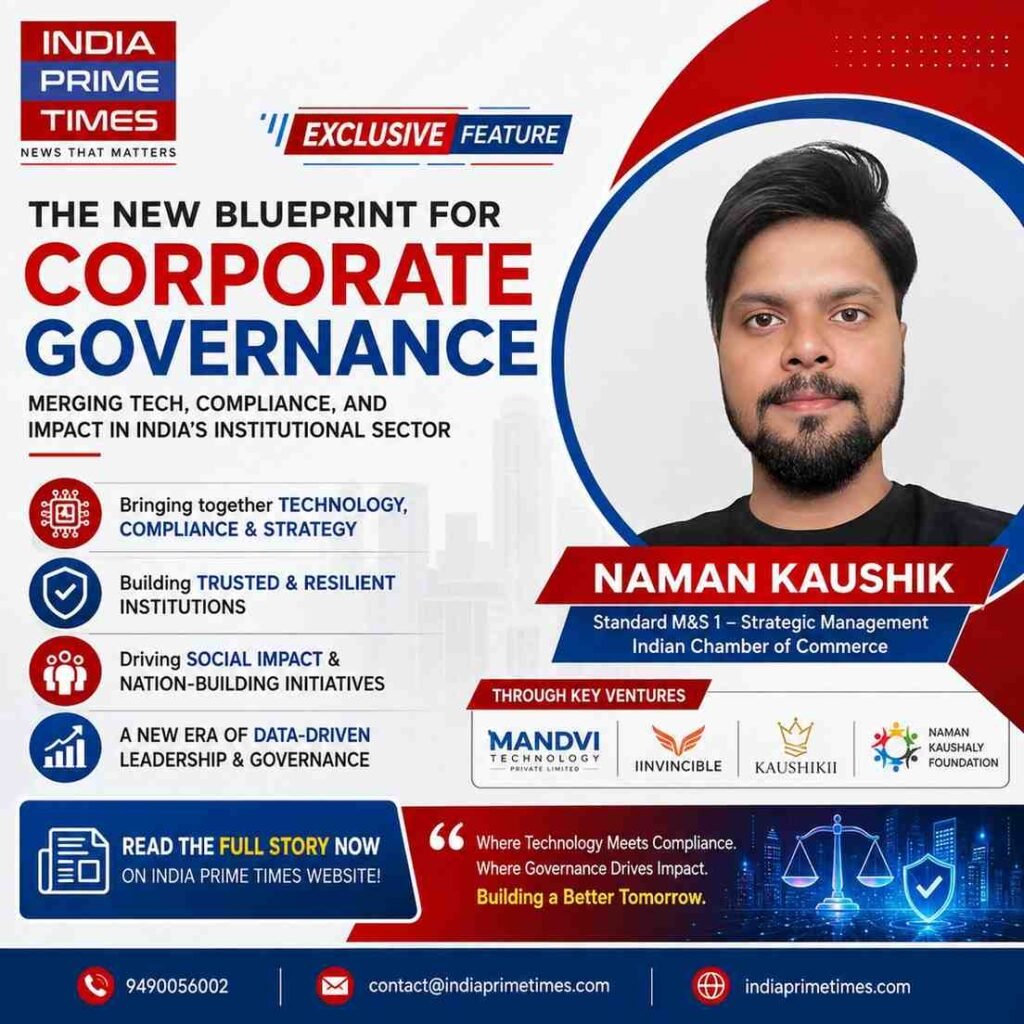
As the Indian economy rapidly scales toward the multi-trillion-dollar mark, the intersection of digital transformation and regulatory compliance has become the most critical battleground for modern enterprises. In an ecosystem where speed frequently overshadows structure, a significant gap has emerged: organizations are desperately seeking partners capable of combining technological excellence with uncompromising regulatory discipline. This is particularly true for high-trust institutions, government bodies, and defense organizations, where operational integrity is non-negotiable.
To investigate how the industry is addressing this critical market gap, the India Prime Times editorial team recently spent time analyzing emerging corporate governance models and strategic management frameworks. During our on-ground coverage, we had the distinct opportunity to meet and converse with Naman Kaushik, who currently serves as Standard M&S 1 – Strategic Management at the Indian Chamber of Commerce.
Observing his operations firsthand provided our team with a profound understanding of how modern enterprise architecture is evolving. We noticed that his approach heavily departs from the traditional “growth-at-all-costs” mindset, prioritizing institutional trust and systemic resilience above all else.
The Hybrid Enterprise: Bridging the Tech-Compliance Divide
During our extensive conversation, a core industry reality became evident: most service providers force a choice. Companies generally specialize in either software development and technology or auditing, taxation, and legal compliance. Finding a multidisciplinary organization that seamlessly integrates both is rare.
Kaushik identified this vulnerability early on and structured Mandvi Technology Private Limited to serve as a comprehensive bridge. Operating at the highest national standards, the organization functions through two highly specialized brands. On one side, IINVINCIBLE drives software development, digital solutions, and technology-driven innovation. On the other, KAUSHIKII serves as a robust online platform connecting businesses with a nationwide network of Chartered Accountants, Company Secretaries, lawyers, and bankers, specializing in stringent company compliances and regulatory services.
This dual-engine approach has yielded significant industry validation. Mandvi Technology operates as a recognized vendor for premier defense and government institutions, including Hindustan Aeronautics Limited (HAL) and the Defence Research and Development Organisation (DRDO). In sectors where security and quality benchmarks are notoriously stringent, this empanelment serves as the ultimate proof of operational caliber.
“I don’t build companies to chase scale-I build systems that can be trusted at scale,” Kaushik shared with the India Prime Times team, summarizing a philosophy that is rapidly gaining traction among modern corporate strategists.
Data-Driven Leadership and Strategic Management
The ability to navigate both the private and public sectors requires a deep reliance on empirical data rather than mere intuition. This methodology is highly visible in Kaushik’s role at the Indian Chamber of Commerce. Operating out of Kolkata, his contributions to the Chamber’s marketing and sales efforts are deeply rooted in advanced business administration.
Our team observed how proficiency in advanced technical ecosystems-specifically Microsoft Azure and Power BI-is being utilized to streamline operations and formulate data-driven strategies at the Chamber. By applying global business thinking to Indian institutional realities, leaders in the strategic management space are moving away from legacy operational models toward highly efficient, cloud-based, and evidence-backed governance.
Redefining Corporate Social Responsibility
Perhaps the most compelling aspect of our discussion centered on the evolution of corporate social responsibility (CSR). Historically, CSR has often been treated as a secondary, transactional obligation by corporate entities. However, the industry is witnessing a shift toward purpose-led scale, where social foundations are subjected to the same rigorous management standards as private tech firms.
The NAMAN KAUSHALY FOUNDATION serves as a prime example of this shift. Focused on nation-building, the foundation spearheads seven major projects spanning education, healthcare, anti-trafficking, defense family protection, livelihood generation, robotics, and the Clean India Campaign (including the Pyari Kali initiative).
What makes this foundation highly newsworthy is its structural credibility: it is an empaneled social initiative with HAL. Building a private enterprise and a social foundation that both achieve HAL empanelment is a monumental industry highlight, proving that profit, compliance, and deep social purpose can successfully coexist within a unified corporate vision.
Key Insights: The Naman Kaushik Playbook
Following our comprehensive meeting and review of his organizational structures, our editorial team isolated the core strategies driving this unique business model. These takeaways serve as a vital framework for emerging entrepreneurs and established enterprises looking to navigate India’s complex regulatory and technological landscape:
- Integrated Ecosystems: Seamlessly blending tech development (IINVINCIBLE) with regulatory depth (Kaushikii).
- Institutional Trust: Leveraging empanelment with organizations like HAL and DRDO as the ultimate brand validation.
- Data-Driven Governance: Using tools like Power BI and Microsoft Azure to move from intuitive to evidence-based management.
- Purpose-Led Scale: Proving that corporate social responsibility (Naman Kaushaly Foundation) can be as strategically rigorous as a private enterprise.
A New Standard for Indian Business
As the Indian market continues its rapid expansion, the demand for long-term partnerships over transactional business models will only increase. The days of bypassing compliance for the sake of rapid tech deployment are ending.
Our time spent observing these operations confirmed a vital industry reality: the future of Indian enterprise belongs to those who view regulation not as a hurdle, but as a foundation for sustainable innovation. Through a rare blend of strategic management, technological execution, and uncompromising compliance, professionals like Naman Kaushik are not just participating in the market-they are actively writing the new standards for institutional trust.
For industry watchers, defense contractors, and SaaS innovators alike, this hybrid model of founder-led governance and accountability stands as a quiet revolution, signaling a mature, future-ready era for the Indian corporate sector.