Anvesh Roy: A Journey Beyond Boundaries, Connecting Science, Humanity and the Power of Knowledge
8 min read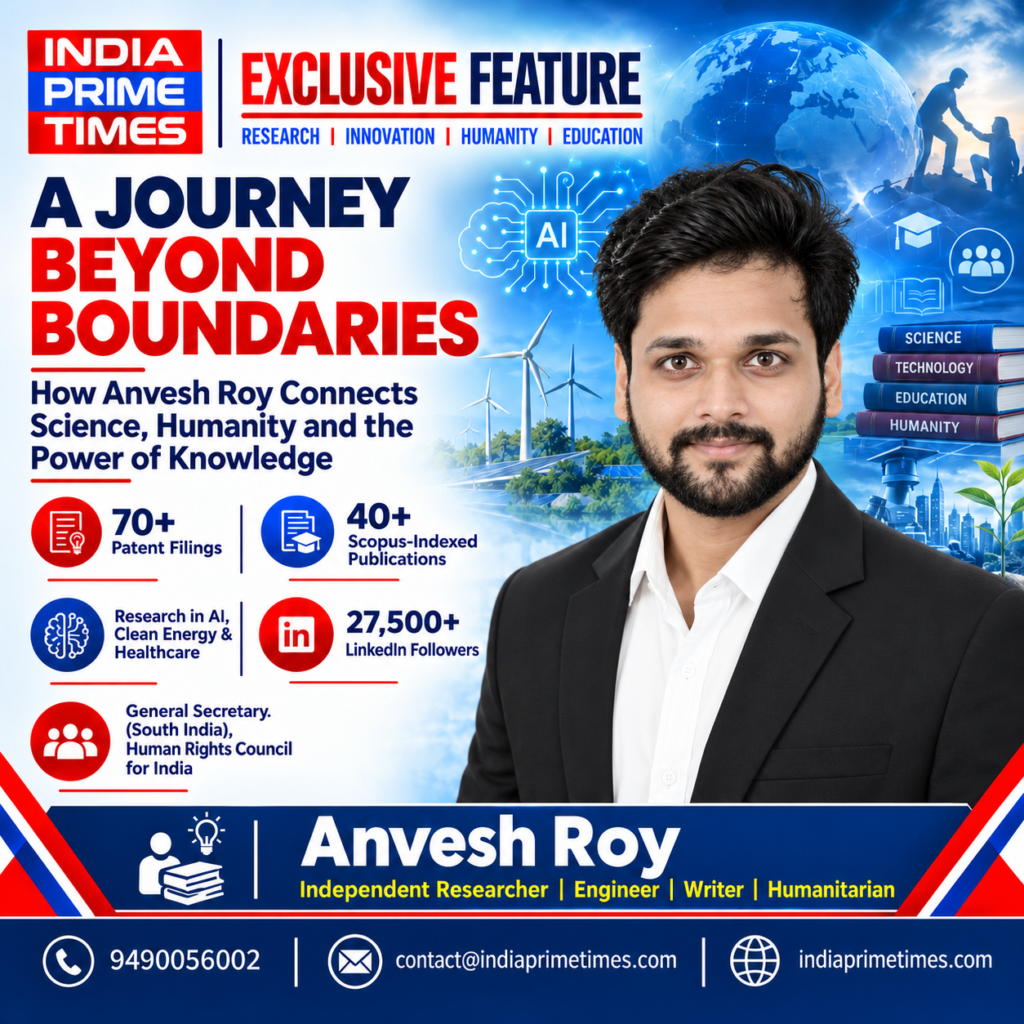
From scientific research and multidisciplinary education to humanitarian leadership, literature and global engagement, Indian independent researcher Anvesh Roy represents a growing generation of thinkers seeking to connect technological progress with human purpose.
BENGALURU, INDIA – In an era when professional identities are increasingly shaped by specialisation, Anvesh Roy has taken a different route. His journey moves across engineering, scientific research, artificial intelligence, psychology, management, literature, education and humanitarian engagement. Rather than confining his interests to a single professional domain, he has pursued an interdisciplinary approach built around a central question: How can knowledge, when applied responsibly, contribute to a better society?
An independent researcher, engineer, scientist, writer, poet, author and humanitarian, Roy has developed a professional portfolio that reflects both technical exploration and an interest in the human condition. Based in Visakhapatnam, India, his journey offers a perspective on modern leadership in which intellectual curiosity, social responsibility and personal purpose are not separate ambitions, but interconnected dimensions of meaningful contribution.
The Foundations of an Unconventional Journey
Roy’s story begins in coastal Visakhapatnam, where he was raised in a modest middle-class household. His family environment played an important role in shaping his outlook. His father, a former Indian Army serviceman, represented discipline, commitment and responsibility, while his mother influenced him through values of patience, compassion and quiet sacrifice.
These early experiences helped establish a foundation that extended beyond conventional definitions of success. Education became a continuing pursuit, not merely a route to professional advancement but an opportunity to understand different aspects of the world.
His academic journey reflects this curiosity. He holds a B.Tech in Electrical and Electronics Engineering, an M.Tech in Power Systems and Automation, and MBAs in Human Resource Management and Operations Management. He also holds an M.Sc in Clinical Psychology, an MA in Journalism and Mass Communication, an MA in Political Science and an MA in Economics. He is currently pursuing an M.Com at Andhra University.
The breadth of this educational background is significant because each discipline offers a different way of examining problems. Engineering encourages structured problem-solving, management introduces organisational and operational perspectives, psychology examines human behaviour, journalism strengthens communication, and political science and economics provide insights into institutions and society.
For Roy, interdisciplinary learning is not simply about studying different subjects. It is about understanding where their ideas intersect and how those intersections can contribute to more comprehensive solutions.
Research at the Intersection of Technology and Society
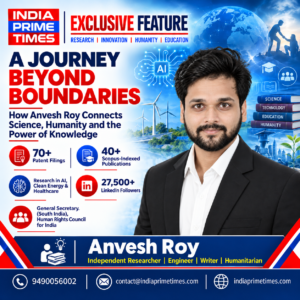
A substantial part of Roy’s professional journey is dedicated to research and intellectual contribution. His portfolio includes more than 70 patent filings across India, the United Kingdom and Canada, along with more than 40 Scopus-indexed research publications.
His research interests span artificial intelligence, machine learning, renewable energy, electric mobility, power systems, quantum computing, the Internet of Things, healthcare, educational technology and behavioural analysis.
These areas may appear technically diverse, but they share an underlying concern: identifying challenges and examining how emerging technologies can help address them.
In sustainable energy and electric mobility, his work explores intelligent energy management, renewable-energy storage, electric-vehicle charging applications and battery-health prediction. These subjects are increasingly relevant as countries examine cleaner energy systems, efficient infrastructure and the future of transportation.
In healthcare and behavioural analysis, his research interests include AI-supported stress and emotion detection, analytical approaches to human behaviour and technology-assisted decision support. In education, his work explores academic stress prediction, intelligent learning environments and applications that may help address student-related challenges.
His research has also been presented through international academic platforms, where he has engaged with emerging discussions involving artificial intelligence, wearable technologies, education and human-centred technological development.
The larger significance of this research direction lies in the questions it raises. Can technology help identify problems earlier? Can intelligent systems support better decisions? Can scientific methods contribute to more sustainable infrastructure and improved human wellbeing?
These questions are particularly important because technological capability alone does not guarantee meaningful progress. Research must also consider reliability, accessibility, ethical responsibility and the needs of the people who may eventually use its outcomes.
Roy’s approach reflects an interest in connecting technical investigation with these broader considerations.
Beyond Patents and Publications: Understanding Contribution
Patent filings and academic publications are important indicators of research activity, but they do not independently establish the real-world impact of an idea. An innovation must undergo appropriate evaluation, validation and development before its practical value can be fully understood.
This distinction is relevant to Roy’s research philosophy. His portfolio documents sustained activity across several fields, but the broader objective is to explore solutions that can eventually contribute to real-world challenges.
His work also reflects the growing importance of interdisciplinary research. Challenges involving energy, healthcare, education and human behaviour rarely fit within the boundaries of one academic subject. Addressing them may require engineering expertise, computational methods, psychological understanding, organisational knowledge and ethical consideration.
Such an approach is particularly relevant as artificial intelligence becomes increasingly integrated into everyday life. The future of research will require not only people who understand how to develop intelligent systems, but also individuals who can examine their social consequences.
Humanitarian Leadership and the Responsibility to Serve
Another important dimension of Roy’s journey is his involvement in community service. He serves as General Secretary (South India) of the Human Rights Council for India, contributing to initiatives connected with human rights awareness and social responsibility.
His community interests include supporting people experiencing homelessness, stray-animal welfare, disaster relief, mental-health awareness and grassroots assistance.
These activities reflect a commitment to concerns that extend beyond professional achievement. Communities facing vulnerability often need consistent attention, practical support and people willing to engage with their circumstances.
Roy’s involvement in humanitarian initiatives also influences his understanding of leadership. A designation or position may provide an opportunity to serve, but its significance ultimately depends on the responsibility with which it is exercised.
In his perspective, progress should not be measured exclusively through economic growth, technological advancement or institutional recognition. It should also be evaluated through dignity, access to opportunity, empathy and the treatment of those who are most vulnerable.
This connection between scientific curiosity and humanitarian responsibility gives his professional journey another dimension. It places the human consequences of progress alongside the pursuit of knowledge.
The Writer Behind the Researcher
While research provides one avenue for exploring the world, writing and poetry offer another. Roy’s creative work focuses on relationships, loneliness, emotional resilience, kindness, personal growth, social experiences and the complexities of human behaviour.
Through his LinkedIn newsletter, Relatable Realities, he shares reflections on everyday experiences and subjects that often remain unspoken in formal professional environments.
His writing explores a different kind of knowledge: the understanding that comes from listening, observing, experiencing and reflecting. Scientific research may investigate measurable patterns, while literature can help communicate emotions and experiences that are difficult to express through technical language.
This creative dimension complements his scientific interests. It also provides a way to communicate with audiences beyond academic and research communities.
His professional presence on LinkedIn has grown to more than 27,500 followers, creating a platform through which he shares research interests, professional developments, poetry and reflections with a wider audience.
Sport, Resilience and the Meaning of Leadership
Roy’s involvement in cricket, football, kabaddi and chess has also influenced his understanding of teamwork and discipline. Sport provides lessons that extend beyond competition: preparation, strategic thinking, collective responsibility, managing pressure and responding constructively to setbacks.
These experiences offer useful parallels with research and professional life. Research involves uncertainty, repeated evaluation and the willingness to reconsider an approach when evidence demands it. Leadership requires listening to others, recognising different strengths and remaining accountable for decisions.
For Roy, resilience is not simply the ability to continue working under pressure. It also involves recognising personal limitations, maintaining perspective and understanding that sustainable progress requires balance.
Recognition Across Multiple Fields
Roy’s work has received recognition across scientific research, education, literature, leadership and humanitarian engagement.
His distinctions include the Outstanding Scientist & Best Researcher Award 2026, Grand Laureate for Educational Excellence 2026 and Shakespeare Poetry Award 2026. His 2025 recognitions include the Global Human Advancement Laureate of the Year, Global Multidisciplinary Humanitarian Polymath & Ethical Innovation Excellence Award, Infinity Renaissance Catalyst Vanguard Award and Best Emerging Scientist Award.
His earlier recognitions include the Best Researcher Award 2024, Best Emerging Scientist Award 2024 and ICONS OF INDIA 2024. He has also been featured in TheCconnects Magazine, including its July and December 2025 editions.
These recognitions provide an additional perspective on his professional journey. However, the continuing development of research, the quality of contributions and the ability to engage meaningfully with society remain important measures of long-term progress.
An International Vision for the Future
Looking ahead, Roy’s aspirations extend beyond geographical boundaries. He aims to contribute to international research environments, interdisciplinary academic discussions and emerging technological developments, particularly in artificial intelligence, sustainable energy, healthcare, education and human-centred innovation.
His interest in global engagement reflects an understanding that many of today’s most important challenges are international in nature. Climate change, technological ethics, public health, education and equitable development require knowledge exchange and collaboration across countries and cultures.
He also hopes to encourage younger generations to approach education with curiosity rather than limitation. In a rapidly changing world, the ability to learn across disciplines, communicate effectively, think critically and act responsibly may become as important as specialised technical expertise.
His journey raises a broader question for aspiring researchers and professionals: must a person choose between scientific achievement, creative expression and service to society?
Perhaps these pursuits can strengthen one another when guided by a clear sense of purpose.
A Philosophy That Extends Beyond Achievement
The defining feature of Roy’s journey is not simply its multidisciplinary nature. It is the effort to connect different forms of knowledge with a broader responsibility towards people and society.
Engineering can build systems. Science can expand understanding. Psychology can deepen awareness of human behaviour. Literature can give expression to experience. Humanitarian service can translate compassion into action.
When these dimensions are brought together thoughtfully, they offer possibilities for a more complete understanding of progress.
As Roy’s personal philosophy expresses:
“We are born not just to exist, but to uplift each other. When kindness guides our actions, empathy shapes our decisions, and integrity anchors our lives, we don’t just build a better future-we become worthy of it.”
For an emerging generation navigating a world shaped by rapid technological change and complex social challenges, this message carries a lasting relevance: the ultimate purpose of knowledge is not merely to distinguish individuals, but to create opportunities for meaningful contributions to humanity.