
Checkmate for Cognitive Growth: How the Science of Chess is Rewiring India’s Educational Landscape
4 min read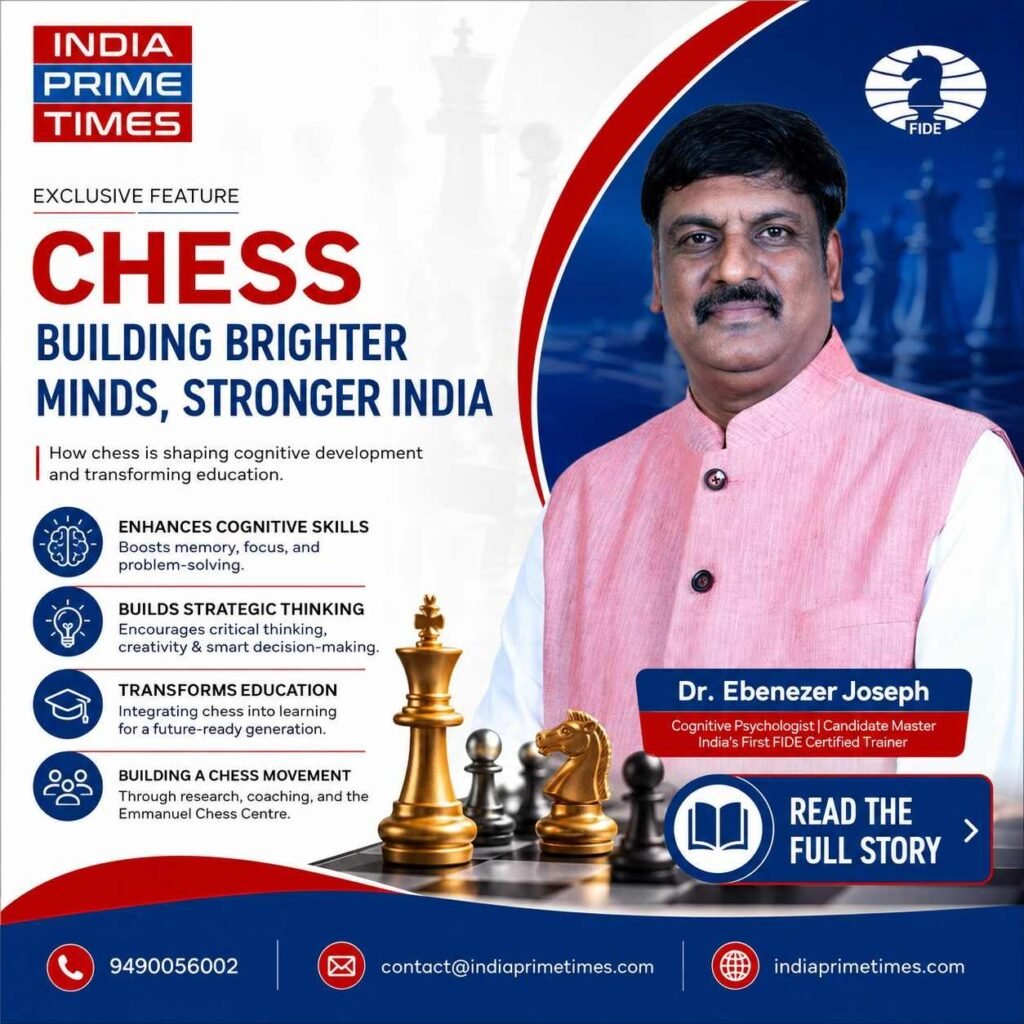
The Indian sports ecosystem is currently witnessing an unprecedented golden age in chess. With a new generation of teenage prodigies dominating the global stage, India has firmly established itself as a geopolitical superpower on the 64 squares. However, beyond the floodlights of international tournaments and the pursuit of Grandmaster norms, a quieter, arguably more profound revolution is taking place within the country’s classrooms. Education policymakers and cognitive scientists are increasingly looking at chess not merely as a competitive sport, but as a critical pedagogical tool capable of rewiring the cognitive infrastructure of young minds.
To investigate this emerging intersection of sports, psychology, and mainstream education, the India Prime Times editorial team recently traveled to Chennai-the undisputed chess capital of India. Our objective was to analyze how structured board game training is being utilized to combat diminishing attention spans and enhance analytical reasoning in children.
During our on-ground coverage, our team observed a highly disciplined, research-backed training module in action at the historic Russian Cultural Centre. The environment was strikingly different from typical sports coaching; it operated with the precision of a cognitive science laboratory. This operational brilliance led our editorial desk to a comprehensive, in-person conversation with the architect behind this methodology: Dr. Ebenezer Joseph.
A cognitive psychologist, Candidate Master, and India’s first certified FIDE (World Chess Federation) Trainer, Dr. Joseph provided our team with a masterclass on the future of intellectual development. Through our interaction, it became undeniably clear that the future of Indian education may very well depend on integrating the strategic rigor of the chessboard into the daily academic curriculum.
The Science of Strategy: A Groundbreaking Ph.D.
During our conversation, the core philosophy driving the modern “Chess in Education” (CIE) movement became immediately apparent. The industry is moving away from anecdotal claims about chess making kids “smarter” and demanding hard, empirical data.
Dr. Joseph is at the absolute forefront of this academic pursuit. He holds the unique distinction of earning India’s first Ph.D. in Chess from the University of Madras. This landmark achievement positioned chess firmly within the realm of scientific and cognitive inquiry.
“We can no longer view chess simply as a recreational activity or a niche competitive sport,” Dr. Joseph explained to the India Prime Times team. “It is a highly structured cognitive exercise. When taught systematically, it actively enhances intelligence, creativity, memory retention, and executive decision-making competencies. These are the exact skills required to survive and thrive in the modern, data-driven global economy.”
This is not mere theory. Dr. Joseph spearheaded a major Cognitive Science Research Initiative Project funded by the Department of Science and Technology (DST), Government of India. The project empirically demonstrated the profound cognitive benefits of systematic chess instruction among children. With over 35 international presentations and 22 scholarly publications to his name, his research is actively shaping global academic discourse, proving that the analytical reasoning forged on the chessboard directly translates into broader academic and life contexts.
Institutionalizing a Legacy: Three Decades of Mentorship
What makes Dr. Joseph’s profile highly newsworthy is his ability to translate high-level academic theory into grassroots, operational reality. In 1996, he founded the Emmanuel Chess Centre in Chennai. Over a span of nearly 30 years, this pioneering institution has trained over 15,000 children and mentored more than 150 chess trainers both in India and abroad.
Our editorial team was struck by his unique global credentials. He is not only India’s first FIDE-accredited trainer but also the only Indian to be certified as a Senior Lead Instructor by the World Chess Federation’s Chess in Education Commission. His pedagogical philosophy is anchored in intellectual discipline and ethical engagement. Whether he is coaching India’s junior team at the Aeroflot International Open in Moscow or training a local school student in Chennai, his goal remains the same: nurturing resilience and critical thinking.
The Competitive Edge and Professional Balance
To teach strategy, one must be a master strategist. Dr. Joseph’s academic and coaching accolades are deeply rooted in his own competitive excellence. A former Captain of the Madras University Team who won the All India University Chess Championship three times, his playing career spans decades of high-stakes international competition.
From participating in the World Youth Chess Championship in Brazil (1991) and attaining the US Master title (2023), to his recent campaigns in the Asian Amateur Championships and World Senior Championships across Dubai, Greece, and Portugal, his competitive drive remains relentless. Currently, he is ranked World Amateur No. 5 (Greece, 2024) and Asia No. 5 Senior 50+ (Iraq, 2025).
Yet, perhaps the most fascinating aspect of his profile is his professional duality. Recruited under the sports quota, he serves as a Supervisor at the Finance and Communications Audit Office in Chennai. This ability to balance elite athletic competition, groundbreaking academic research, and a demanding corporate governance role perfectly encapsulates the intellectual discipline he imparts to his students.
The Roadmap for Mainstream Education
As our time with Dr. Ebenezer Joseph concluded, the broader implications for India’s educational sector came into sharp focus. The modern workforce requires dynamic problem solvers, and traditional rote-learning systems are failing to produce them.
Dr. Joseph is currently advocating for the institutionalization of chess within mainstream education through well-defined CIE frameworks. His vision emphasizes the scalability, inclusivity, and long-term cognitive impact of integrating chess into school curricula across the country.
For educational policymakers, school boards, and industry analysts, the blueprint being executed by leaders like Dr. Joseph is essential studying. By successfully merging empirical cognitive science with structured sports pedagogy, visionaries like Dr. Ebenezer Joseph are proving that the chessboard is not just a battleground for grandmasters-it is the ultimate training ground for the next generation of global leaders.