
Standardizing the Soul of Regional Cuisine: How Rakesh Kumar N A is Engineering the Global Rise of Davanagere’s Culinary Heritage
5 min read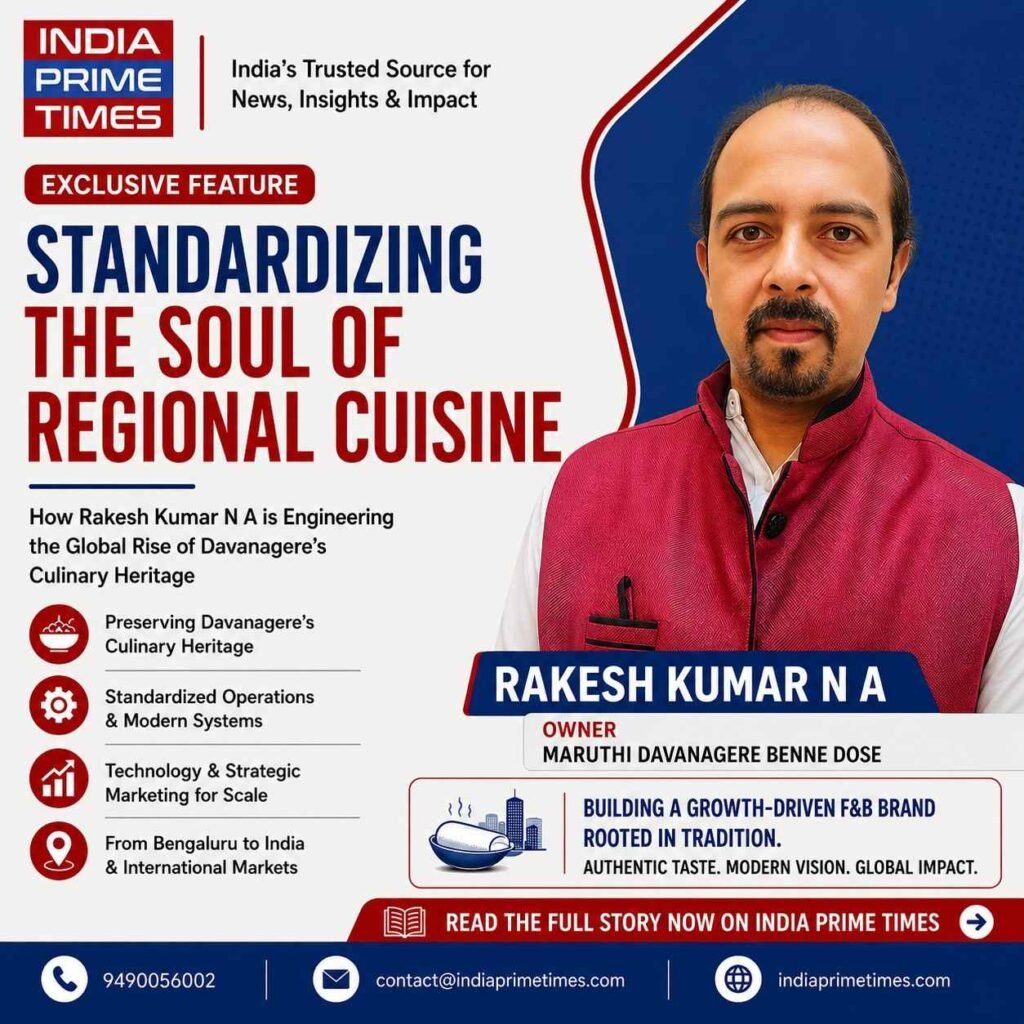
The Indian Food and Beverage (F&B) industry is currently undergoing a massive structural and cultural pivot. For decades, the restaurant ecosystem in metropolitan cities was dominated by generic multi-cuisine diners or heavily Westernized fast-food chains. However, as the Indian consumer’s palate matures, a powerful new trend is sweeping the market: the rise of hyper-regional, highly specialized culinary experiences. Today’s urban diners are actively seeking out authentic, heritage-rich regional dishes served in modern, hygienic, and process-driven environments.
To investigate how regional culinary legacies are being commercialized and scaled without losing their cultural authenticity, the India Prime Times editorial team recently focused its coverage on the vibrant food corridors of Bengaluru. Our objective was to analyze the intersection of traditional gastronomy and modern corporate operational frameworks.
During our on-ground reporting, our team observed a remarkable phenomenon unfolding at Maruthi Davanagere Benne Dose. We noticed a diverse demographic-from young IT professionals to traditional families-lining up for a highly focused South Indian dining experience. The operational efficiency, impeccable hygiene standards, and the unmistakable, rich aroma of authentic Benne (butter) Dosas prepared using traditional techniques immediately caught our attention.
Intrigued by how this localized concept was operating with the precision of a corporate entity, our editorial desk reached out to the architect of the brand. We had the distinct opportunity to sit down and converse with Rakesh Kumar N A, the Owner of Maruthi Davanagere Benne Dose. What followed was a profound discussion on the business of food, the transition from the corporate world to the kitchen, and the blueprint for taking a regional delicacy to the global stage.
From the Corporate Boardroom to Culinary Entrepreneurship
During our interaction, the core philosophy driving Rakesh Kumar’s enterprise became immediately evident. He represents a growing demographic of highly educated professionals who are leaving lucrative corporate careers to structure and elevate India’s unorganized food sector.
“I have had a deep passion for food since childhood-it has always been at the center of my thoughts and creativity,” Rakesh explained to the India Prime Times team. “Even though I come from a medical background and had a well-established corporate career, my inclination towards food never faded. Starting this restaurant was not just a business choice; it was a conscious decision to step away from a secure corporate path to live my passion and share authentic, meaningful culinary experiences.”
Our team noted that this corporate pedigree heavily influences how Maruthi Davanagere Benne Dose operates. While the food is deeply traditional, the backend operations are fiercely modern.
Preserving the Legacy on a Plate
The primary challenge of scaling a hyper-regional dish like the North Karnataka staple, Davanagere Benne Dosa, is maintaining its soul. When food brands scale, they often standardize to the point of clinical sterility, losing the very essence that made them popular.
“In a time where standardization often replaces soul, we have consciously chosen to stay rooted-focusing on craft, consistency, and care in every detail,” Rakesh noted. “For us, this journey has never been just about serving food. It has always been about preserving a legacy on a plate. Every Davanagere Benne Dosa we serve carries with it the authenticity, tradition, and emotion of a region that we are deeply committed to representing with absolute honesty.”
During our visit, our team experienced this firsthand. The brand has successfully curated a customer-friendly setting that marries the nostalgic, rich flavors of high-quality ingredients with consistent, modern hygiene standards. The emotional connection the brand fosters with its patrons is evident in the genuine experiences prioritizing community over mere transactional dining.
The Mechanics of Scaling Authenticity
What makes Rakesh Kumar’s profile highly newsworthy is his clinical approach to growth and marketing. Scaling a restaurant brand requires more than just good food; it requires bulletproof systems.
When asked about maintaining quality across multiple locations, Rakesh detailed a highly structured operational blueprint. “To ensure the same authentic taste and experience across all locations, we are building strong internal systems,” he explained. This includes the development of standardized recipes, the centralized sourcing of key ingredients, well-defined Standard Operating Procedures (SOPs) for kitchen operations, and rigorous, regular staff training and audits. Furthermore, the brand is actively integrating technology for inventory management, quality checks, and real-time customer feedback.
This operational rigor is matched by an aggressive, 360-degree marketing strategy. Rather than relying solely on organic footfall, Maruthi Davanagere Benne Dose has successfully bridged the gap between traditional and modern consumer outreach.
“We have consistently leveraged digital channels through targeted promotions to build strong brand recall among new-age consumers,” Rakesh detailed. “Simultaneously, we have implemented effective offline strategies, including newspaper advertisements, pamphlet insertions, and strategically placed display banners to capture local market attention.”
This integrated approach has yielded tangible business results, significantly increasing footfall, driving strong word-of-mouth referrals, and generating consistent growth in repeat customer metrics and overall sales.
The Road Ahead: From Bengaluru to the World
As our conversation with Rakesh Kumar N A concluded, the broader trajectory of his enterprise came into sharp focus. The brand is not resting on its local success; it is executing a clear, phased growth strategy. In the near term, the focus is on establishing six to seven company-owned outlets to consolidate brand presence and operational control. This will lay the groundwork for a state-wide expansion, followed by a structured national rollout, and ultimately, an ambitious vision to enter international markets.
Currently in the running for prestigious industry recognition, Rakesh views such accolades through a cultural lens rather than a commercial one. “Winning this award would not just be a recognition of our business,” he stated passionately, “but a celebration of the tradition we are striving to keep alive and share with a wider audience.”
For industry analysts tracking the Indian F&B sector, the business model being executed by Maruthi Davanagere Benne Dose serves as a definitive case study. By combining deep-rooted culinary authenticity with strict corporate discipline, innovative marketing, and technological integration, leaders like Rakesh Kumar N A are proving that India’s hyper-regional cuisines are fully equipped to dominate the global culinary map.