
Sovereignty from Orbit: How Indigenous Micro-Satellite Constellations Are Powering India’s Commercial Spacetech Revolution
4 min read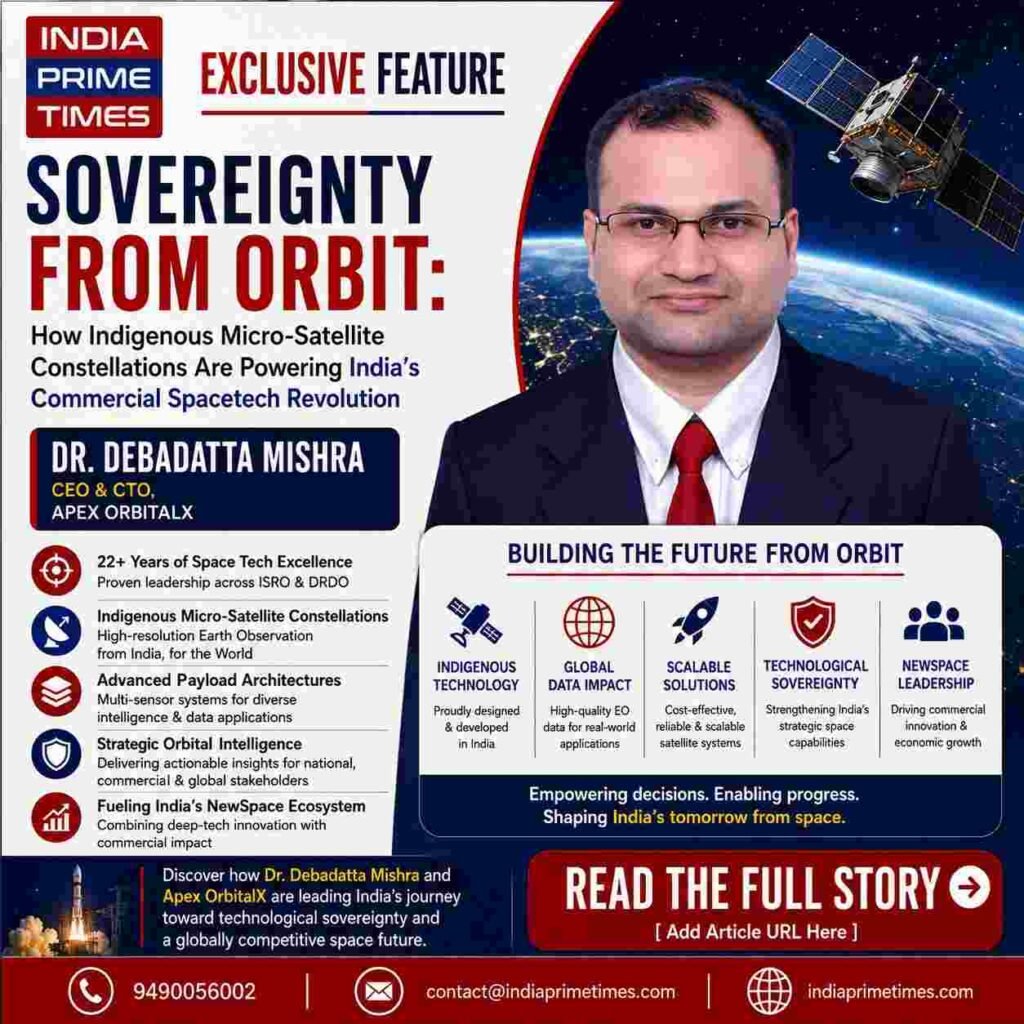
The global space economy is undergoing its most radical transformation since the dawn of the space race. For decades, orbital infrastructure and Earth observation (EO) capabilities were the exclusive domain of state-funded space agencies operating multi-ton, multi-hundred-million-dollar satellites. However, the rise of the commercial “NewSpace” movement-accelerated by privatized launch vehicles, miniaturized avionics, and the democratization of low Earth orbit (LEO)-has fundamentally disrupted this paradigm.
Today, national security, maritime surveillance, precision agriculture, and disaster management depend not on sparse, monolithic satellites, but on agile, cost-efficient constellations capable of real-time, 24/7/365 orbital intelligence. In India, following landmark policy reforms and the establishment of the Indian National Space Promotion and Authorization Center (IN-SPACe), private spacetech ventures are rapidly transitioning from conceptual design to manufacturing high-performance space assets.
To examine how indigenous deep-tech engineering is driving this sovereign space ecosystem, the India Prime Times editorial team recently conducted extensive reporting across India’s premier aerospace and defense corridors.
During our field assessment, our team evaluated next-generation satellite payload architectures engineered to deliver continuous, all-weather synthetic aperture radar (SAR), multispectral, and electronic intelligence (ELINT) downlinks. Intrigued by the engineering precision and strategic scope of these technologies, the India Prime Times team met with Dr. Debadatta Mishra, Chief Executive Officer and Chief Technology Officer of Apex OrbitalX, and had an in-depth conversation regarding the future of India’s commercial space power.
Our interaction with Mr. Mishra revealed how two decades of institutional defence and space research are now being channelled into category-defining commercial orbital systems.
A Two-Decade Pedigree: From ISRO’s Heavy Launchers to Gaganyaan
A major bottleneck in commercial spacetech globally is the execution gap: startups often possess software prowess but lack the rigorous, failure-intolerant hardware engineering required for the harsh realities of space.
Mr. Mishra bridges this gap with over 22 years of distinguished service across India’s premier strategic research organizations-the Indian Space Research Organisation (ISRO) and the Defence Research and Development Organisation (DRDO).
Holding a B.Tech in Mechanical Engineering (First Class Honours, University Rank Holder) from Biju Patnaik University of Technology and an M.Tech in Aerospace Engineering (First Class Honours) from IIT Kharagpur and PhD in Missile Propulsion Technologies his foundational career has been anchored in the most complex aerospace domains. As an Ex-Senior Scientist (Scientist-F) at ISRO, Dr. Mishra played pivotal roles in space mission design, cryogenic propulsion, satellite launch vehicles, earth observation satellites, and as Project Manager within India’s prestigious Gaganyaan Human Spaceflight Programme.
“Space is completely unforgiving; you cannot send a repair crew to low Earth orbit,” Mr. Mishra explained to the India Prime Times team. “The rigorous systems engineering, thermal modeling, and vibration resilience mastered during national space missions must be embedded into commercial satellite development from day one. That foundational discipline is what makes commercial constellations reliable and mission-ready.”
His multidisciplinary background is further reinforced by a Ph.D. in Missile Propulsion Technology, an MA in Space and Telecommunication Law from NALSAR University, Hyderabad, and executive management studies from Symbiosis University, Pune.
Apex OrbitalX: Redefining All-Weather Earth Intelligence
At the center of Dr. Mishra’s entrepreneurial mandate is Apex OrbitalX, a space-tech venture incubated at IIT Bhubaneswar and recognized by DPIIT, Startup Odisha, MSME, and IN-SPACe / ISRO.
During our discussions, our team explored Apex OrbitalX ’s flagship project: building India’s first cost-efficient Micro Earth Observation Satellite Constellation. Traditional optical satellites face severe operational constraints-they cannot image Earth through cloud cover or during night cycles. Apex orbitalX is overcoming this barrier by engineering an integrated multi-sensor payload architecture combining Visible and Thermal-Infrared capabilities.
Crucially, the constellation integrates an Electronic Intelligence (ELINT) payload alongside Earth observation sensors, creating a dual-use platform purpose-built for:
- Defense & Maritime Surveillance: Providing persistent monitoring of sovereign maritime boundaries, exclusive economic zones (EEZ), and strategic border corridors.
- Civilian and Blue Economy Solutions: Delivering high-precision satellite data for soil moisture analysis, crop acreage calculation, mineral exploration, and oil and gas pipeline monitoring.
Demonstrating its strategic value, Apex OrbitalX was recently recognized for FICCI Start up R & D award, Institution of Engineers (IEI) Start up Excellency Award, etc . The company is actively progressing toward the scheduled orbital launch of its first satellite in the fourth quarter of 2028 (Q4 2028).
Transforming the Aerospace Workforce and Startup Ecosystem
Beyond satellite engineering, Dr. Mishra’s contributions extend deeply into national workforce transformation and deep-tech incubation. He previously served as the Chief Executive Officer (Officiating) of the Aerospace & Aviation Sector Skill Council (AASSC) under the National Skill Development Corporation (NSDC) and the Ministry of Skill Development and Entrepreneurship.
In this role, he spearheaded national skill qualification frameworks in collaboration with global and domestic giants such as Boeing, Airbus, HAL, Godrej Aerospace, and Safran, aligning Indian technical talent with international aviation benchmarks.
Today, as a Senior Mentor with the Atal Incubation Centre at Rashtriya Raksha University (Ministry of Home Affairs) and an advisor to major educational and research institutions, Mr. Mishra has mentored emerging aerospace and defence startups on product design, regulatory compliance, and investment outreach, supporting projects valued at over INR 1,000 Crore (USD 120+ Million).
The Strategic Horizon for Indian Spacetech
As our conversation with Dr. Debadatta Mishra concluded, the broader implications for India’s geopolitical and technological standing became clear. The modern space race will not be won solely by launch vehicle cadence; it will be defined by sovereign control over orbital intelligence, precision sensor data, and downstream analytics.
For defense analysts, institutional investors, and enterprise stakeholders tracking the global space economy, the operational trajectory of Apex OrbitalX represents a vital case study. By uniting elite institutional spaceflight experience with commercial agility, high-density sensor integration, and strategic governance, leaders like Dr. Debadatta Mishra are not just launching satellites-they are securing India’s technological sovereignty from orbit.