The Algorithmic Physician: How Dr. Latha Kiran Krishna Rajendran is Rewiring Oncology and Clinical Practice with Artificial Intelligence
4 min read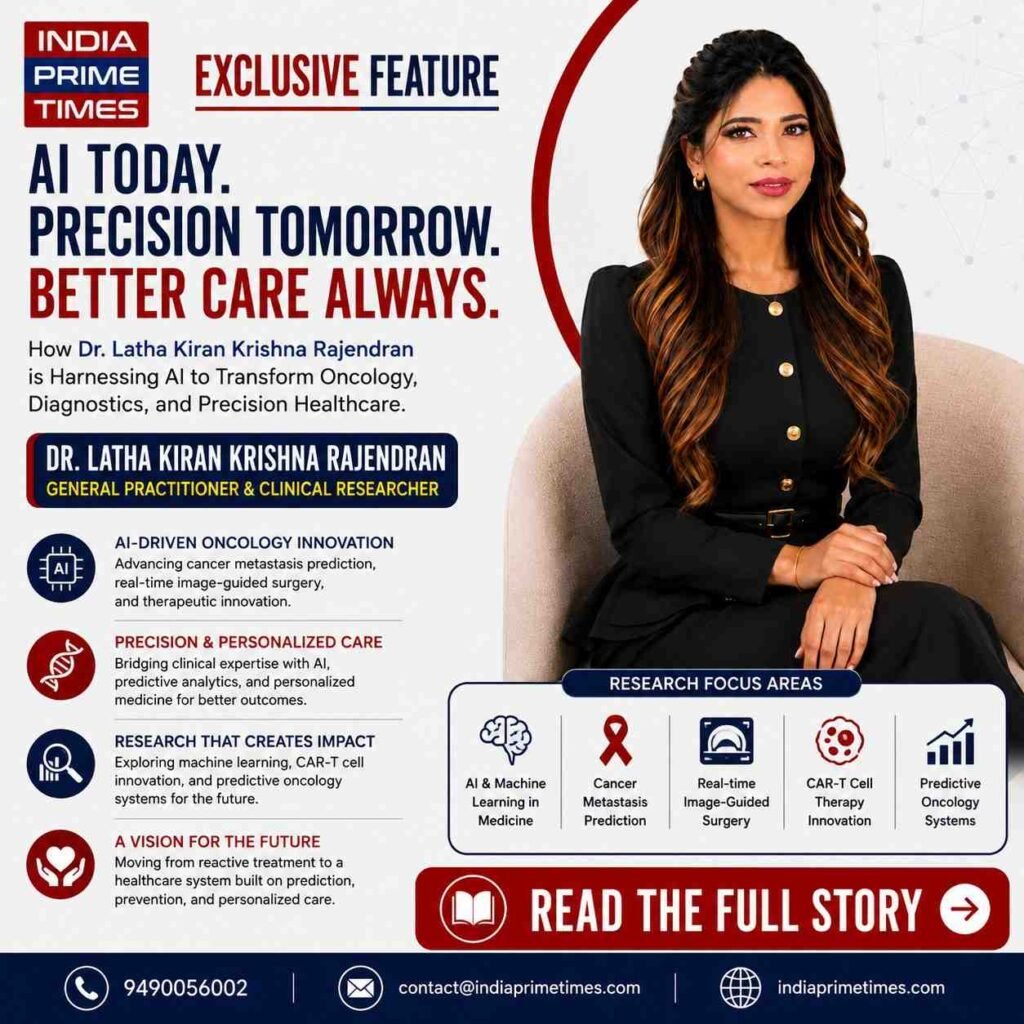
The global medical fraternity is currently standing at the precipice of a digital revolution. For centuries, clinical medicine has operated on a reactive paradigm-diagnosing and treating diseases only after symptoms manifest. Today, however, the integration of Artificial Intelligence (AI), machine learning, and predictive analytics is fundamentally shifting the industry toward a proactive, precision-based model. The goal is no longer just to treat, but to predict, personalize, and prevent.
Yet, a critical gap remains in this technological leap. Most AI algorithms are designed by data scientists who lack frontline clinical experience, while most physicians lack the computational expertise to guide algorithmic development.
To explore how the Indian healthcare ecosystem is bridging this divide, the India Prime Times editorial team recently focused its coverage on the emerging class of “physician-scientists” in Bengaluru’s advanced medical corridors.
During our field reporting, our team visited Elova Hospitals, where we observed an extraordinary convergence of high-volume clinical practice and cutting-edge computational research. The operational efficiency, rapid diagnostic accuracy, and evidence-based precision we witnessed on the floor immediately captured our attention.
Intrigued by this seamless blend of human empathy and data-driven medicine, the India Prime Times team met and experienced the exceptional work of Dr. Latha Kiran Krishna Rajendran, a leading General Practitioner and Clinical Researcher. Over a comprehensive conversation, we discussed her journey, her pioneering research in AI-driven oncology, and how she is redefining modern healthcare delivery.
The Clinical Foundation: Medicine at Scale
Unlike many researchers who operate purely in academic silos, Dr. Latha’s computational theories are deeply rooted in frontline medical realities. Before algorithms can cure, a physician must understand the patient.
During our visit to Elova Hospitals, our team observed Dr. Latha managing a highly demanding outpatient practice, consulting 40 to 60 patients daily. Her clinical footprint is massive: she provides comprehensive medical care to over 10,000 patients annually. Her hands-on experience spans across managing non-communicable chronic diseases, treating over 5,000 pediatric patients, executing 2,000+ minor surgical and dermatological procedures, and conducting over 8,000 antenatal and postnatal consultations.
This relentless clinical volume is further backed by her formidable public health leadership. Serving as a Medical Officer at the Karuna Trust / Adugodi UPHC during the peak of the COVID-19 pandemic, she spearheaded the administration of over 150,000 vaccinations under national immunization programs, alongside rapid diagnostic testing and emergency stabilization.
“When you treat thousands of patients across emergency, pediatric, and geriatric care, you quickly realize the limitations of generalized medicine,” Dr. Latha explained to the India Prime Times team. “Every human body reacts differently. My clinical experience is the engine that drives my research. I wanted to build computational tools that could look past standard protocols and offer truly personalized, predictive care.”
Pioneering Precision Oncology: The Power of Predictive AI
The true differentiator in Dr. Latha’s profile is her transition from a frontline clinician to an international clinical researcher focused on precision oncology and artificial intelligence. With 15+ peer-reviewed scientific publications and over 1000 citations, her work addresses some of the most critical blind spots in cancer treatment.
During our interaction, we discussed one of her most significant breakthroughs: predicting lymph node metastasis in Head and Neck Squamous Cell Carcinomas (HNSCC). Traditional diagnostic imaging frequently fails to detect microscopic cancer spread in lymph nodes, leading oncologists to apply broad, non-personalized radiation therapies that cause severe side effects.
To solve this, Dr. Latha developed an advanced model leveraging Mixture Hidden Markov Models (HMMs). By analyzing multi-centric data from over 1,200 patients, her AI framework accurately predicts the hidden spread of cancer based on specific primary tumor locations. This breakthrough allows for hyper-targeted radiation therapy, maximizing tumor destruction while sparing healthy tissue.
Engineering Real-Time Surgical Navigation
Beyond predictive diagnostics, Dr. Latha is pushing the boundaries of intra-operative surgical technology. Our editorial team was fascinated by her research framework concerning Real-Time Volumetric Alignment for Image-Guided Brain Tumor Resection.
During brain surgery, the brain physically shifts (“brain shift”) after the skull is opened, making pre-operative MRI scans immediately inaccurate. Using Dynamic Data-Driven Non-Rigid Registration (NRR) and distributed computing architectures, her computational framework continuously updates surgical imaging in real-time. This maintains sub-2mm target registration accuracy throughout the procedure, ensuring neurosurgeons can safely and completely excise brain tumors without damaging critical healthy tissue.
A Global Voice in Computational Medicine
Dr. Latha’s influence extends far beyond the hospital walls. Her prolific academic output includes highly anticipated books on Immunotherapy, CAR-T Cell Innovations, and Theranostics (combining diagnostic imaging and targeted nanotherapy). Furthermore, she holds multiple Indian Utility Patents for AI-Optimized CAR-T Cell Engineering and AI-Driven Predictive Systems for Colorectal Cancer.
Her standing in the global research community is undisputed. She actively serves as a peer reviewer for prestigious international journals, a session chair for major global data analytics conferences, and an invited speaker on AI-powered early cancer detection. This unique intersection of skills has earned her prestigious memberships, including the American Society of Clinical Oncology (ASCO), Sigma Xi (a premier scientific research honor society), and recognition as a Senior Member of IEEE, A SCRS (Soft Computing Research Society) fellow member.
The Future of Data-Driven Healthcare
As our conversation with Dr. Latha Kiran Krishna Rajendran came to a close, the overarching trajectory of modern medicine became strikingly clear. The era of trial-and-error medicine is ending, making way for an era defined by genomic profiling, AI-guided therapies, and computational diagnostics.
“The future of medicine lies not in treating diseases after they appear, but in predicting, preventing, and personalizing care before they progress,” she noted powerfully.
For healthcare administrators, medical technology innovators, and policymakers navigating this digital transition, the blueprint provided by leaders like Dr. Latha Kiran Krishna Rajendran is invaluable. By seamlessly uniting frontline clinical empathy with advanced machine learning algorithms, the new generation of physician-scientists is not merely treating patients-they are actively engineering a safer, smarter, and highly personalized future for global healthcare.