The Greening of Regional Hospitality: How Flamingo Club & Resort is Redefining Eco-Conscious Tourism in the Diu Circuit
4 min read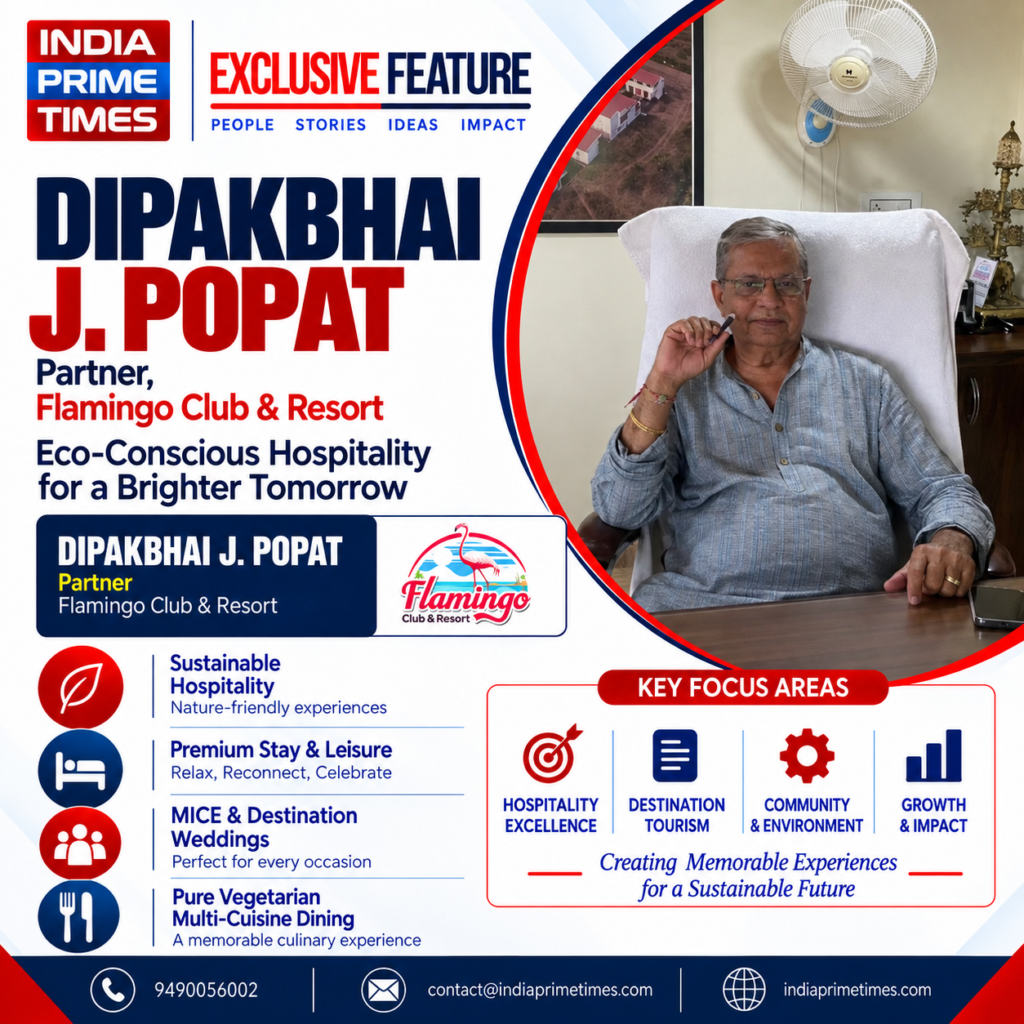
The Indian domestic tourism and hospitality sector is undergoing a rapid structural realignment. As urban travelers increasingly seek refuge from densely populated cities, the demand for integrated, eco-conscious resorts in regional coastal circuits has surged. However, building a premium hospitality destination that successfully balances modern recreational infrastructure with strict environmental sustainability remains a complex operational challenge.
Recently, the Federation of Hotel & Restaurant Associations of India (FHRAI)-one of the country’s most authoritative hospitality bodies-awarded its highly coveted “Green Hotel of the Year (E)” to a rising property on the periphery of the Diu tourism circuit: Flamingo Club & Resort.
To investigate the operational architecture and ecological strategies behind this national recognition, the India Prime Times editorial team recently traveled to the resort. During our field reporting, our team experienced firsthand the property’s meticulous integration of natural habitats with premium hospitality. Walking through the sunset and bird-watching decks, and observing the resort’s sustainable footprint, the tangible commitment to green hospitality was immediately evident.
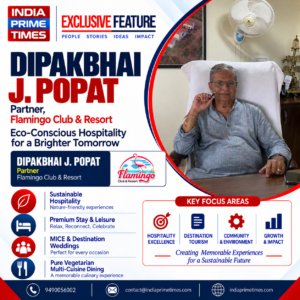
It was within this tranquil environment that our editorial desk sat down for an extensive conversation with Dipakbhai J. Popat, Partner at Flamingo Club & Resort. Our discussion explored his highly unconventional entry into the hospitality sector, the strategic positioning of the property, and the future of responsible tourism in regional India.
The Advocate Turned Hotelier
The foundational story of Flamingo Club & Resort is as compelling as its infrastructure. The property is not the product of a legacy hospitality conglomerate, but rather the vision of a seasoned legal professional.
Dipakbhai J. Popat spent over four decades building a formidable career as a practicing advocate. Transitioning from the rigorous, highly structured environment of the courtroom to the dynamic, service-oriented world of resort development represents a bold entrepreneurial pivot.
“After forty years in the legal profession, the objective was not just to start a business, but to curate a legacy,” Dipakbhai J. Popat shared with the India Prime Times team. “We wanted to build a sanctuary where the architecture respects the land, where families can genuinely disconnect from urban fatigue, and where every celebration feels rooted in nature. The FHRAI award validates our core thesis: luxury and ecological responsibility are not mutually exclusive.”
His decades of legal discipline translate directly into the resort’s operational governance, ensuring strict compliance, meticulous planning, and a highly structured approach to guest experiences.
Architecting a Multi-Dimensional Destination
What distinguishes Flamingo Club & Resort in the competitive coastal tourism market is its comprehensive spatial planning. The property is engineered to serve as a self-contained destination rather than a mere transit hotel.
Our team analyzed the resort’s infrastructure, which is strategically designed to accommodate diverse traveler demographics:
- Premium Accommodation: The resort features 31 expansive units, broken down into 20 private Villas, 7 Executive Rooms, 3 Suites, and 1 exclusive Maharaja Suite, catering seamlessly to couples, large families, and corporate executives.
- Recreational Ecosystem: The property houses a state-of-the-art swimming pool, comprehensive indoor and outdoor sports courts, and a mini gymnasium.
- Nature Integration: Departing from concrete-heavy resort designs, Flamingo features dedicated bird-watching decks, sunset observation points, and interactive zones with caged and free-roaming birds and rabbits-a deliberate design choice that heavily appeals to families and young children.
The Strategic MICE and Destination Wedding Engine
While leisure travel forms the baseline of coastal tourism, the true financial engine of modern hospitality lies in the MICE (Meetings, Incentives, Conferences, and Exhibitions) and destination wedding sectors. Flamingo Club & Resort has been purpose-built to capture this high-yield market.
The resort’s event infrastructure is remarkably robust for a boutique property. It boasts a 150-person indoor banquet hall tailored for corporate conferences, dealer meets, engagements, and intimate family gatherings. For large-scale events, the property transitions into a sprawling 500-person party lawn.
“The modern Indian wedding or corporate retreat requires centralized logistics,” noted Dipakbhai J. Popat during our tour of the grounds. “By offering spacious party lawns, high-capacity banquets, luxury villas, and multi-cuisine dining within a single, secure perimeter, we eliminate the logistical friction for event organizers. We are a property that actively focuses on the middle and upper-middle class, and we take pride in offering the best destination wedding options tailored specifically for middle and upper-middle-class families. The entire property becomes a private, immersive experience for the hosting family or corporation.”
This infrastructure positions the resort as a premier venue for team-building retreats, incentive travel, and grand social functions in the Saurashtra-Diu corridor.
A Culinary Differentiator: Premium Pure-Vegetarian Dining
Perhaps one of the most strategic market differentiators our editorial team noted during our stay was the resort’s culinary positioning. The Diu tourism circuit is heavily dominated by seafood and non-vegetarian coastal cuisine, which frequently poses a significant challenge for strict vegetarian families, particularly those traveling from mainland Gujarat.
Flamingo Club & Resort addresses this massive market gap with a state-of-the-art, 70-seater pure-vegetarian multi-cuisine restaurant. By maintaining a strictly vegetarian kitchen, the resort provides absolute dietary peace of mind for specific communities, transforming the restaurant into a standalone destination for visitors across the region.
As regional tourism continues to expand post-pandemic, travelers are demanding more than just a room; they are demanding curated environments, sustainable practices, and comprehensive on-site amenities. The FHRAI “Green Hotel of the Year (E)” award serves as a powerful market signal that Flamingo Club & Resort is successfully leading this transition. By synthesizing the disciplined vision of a legal veteran with thoughtful ecological design, high-capacity event infrastructure, and a rare pure-vegetarian culinary offering, the property is rapidly establishing itself as the definitive eco-luxury destination on the Diu circuit.