Decoding the Scriptural Algorithm: How a Former Banker is Engineering a New Era of Gen Next Interpretation of scriptures
4 min read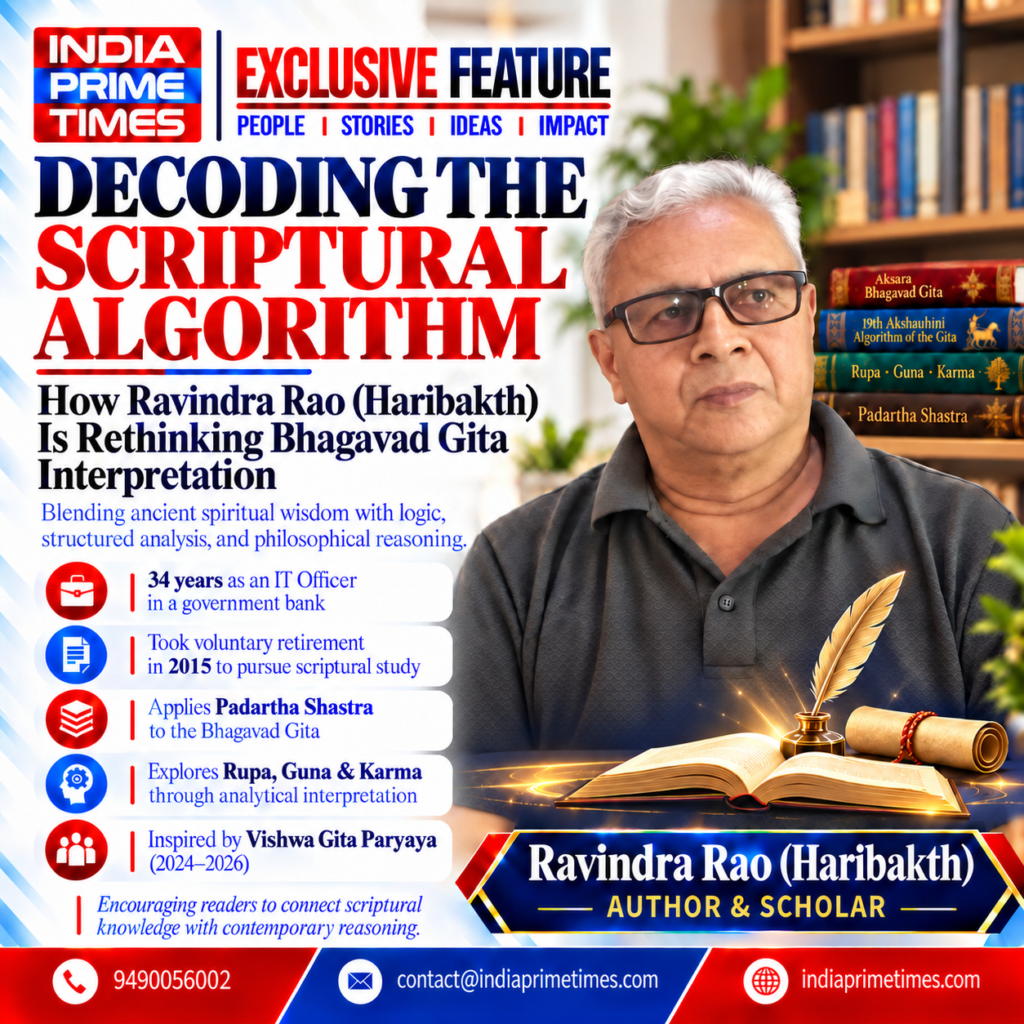
The global landscape of scriptural study is currently undergoing a profound structural shift. For millennia, commentaries on ancient Indian texts like the Bhagavad Gita have been heavily dominated by semantic interpretations, linguistic variations, and rigid philosophical lineages. Today, a new wave of analytical research is emerging, one that actively bridges ancient spiritual wisdom with empirical, systemic frameworks. To understand this rapidly evolving intersection of logic and theology, the India Prime Times editorial team recently directed its focus toward the latest developments in contemporary scriptural analysis.
During our field reporting, our team stumbled upon the transformative and highly unconventional work of Ravindra Rao, an Indian author and known in literary circles by his pen name, Haribakth. We noticed a distinct, algorithmic precision in his approach to the Bhagavad Gita that separates his methodology from thousands of existing traditional commentaries. This intellectual rigor led our editorial desk to a comprehensive, in-person conversation with the author to discuss the future of Indian ontological research and his unique journey into spiritual scholarship.
Rao’s professional background is highly untraditional for a spiritual commentator. Holding a Master’s degree in Commerce and a Bachelor’s degree in Law from Dr. Babasaheb Ambedkar Marathwada University, he spent 34 years executing complex logic as an IT Officer at the state-owned Bank. In 2015, he opted for voluntary retirement to dedicate his life to find new ways of interpreting the scriptures in general and Bhagavad Gita in specific. Rather than presenting himself as a newly minted guru, he candidly describes himself as a “self-confessed plagiarist who steals ideas from the Almighty’s words.” This reflects a philosophy strictly anchored in interpreting textual authority rather than fabricating personal dogmas.
A Global Catalyst: The Vishwa Gita Paryaya
Rao’s latest analytical endeavors are deeply intertwined with a massive cultural and spiritual movement currently underway: the “Vishwa Gita Paryaya” (2024–2026). Initiated by His Holiness Sri Sri Sugunendra Theertha Swamiji of the Puthige Mutt in Udupi, this global campaign operates on the core mission of placing the Gita in every home and heart.
During our interaction, Rao cited this movement as a profound external inspiration for his work. He specifically highlighted the Koti Gita Lekhana Yajna, a monumental initiative aimed at collecting handwritten Gita volumes from one crore people globally. This initiative ships multilingual script kits worldwide, asking participants to make a resolve to abandon one negative habit while writing. The completed texts are ceremonially placed before the main deity at the Gita Mandir before being returned to families as a multi-generational heirloom. The sheer scale of this universal inclusivity deeply stirred Rao’s spiritual sensibilities, pushing him to demystify the text for a global audience.
Applying Padartha Shastra to the Gita
The core innovation of Rao’s work lies in his application of Padartha Shastra-the ancient Indian science of ontological realities, categories, and substances-directly to the Bhagavad Gita. He examines the sacred text as a distinct cosmic substance defined by its own Rupa (Form), Guna (Intrinsic Properties), and Karma (Actions).
“For over five millennia, the dominant tradition relied primarily on semantic and philosophical expositions by Gurus,” Rao explained to the India Prime Times team. “We are now witnessing a paradigm shift where future commentaries will be structurally grounded in these systemic Shastras. This marks the dawn of an era of Rupa-Guna-Karma based commentaries, charting the course for spiritual scholarship for the next five thousand years.”
This systemic approach requires a complete narrative perspective shift. While traditional literature operates from a second-person point of view-an instruction directed at the seeker-Rao’s work adopts a third-person, omniscient perspective. He steps back to view the entire cosmic dialogue from an objective, systemic framework.
The Mathematical Integration of Divergent Philosophies
Another striking aspect of his methodology, Traditional commentaries often operate as isolated variables representing exclusive schools of thought, such as Advaita, Dvaita, or Vishishtadvaita. Rao’s framework treats the Gita as a unified summation of these seemingly disparate perspectives.
When asked about this inclusivity and whether all perspectives lead to the exact same absolute truth, he drew a compelling empirical parallel during our conversation.
“It is a matter of evolution,” Rao noted. “A primary student calculates 3 minus 2 equals 1, but will say 3 minus 9 is an error. A high school student knows the answer is negative 6. Neither student is wrong. They are both speaking the truth from their individual level of evolution or frequency. The Lord’s divine Maya is deliberately structured to lead all seekers back to the same unified truth, validating human experience at every level of awareness.”
Overcoming Institutional Friction
By bypassing traditional theological boundaries and lacking formal initiation into a specific religious sampradaya, Rao’s work naturally invites institutional skepticism. Yet, he remains completely unfazed by this friction. He argues that true authority does not exclusively flow from institutional lineage or academic credentials; it resonates from the self-evident logical and spiritual coherence of the framework itself. He has explicitly designed his books to offer no prescriptive purports or rigid conclusions, leaving the ultimate interpretation entirely reader-centric.
As the Udupi Sri Krishna Matha continues its massive two-year cycle of global Gita-centric activities-including continuous daily recitations and international academic conclaves-works like Rao’s are providing the necessary intellectual scaffolding for modern, analytical seekers. Looking ahead, he is already mapping out future titles, including Hermeneutics – A Gita paradigm and Krishna’s Karma Yoga, a Sankhya and Nyaya perspective.
He has replaced blind dogmatic approach to the ancient scriptures with reconciling ancient texts with existing realities and experiences of the same. His works attempt to integrate the society by engineering an inclusive interpretation of sacred texts by stripping away sectarian bias and backed by logic , experience and scriptural ratios. A beginning has been made. It is for the seekers to choose their path.