Academic Rigour Meets Ancient Practice: How the Institutionalization of Yoga is Transforming India’s Higher Education Landscape
4 min read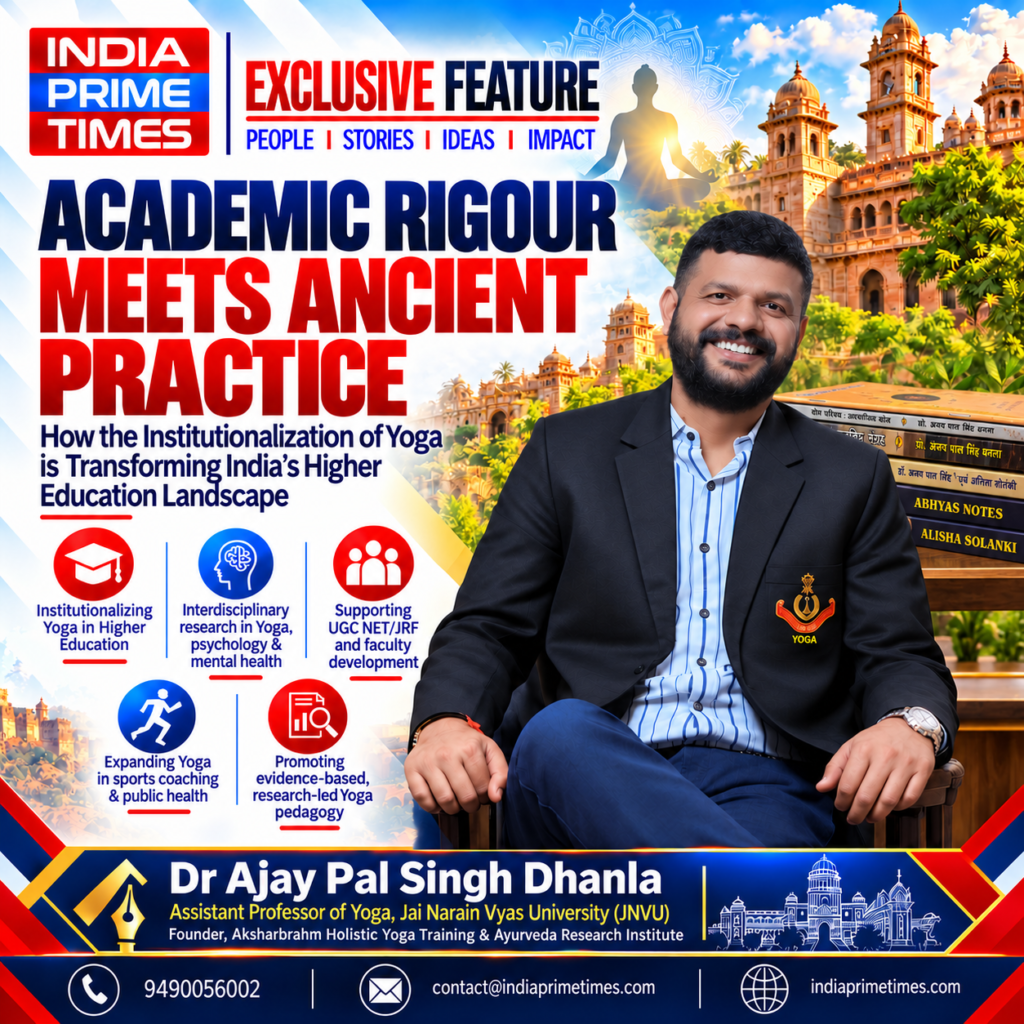
The landscape of Indian higher education is witnessing a profound structural reorientation. For decades, the global resurgence of Yoga was largely framed as an export of physical wellness, localized in private studios, boutique retreats, and international festivals. Today, however, the discipline is undergoing a significant transition from commercial wellness to rigorous academic institutionalization. Under the framework of the Indian Knowledge Systems (IKS) and multidisciplinary research mandates, premier academic institutions across the country are establishing full-fledged departments, clinical study programs, and doctoral research tracks dedicated to Yoga and Naturopathy. This transition demands a new caliber of academic leadership-scholars capable of treating ancient treatises with the empirical scrutiny of modern science while training the next generation of university educators.
To analyze how this academic transition is materializing within university corridors, the India Prime Times editorial team recently traveled to Rajasthan, visiting the academic center of Jodhpur. During our field reporting across regional universities and training institutes, our team experienced the expanding footprint of structured Yoga pedagogy and observed research methodologies that move far beyond routine physical postures. This operational dedication led our editorial desk to a comprehensive, in-person conversation with Dr Ajay Pal Singh Dhanla, Assistant Professor of Yoga at Jai Narain Vyas University (JNVU) and the Founder of the Aksharbrahm Holistic Yoga Training & Ayurveda Research Institute. Having observed his classroom training and research work firsthand, we sat down with him to discuss the challenges of standardizing Yoga education, the growing demand for university-level faculty, and the integration of traditional modalities into contemporary mental healthcare.
The Academic Paradigm and Interdisciplinary Research
One of the persistent obstacles facing the traditional wellness sector in India has been a lack of interdisciplinary bridge-building. Historically, scholars of classical philosophy often worked in isolation from modern clinical and behavioural sciences. Dr Ajay Pal Singh Dhanla’s trajectory illustrates the shift toward cross-disciplinary scholarship. His formal qualifications span multiple domains, including a Master of Arts in Yoga and Science of Living, a Master of Arts in Psychology, a Master of Arts in History, a Bachelor of Education, and a Bachelor of Library and Information Science.
This diverse foundation heavily informs his ongoing research initiatives. Pursuing his doctoral work in Yoga and Naturopathy at Monad University, Dr Ajay Pal Singh Dhanla has focused his thesis on the therapeutic evaluation of traditional practices: “मानसिक स्वास्थ्य संवर्धन में क्रियायोग की भूमिका: एक समीक्षात्मक अध्ययन“ (The Role of Kriya Yoga in Mental Health Promotion: A Critical Study). The study evaluates classical yogic concepts against contemporary psychological frameworks, addressing the rising prevalence of stress, anxiety, and lifestyle-induced cognitive disorders.
“The greatest misconception in contemporary society is reducing Yoga to a purely physical workout,” Dr Ajay Pal Singh Dhanla shared with the India Prime Times team during our discussion. “When approached through an academic and clinical lens, Yoga represents a comprehensive cognitive science. By synthesizing classical texts with modern psychological methodologies, we can formulate non-invasive, evidence-based interventions that address India’s escalating mental health crisis.”
Addressing the Institutional Faculty Deficit
As state and central universities across India expand degree-granting programs in Yoga, the academic ecosystem faces an acute supply-chain challenge: a severe shortage of qualified, accredited educators. To teach at the university level, candidates must meet the rigorous benchmarks established by the University Grants Commission (UGC), specifically qualifying for the National Eligibility Test (NET) and Junior Research Fellowship (JRF).
Recognizing this institutional gap, Dr Ajay Pal Singh Dhanla established the Aksharbrahm Holistic Yoga Training & Ayurveda Research Institute (also known as Akshar Brahm Yoga) in early 2024. The institute functions as an academic incubator, specializing in preparing postgraduate scholars for national eligibility exams. Beyond general coaching, Dr Ajay Pal Singh Dhanla authored the widely cited guidebook “Yog Hansh”, which has become an authoritative reference volume for candidates preparing for UGC NET/JRF, Yoga Certification Board (YCB) qualifications, and university doctoral entrance examinations.
By structuring curriculum modules around classical terminology, research methodology, and pedagogical technique, the initiative has helped systematically elevate pass rates and produce faculty members capable of commanding university lecture halls.
Expanding Applications: From High-Performance Athletics to Public Health
The academic evolution of Yoga is also redefining its applications in competitive athletics. While classical Yoga emphasizes spiritual detachment, modern sports science has begun leveraging yogic breath control (pranayama) and neuromuscular conditioning for athletic recovery.
Dr Ajay Pal Singh Dhanla brought formal sports training into his practice by completing the specialized Six-Week Certificate Course in Yoga Sports Coaching from the premier Netaji Subhas National Institute of Sports (NSNIS), Patiala, under the aegis of the Sports Authority of India (SAI). In his work with competitive athletes, yogic techniques are deployed to improve flexibility, accelerate post-exertion physiological recovery, and enhance concentration under competitive pressure.
Simultaneously, Dr Ajay Pal Singh Dhanla maintains active public health engagements. Serving as a Yoga Counsellor at Vardhman Mahaveer Open University (VMOU), Kota, he provides community counseling centered on drugless healing principles and lifestyle management. His outreach portfolio includes educational broadcasts through Akashvani, training camps across educational institutions, and honoring grassroots wellness contributions through his institute’s Abhyas Ayushya Ratna initiative.
As our conversation with Dr Ajay Pal Singh Dhanla concluded, the future trajectory of Indian wellness scholarship came into clear focus. If the traditional wisdom of Yoga is to maintain international credibility and institutional authority, it cannot rely solely on commercial trends. It requires systematic educational structures, rigorous empirical inquiry, and university mentors dedicated to building high-level academic standards. Through his combined focus on university-level instruction, doctoral research, sports coaching, and faculty development, Dr Ajay Pal Singh Dhanla continues to play a pivotal role in solidifying Yoga’s position as a serious, evidence-based academic discipline for the nation.