The Autonomous Operating Layer: How Manva.ai is Rewiring the Small Business Ecosystem
4 min read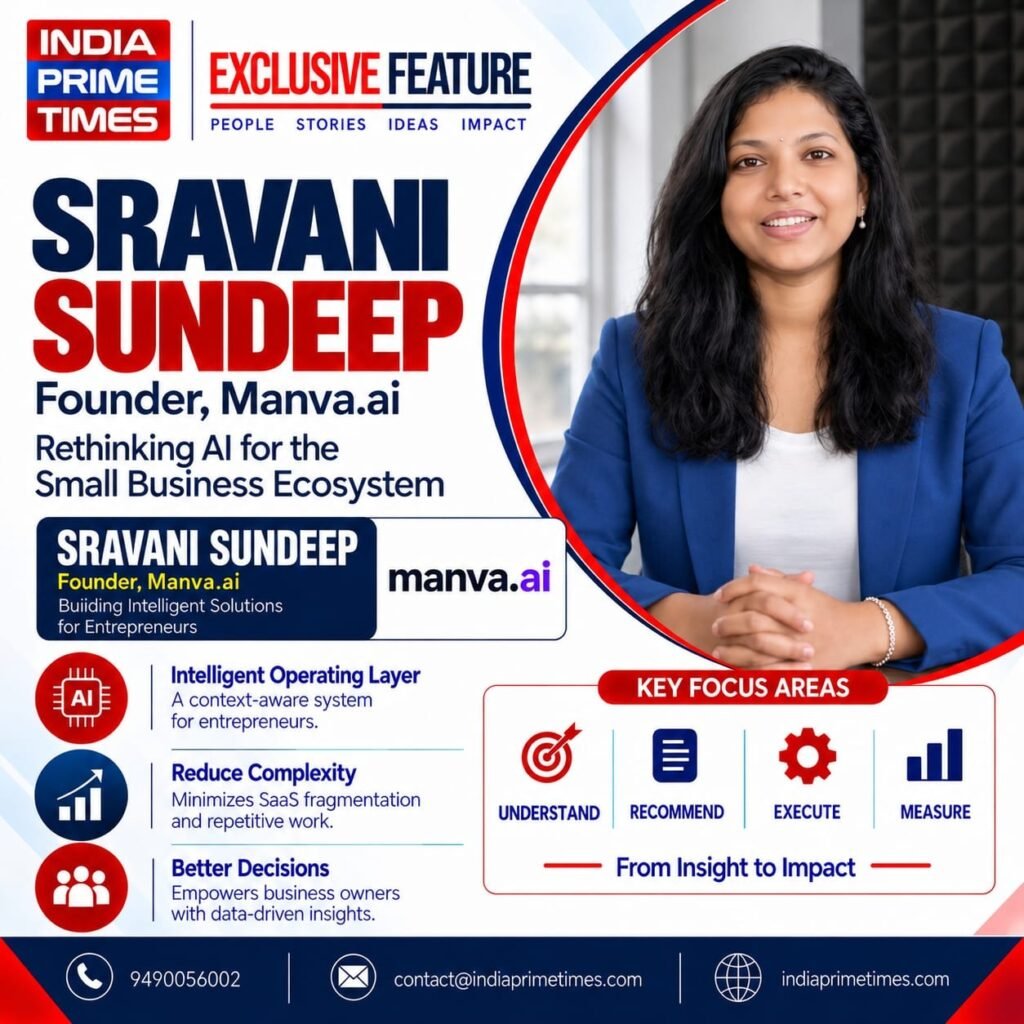
Artificial intelligence is fundamentally restructuring the global enterprise landscape at an unprecedented velocity. However, while multi-billion-dollar corporations deploy massive budgets to integrate AI into their supply chains and data centers, millions of small and growing businesses face a distinctly different reality. For a grassroots entrepreneur, running a business often means simultaneously operating as a chief marketer, sales director, customer support executive, and IT administrator. The promise of AI has historically added to this burden, introducing a fragmented maze of complex tools rather than simplifying daily operations.
To investigate how emerging technology is attempting to solve this critical operational bottleneck, the India Prime Times editorial team recently focused its coverage on the evolution of enterprise software. During our field reporting, we met with Sravani Sundeep, the visionary entrepreneur and Founder of Manva.ai. Over an extensive conversation, our team experienced her exceptional work firsthand, exploring how she is moving beyond standalone generative tools to build an intelligent, context-aware operating layer for the next generation of businesses.
Redefining the AI Mandate: Understanding Over Generation
The first generation of commercial artificial intelligence was almost exclusively focused on a single question: “What can AI create?” The market was flooded with applications designed to write blog posts, generate digital imagery, summarize meeting notes, and output raw code.
While impressive, these generative capabilities often failed to address the core operational needs of a small business. During our interaction, Sravani Sundeep highlighted a pivotal shift in this technological paradigm. The most critical question for an entrepreneur is no longer what AI can create, but rather, “What can AI understand and do for my business?”
A modern business owner does not necessarily need another detached application that generates marketing copy. They require a cohesive technology layer that inherently understands the unique context behind their specific operations, inventory, and customer base, ultimately helping them make highly informed, data-driven decisions. This operational philosophy forms the architectural foundation of Manva.ai.
Curing the SaaS Fragmentation Crisis
Today’s digital businesses operate across a chaotic web of isolated platforms. An entrepreneur might manage their website on one system, track inventory on another, handle customer communication through fragmented social media channels, and execute marketing campaigns on yet another dashboard. Large enterprises solve this fragmentation by deploying specialized, heavily staffed departments. Small businesses, however, lack that luxury, leaving the founder to act as the exhausted connective tissue between dozens of software applications.
Ms. Sundeep sees a massive opportunity to completely dismantle this dynamic. Instead of forcing entrepreneurs to constantly switch between a dozen different tools, Manva is engineered to act as an intelligent, connective layer that allows founders to interact with their business organically.
Through this operating layer, a merchant can simply ask their system, “How is my business doing today?” The AI can then process data across the entire technology stack to answer. The merchant can follow up with, “What needs my attention?” and subsequently, “What should I do about it?” By moving fluidly from raw information to actionable insight, the technology ceases to be a passive tool and becomes an active business partner.
The Closed-Loop Execution Engine
A defining feature of the Manva.ai framework is its departure from general-purpose chatbots. If a merchant asks how to promote a new collection, a standard chatbot provides generic internet advice. An intelligent business assistant, however, grounds its strategy in the merchant’s actual sales data and historical performance.
The next evolution of this intelligence is closing the operational loop. For Sravani Sundeep, true technological utility occurs when AI moves from mere recommendation to direct execution. The Manva ecosystem is built on a continuous, autonomous cycle: Understand → Recommend → Confirm → Execute → Measure.
In this workflow, the AI identifies a critical business gap and explains the reasoning to the owner. The owner reviews and approves the recommendation, allowing the system to automatically execute the complex backend actions required. Finally, the system measures the real-world outcome. The objective is not to make the AI appear conversational; the objective is to make the business measurably more effective.
Human Governance and Existing Ecosystems
While automation drives efficiency, blind execution creates immense operational risk. A system that unilaterally alters pricing, inventory, or customer communication without understanding nuanced real-world consequences can destroy a brand overnight.
Manva.ai mitigates this through a strict human-control philosophy. AI is utilized to identify opportunities, analyze data, and draft recommendations, but meaningful execution always requires explicit human approval. This architectural balance ensures that the AI handles the exhausting busywork while the entrepreneur retains absolute sovereign control over the business.
Furthermore, this operating layer is designed to integrate with a business’s existing technological ecosystem. Rather than forcing an established merchant to tear down their current ecommerce infrastructure and rebuild from scratch, the AI layer wraps around the systems they already depend on, injecting intelligence directly into their established workflows.
Measuring Outcomes, Not Features
As our conversation with Sravani Sundeep concluded, the future trajectory of business software became distinctly clear. The enterprise AI industry frequently falls into the trap of aggressively marketing new features-but business owners measure success differently. They want to know if a tool saved them time, recovered a lost opportunity, reduced repetitive administrative labor, or directly increased their sales volume.
The competitive advantage for the next generation of entrepreneurs will not come from hiring massive teams, but from how intelligently they combine human judgment with autonomous technology. AI acts as the ultimate equalizer, granting a single founder the operational capabilities of a massive corporate organization.
The ambition driving Manva.ai is not simply to launch another software product into a crowded market. It is a fundamental rethinking of how humans interact with commercial technology. The future of enterprise software will not be defined by the number of standalone tools a business owner can juggle, but by the deployment of an intelligent, unified operating layer that actively helps the business adapt, execute, and grow.