PUBLIC NOTICE & LEGAL WARNING: COPYRIGHT INFRINGEMENT AND RESTRAINT ON OTT / DIGITAL RELEASE OF TELUGU FEATURE FILM ‘CHENNAI LOVE STORY’
3 min read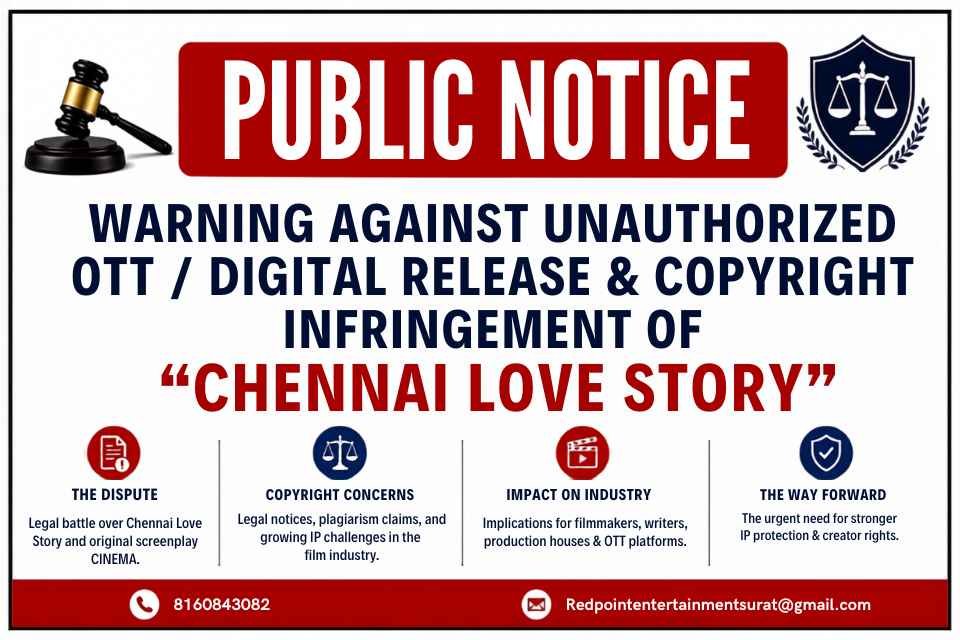
TO WHOMSOEVER IT MAY CONCERN / ALL OTT PLATFORMS, DIGITAL STREAMING SERVICES, SATELLITE BROADCASTERS, OVERSEAS DISTRIBUTORS & GENERAL PUBLIC
This is an official Public Notice and Press Release issued under the direct instructions of Mr. Anapana Lakshmi Narayan, Partner at M/S Redpoint Entertainment (Surat, Gujarat), hereafter referred to as the “Claimant.”
This notice pertains to the severe copyright infringement, misappropriation, and unauthorized adaptation of the Claimant’s registered original screenplay titled “CHINEMA / CINEMA” by the newly released Telugu feature film “CHENNAI LOVE STORY”.
Background of Intellectual Property Ownership Mr. Anapana Lakshmi Narayan is the sole original author, creator, and legal copyright owner of the screenplay “CHINEMA / CINEMA.” The script is duly vetted, registered, and protected under the Screenwriters Association (SWA), Mumbai, in strict accordance with the Copyright Act, 1957.
Allegations of Unlawful Misappropriation It has been brought to our legal notice that the Telugu feature film “CHENNAI LOVE STORY”-produced jointly by M/S Mass Movie Makers LLP (Partners: Dasari Maruti & Sreenivasa Kumar Gade) and M/S Amrutha Productions LLP (Partners: Sai Rajesh Neelam & Subhashini Vangipuram), and directed by Mr. Ravi Namburi-has unlawfully copied and adapted the core plot, creative spine, and narrative of the Claimant’s copyrighted work. This adaptation has been executed without any prior consent, licensing, or legal authorization from the original creator.
Active Legal Action & Police Complaint In response to this blatant violation of intellectual property rights, aggressive legal actions have been initiated:
- A formal Police Complaint was lodged at the Pandesara Police Station, Surat on 27/07/2026.
- A detailed Legal Cease & Desist Notice was officially issued and served upon all accused parties on 29/07/2026.
As of the date of this publication, the copyright and intellectual property dispute concerning the film “CHENNAI LOVE STORY” remains expressly CONTESTED and UNRESOLVED before the competent authorities and courts of law.
RESTRAINT ON UPCOMING OTT / DIGITAL RELEASE Notice is hereby given strictly restraining the streaming, releasing, broadcasting, or monetizing of the feature film “CHENNAI LOVE STORY” across all OTT Platforms and Broadcast Media.
This mandatory restraint explicitly includes, but is not limited to: NETFLIX, AMAZON PRIME VIDEO, DISNEY+ HOTSTAR, AHA, ZEE5, SONY LIV, YOUTUBE, and covers all SATELLITE/TELEVISION, OTT/DIGITAL, REMAKE, DUBBING, ADAPTATION, AND ALL OTHER ANCILLARY RIGHTS.
A copy of this Public Notice, along with relevant case and police complaint information, is being transmitted via corporate email to the respective official channels of these platforms purely for formal information, record, and compliance.
STRICT LEGAL WARNING TO ALL DISTRIBUTORS & OTT PLATFORMS
- NO THIRD-PARTY MONETIZATION: Any digital streaming service, distributor, or platform streaming or hosting “CHENNAI LOVE STORY” shall be treated as an active co-infringer under the Copyright Act, 1957.
- STAY / MANDATORY HOLD: All platforms must maintain the status quo and HOLD / SUSPEND any planned release, acquisition, or broadcasting until absolute legal clearance is obtained directly from the Claimant.
- LEGAL PROCEEDINGS: Any violation or action beyond this Public Notice will constrain the Claimant to implead such OTT platforms/broadcasters directly as Co-Defendants in the pending Suits. This will result in actions seeking severe civil damages, the immediate confiscation/blocking of media content, and subsequent criminal prosecution.
ISSUED BY & LEGAL COUNSEL DETAILS:
SAJAN V. SHUKLA, ADVOCATE
Address: 111, Devi Darshan Nagar, Bamroli Road, Pandesara, Surat – 394221, Gujarat
Mobile: +91 81608 43082
Email: advsajan4031@gmail.com
(Acting on behalf of Mr. Anapana Lakshmi Narayan, M/S Redpoint Entertainment)
Disclaimer: This article is a paid promotional and sponsored piece / Official Public Notice. The publication has no involvement in the creation, content, opinions, or views expressed in this article. The content has been entirely written and provided by the author/legal counsel and represents their own views, claims, and legal standing. The publication does not take any responsibility or liability for the content, statements, claims, or opinions expressed herein.