
12 Trending Cloud Platforms to Watch in 2026
8 min read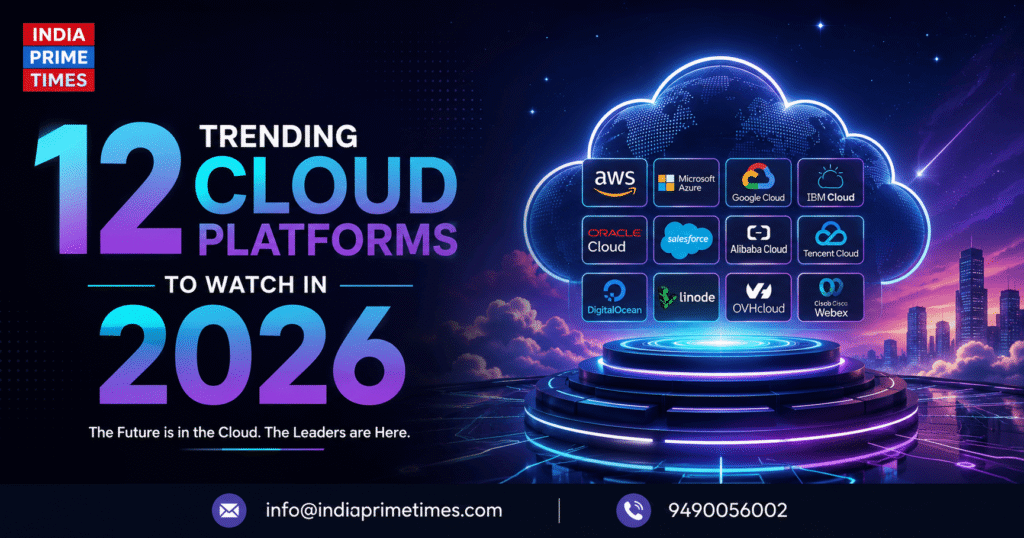
As the world moves deeper into 2026, cloud computing is no longer viewed as just an IT infrastructure service. It has evolved into the foundation of the global digital economy. Businesses across industries are now depending on advanced cloud platforms to power artificial intelligence, automation, cybersecurity, analytics, remote collaboration, and digital transformation strategies. The rapid rise of Generative AI, edge computing, sovereign cloud regulations, and intelligent automation has completely changed the way enterprises select cloud providers.
In 2026, global cloud spending is expected to cross the 500-billion-dollar mark for the first time in history. Organizations are shifting from traditional cloud migration strategies toward AI-native ecosystems where cloud platforms are capable of automatically optimizing operations, improving security, reducing costs, and enabling autonomous business workflows. Companies are no longer using the cloud only for storage or hosting applications. Modern cloud platforms are becoming intelligent operational engines capable of managing entire digital ecosystems.
Across sectors such as banking, healthcare, manufacturing, logistics, retail, government, and telecommunications, enterprises are competing to modernize their infrastructure and remain competitive in an increasingly AI-driven world. Businesses that fail to adopt scalable cloud technologies risk falling behind in innovation, customer experience, and operational efficiency.
Here are the 12 cloud platforms that are shaping the enterprise technology landscape in 2026 and why they are becoming critical for future business growth.
1. Amazon Web Services (AWS): The Global AI Infrastructure Leader
Amazon Web Services continues to dominate the global cloud market with an estimated market share of nearly 28 percent in 2026. AWS has strengthened its leadership position by heavily investing in AI infrastructure, custom silicon chips, and next-generation cloud automation technologies.
One of the major reasons AWS is trending this year is the rapid adoption of Amazon Bedrock 2.0, which enables enterprises to build secure and scalable large language model applications without depending entirely on third-party AI providers. AWS has also expanded the adoption of its Trainium and Inferential chips, which significantly reduce AI training and inference costs compared to traditional GPU-based infrastructure.
AWS is increasingly becoming the preferred platform for enterprises managing large-scale data operations in sectors such as manufacturing, automotive, energy, logistics, and media. The company’s focus on agentic orchestration allows businesses to deploy autonomous AI agents capable of handling multi-step operational processes with minimal human intervention.
Another major advantage of AWS is its extensive global data centre presence, offering low latency, high availability, and strong disaster recovery capabilities. Organizations looking for scalability, flexibility, and advanced AI capabilities continue to prioritize AWS as their primary cloud partner.
2. Microsoft Azure: The Enterprise AI Integration Giant
Microsoft Azure has emerged as one of the strongest enterprise cloud ecosystems due to its deep integration with Microsoft 365, OpenAI technologies, enterprise collaboration tools, and hybrid cloud services. Azure now holds an estimated 21 percent share of the global cloud market.
Azure’s biggest strength in 2026 lies in its ability to seamlessly integrate AI into everyday business operations. Microsoft Copilot technologies are now deeply embedded across enterprise applications, enabling businesses to automate workflows, generate insights, improve productivity, and streamline communication.
The introduction of Microsoft’s Maia AI chips has significantly improved the efficiency and affordability of Azure AI services. Enterprises in banking, healthcare, insurance, education, and government sectors are rapidly adopting Azure because of its strong security framework, compliance capabilities, and enterprise-grade identity management.
Azure is also gaining popularity for hybrid cloud deployments, allowing organizations to operate applications across on-premise infrastructure and cloud environments without disruption. Companies heavily invested in Windows ecosystems continue to find Azure the most practical and cost-effective cloud platform for digital transformation.
3. Google Cloud Platform (GCP): The Data and Analytics Powerhouse
Google Cloud Platform has positioned itself as the leading cloud platform for data analytics, artificial intelligence, and machine learning workloads. GCP continues to expand rapidly due to its strong expertise in large-scale data processing and open-source AI technologies.
The company’s Vertex AI ecosystem and advanced Tensor Processing Units have become highly attractive for enterprises building sophisticated AI applications. Google’s Gemini-powered AI security solutions are also helping organizations identify and mitigate cyber threats in real time.
Retail, media, e-commerce, and digital entertainment companies are increasingly adopting GCP for its advanced analytics capabilities, AI-driven customer personalization, and efficient cloud-native development environment. Google’s strong support for Kubernetes, containerization, and multi-cloud deployments has further strengthened its position in the enterprise market.
Another key advantage of GCP is its sustainability focus. Google continues to invest heavily in carbon-neutral infrastructure and renewable energy initiatives, making it attractive for enterprises prioritizing environmental goals and ESG compliance.
4. Oracle Cloud Infrastructure (OCI): The High-Performance Enterprise Challenger
Oracle Cloud Infrastructure has experienced substantial growth in 2026 as enterprises seek high-performance computing environments and better database optimization capabilities. OCI is increasingly becoming popular among organizations running large enterprise applications and AI-driven workloads.
Oracle’s aggressive expansion of sovereign cloud infrastructure has positioned the company strongly in regions with strict data residency and regulatory compliance requirements. Businesses operating in India, Europe, and the Middle East are turning to Oracle to meet local compliance obligations while maintaining cloud agility.
OCI’s distributed cloud model enables organizations to deploy Oracle services directly inside their own data centres while maintaining the same functionality as public cloud environments. This flexibility is particularly attractive for industries such as finance, defense, healthcare, and telecommunications.
Oracle’s strong database performance, low-latency architecture, and enterprise application integration continue to make it one of the fastest-growing enterprise cloud providers globally.
5. IBM Cloud: The Leader in Responsible and Secure AI
IBM Cloud has carved out a strong niche in regulated industries by focusing heavily on responsible AI, hybrid cloud deployments, and enterprise security. The company’s Watson AI platform is now widely recognized for AI governance, explainability, and ethical AI implementation.
Government agencies, defense organizations, healthcare providers, and financial institutions are increasingly relying on IBM Cloud because of its strong compliance frameworks and advanced cybersecurity capabilities. IBM has also invested heavily in quantum-safe cryptography to prepare enterprises for future cybersecurity threats associated with quantum computing.
The company’s hybrid cloud strategy allows enterprises to modernize legacy infrastructure while maintaining strict control over sensitive data and mission-critical applications. IBM’s long-standing relationships with large enterprises continue to provide it with a strong position in highly regulated sectors.
6. Alibaba Cloud: Expanding Across Asia-Pacific
Alibaba Cloud remains one of the most influential cloud providers in the Asia-Pacific region. The platform continues to dominate markets such as China, Southeast Asia, and parts of the Middle East due to its strong e-commerce, logistics, and AI integration capabilities.
Alibaba Cloud has become especially attractive for businesses expanding into Asian markets because of its deep regional infrastructure and localized cloud services. The company’s AI-driven retail platforms and intelligent supply chain solutions are helping businesses optimize operations and improve customer engagement.
Its open-source AI ecosystem, ModelScope, has gained significant popularity among developers and startups looking to build localized AI applications for Asian markets. Alibaba’s continued investment in smart cities, digital commerce, and industrial AI is expected to drive further growth in the coming years.
7. DigitalOcean: The Startup-Friendly AI Cloud
DigitalOcean has successfully transformed itself from a simple developer-focused hosting provider into a modern AI-native cloud platform for startups and small businesses. The company has seen significant growth due to its simplified cloud infrastructure and transparent pricing model.
Startups, SaaS companies, and independent developers are increasingly choosing DigitalOcean because it provides affordable access to GPU infrastructure without the complexity associated with larger cloud providers. The platform’s managed AI agents and simplified deployment environment allow businesses to launch AI applications faster and with lower operational overhead.
DigitalOcean’s focus on usability, developer experience, and predictable pricing has made it one of the most attractive cloud platforms for emerging digital businesses and AI startups.
8. Cloudflare: Driving the Future of Edge Computing
Cloudflare has evolved beyond its traditional role as a content delivery network and now positions itself as a complete connectivity and edge computing cloud platform. Its Workers AI infrastructure allows developers to run AI inference directly at the network edge, reducing latency and improving performance.
The rise of IoT devices, smart manufacturing systems, connected vehicles, and real-time gaming platforms has significantly increased demand for edge computing solutions. Cloudflare’s Zero Trust architecture and AI-powered network security capabilities are helping enterprises secure distributed digital environments more effectively.
Businesses requiring ultra-fast application performance and real-time data processing are increasingly turning to Cloudflare for scalable edge computing solutions.
9. Salesforce Cloud: Transforming Customer Intelligence
Salesforce continues to strengthen its position as the global leader in customer relationship management and AI-powered business automation. Its Data Cloud platform enables organizations to unify customer data from multiple sources into a single intelligent ecosystem.
The company’s Einstein GPT capabilities are helping businesses automate customer engagement, sales forecasting, service operations, and marketing personalization. Salesforce is increasingly becoming the backbone of AI-driven customer experience strategies across industries.
Organizations seeking to improve customer retention, sales efficiency, and business intelligence are heavily investing in Salesforce cloud technologies to gain competitive advantages in rapidly evolving markets.
10. SAP Business Technology Platform (BTP): Modernizing Enterprise Operations
SAP BTP has become a critical platform for enterprises modernizing ERP systems and digitizing complex business operations. Companies running SAP environments are increasingly using BTP to integrate AI, analytics, automation, and cloud-native development into their operations.
SAP’s Joule AI assistant helps enterprises simplify finance, procurement, supply chain, and HR operations through natural language interactions and intelligent automation. Businesses are also leveraging SAP BTP to implement clean core strategies that improve system flexibility while reducing technical debt.
Manufacturing, retail, logistics, and industrial enterprises continue to depend on SAP for mission-critical operations, making BTP a key enabler of enterprise digital transformation.
11. VMware Cloud: The Hybrid Infrastructure Specialist
Following Broadcom’s acquisition of VMware, the company has intensified its focus on hybrid cloud infrastructure and private cloud management. VMware remains one of the most trusted platforms for enterprises that require consistent operations across public cloud, private cloud, and on-premise environments.
VMware Cloud Foundation 6.0 simplifies multi-cloud management and enables organizations to modernize applications without completely abandoning existing infrastructure investments. Enterprises with complex IT environments continue to rely on VMware for workload portability, virtualization, and infrastructure consistency.
The platform is particularly valuable for industries with strict regulatory requirements and organizations transitioning gradually toward cloud-native architectures.
12. Emerging AI-Native Cloud Ecosystems: CoreWeave and SiliconFlow
One of the biggest developments in 2026 is the rise of specialist AI-native cloud providers such as CoreWeave and SiliconFlow. These companies focus entirely on delivering high-performance GPU infrastructure optimized for AI model training and inference workloads.
As demand for advanced GPUs such as NVIDIA H100 and Blackwell accelerators continues to grow, many AI startups and research organizations are seeking alternatives to traditional hyperscale cloud providers. Specialist AI clouds provide cost-efficient access to large-scale GPU clusters without long-term infrastructure commitments.
Inference-as-a-Service models are also becoming increasingly popular because businesses only pay for the AI tokens or workloads they actually consume. This flexible pricing approach is attracting AI startups, research labs, and enterprises building next-generation AI applications.
Conclusion
The future of cloud computing is increasingly centered around autonomous AI operations, intelligent infrastructure optimization, cybersecurity automation, and sovereign cloud ecosystems. Businesses are moving away from static infrastructure management toward intelligent cloud environments capable of self-monitoring, self-healing, and self-optimizing operations.
FinOps 2.0 is also emerging as a major trend where AI agents automatically optimize cloud spending, allocate workloads efficiently, and reduce infrastructure waste. At the same time, governments around the world are introducing stricter data sovereignty regulations, driving demand for localized and compliant cloud environments.
For India’s rapidly growing technology sector, these cloud platforms are expected to become the foundation for the next generation of startups, unicorns, digital enterprises, and AI-driven innovation ecosystems. Organizations that successfully embrace intelligent cloud technologies will be better positioned to compete in the global digital economy over the next decade.
For updates, publishing opportunities, or business inquiries, contact India Prime Times.
Phone: +91 9490056002
Email: info@indiaprimetimes.com
WhatsApp : https //wa.me/919490056002