
A Paradigm Shift in Personal Computing: Nvidia Disrupts the PC Market with the RTX Spark Superchip
4 min read
The battle for computing supremacy has officially spilled out of the data center and onto the desktop. For nearly four decades, the personal computer landscape has been dominated by the x86 architecture championed by Intel and Advanced Micro Devices (AMD). However, that long-standing duopoly is now facing its most formidable challenge yet.
At the Computex 2026 conference in Taipei, Nvidia CEO Jensen Huang unveiled a groundbreaking new processor: the RTX Spark superchip. Designed in collaboration with Microsoft, this Arm-based chip marks Nvidia’s aggressive push into the consumer PC market, signaling a radical shift in how laptops and desktops will handle artificial intelligence.
“This reinvention of the computer is as big of a deal as the reinvention of the phone into what we now know as the smartphone,” Huang declared during his keynote address, predicting a future where agentic AI runs seamlessly across all new devices.
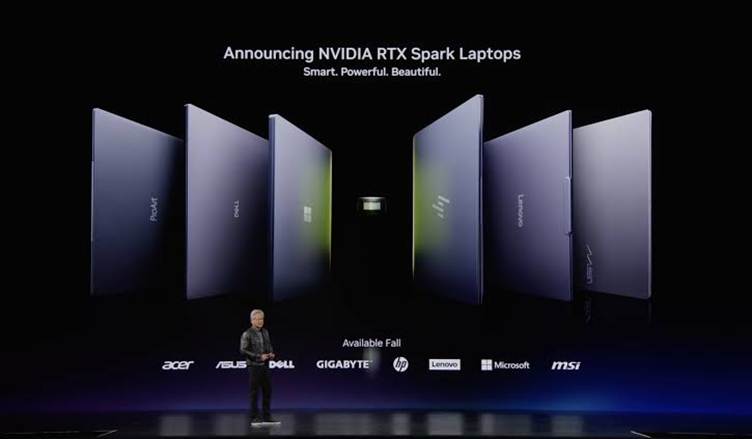
Nvidia CEO Jensen Huang unveils RTX Spark laptops at Computex 2026.. Source: PCMag
The Architecture: What Makes the RTX Spark a “Superchip”?
The RTX Spark (also referred to internally as the N1X) is not just another processor; it is a system-on-a-chip (SoC) that fuses different processing powers into a single, highly efficient unit. Here is a breakdown of the hardware:
- The Fusion: The superchip pairs one of Nvidia’s powerful Blackwell Graphics Processing Units (GPUs) with a newly designed, Arm-based custom Grace Central Processing Unit (CPU).
- Unified Memory: Taking a page out of Apple’s MacBook Pro playbook, the RTX Spark features 128 gigabytes of unified memory. This massive pool of shared memory allows both the CPU and GPU to access data simultaneously, which is crucial for running large AI models locally without lag.
- Manufacturing: The chip is being manufactured using Taiwan Semiconductor Manufacturing Co.’s (TSMC) cutting-edge 3-nanometer technology.
- The MediaTek Partnership: Nvidia designed the graphics and AI hardware, but utilized Taiwanese firm MediaTek’s platform integration of Arm Cortex CPU cores to bring the SoC to life.
According to Nvidia, the performance of the RTX Spark is currently “roughly equivalent” to its leading RTX 5070 laptop GPU.
Why This Matters: The AI Bottleneck
The catalyst for this architectural shift is the explosive growth of artificial intelligence. While GPUs are excellent for the parallel math required to train large AI models, the process of accessing that data and pushing it out to multiple AI agents requires the general compute power offered by a CPU.
Earlier this year, Nvidia noted that traditional CPUs were “becoming the bottleneck” amid surging AI workflows. The RTX Spark is designed specifically to eliminate this bottleneck, providing the horsepower necessary to run a 120-billion-parameter open-source model directly on a laptop, without relying constantly on cloud servers.
Breaking the x86 Monopoly and the Revival of Windows on Arm
The introduction of the RTX Spark is a massive win for the “Windows on Arm” ecosystem. For years, Apple has demonstrated the power and efficiency of Arm-based processors with its custom M-series chips. Now, Nvidia is bringing that same level of integrated power to Windows machines.
The RTX Spark will debut this fall in a fresh line of ultra-thin Windows PCs (some as thin as 14 millimeters) from major manufacturers including Microsoft, Dell, HP, ASUS, Lenovo, and MSI. Nvidia plans to release over 30 laptop models and 10 desktop models featuring the new chip over time.
Furthermore, this move promises to fix a historical weak point for Windows on Arm: gaming. Nvidia announced that Microsoft will resolve kernel-level anti-cheat technology compatibility on Arm. Consequently, major game developers like Riot Games (Valorant) and Krafton (PUBG) will bring their libraries to Arm with native support. The RTX Spark laptops will also feature Nvidia’s DLSS 4.5 technology, ensuring high-end gaming performance.
The Vera CPU Enters Full Production
While the RTX Spark grabbed the headlines for consumer tech, Huang also made a significant announcement regarding data center hardware. Nvidia’s Vera CPU, designed specifically for data centers, is now in full production.
“This is going to be our new major growth driver,” Huang stated. The Vera CPUs are designed to be extremely energy-efficient, ensuring that data centers can maximize processing power without compromising energy allocation for AI token generation. Early adopters of the Vera CPU include AI heavyweights like OpenAI, Anthropic, SpaceX’s xAI, Dell, Oracle, and CoreWeave.
The Market Shakeup
Nvidia’s entry into the PC processor market turns what was primarily a two-horse race between Intel and AMD into a highly competitive four-way battle, with Qualcomm also vying for dominance in the Windows on Arm space.
While the top-tier RTX Spark laptops with 128GB of memory are expected to carry a premium price tag (potentially upwards of $3,000), rumors suggest Nvidia will release lower-tier versions to make the technology accessible to mainstream consumers.
Ultimately, this development forces the entire industry to adapt. Apple faces renewed competition for the creative and developer class; Intel and AMD must innovate rapidly to defend their x86 legacy; and consumers can look forward to a new generation of PCs that are significantly more powerful, efficient, and intelligent.
Contact India Prime Times For any updates, queries, or to publish a news article, please reach out to us:
- Phone: +91 9490056002
- Email: info@indiaprimetimes.com
- WhatsApp: https://wa.me/919490056002