The Evolution of Primary Care: How Dr. Rajatha Maradi Hemanth Kumar is Merging Traditional Medicine, Advanced Aesthetics, and Clinical Research at Elova Hospital
4 min read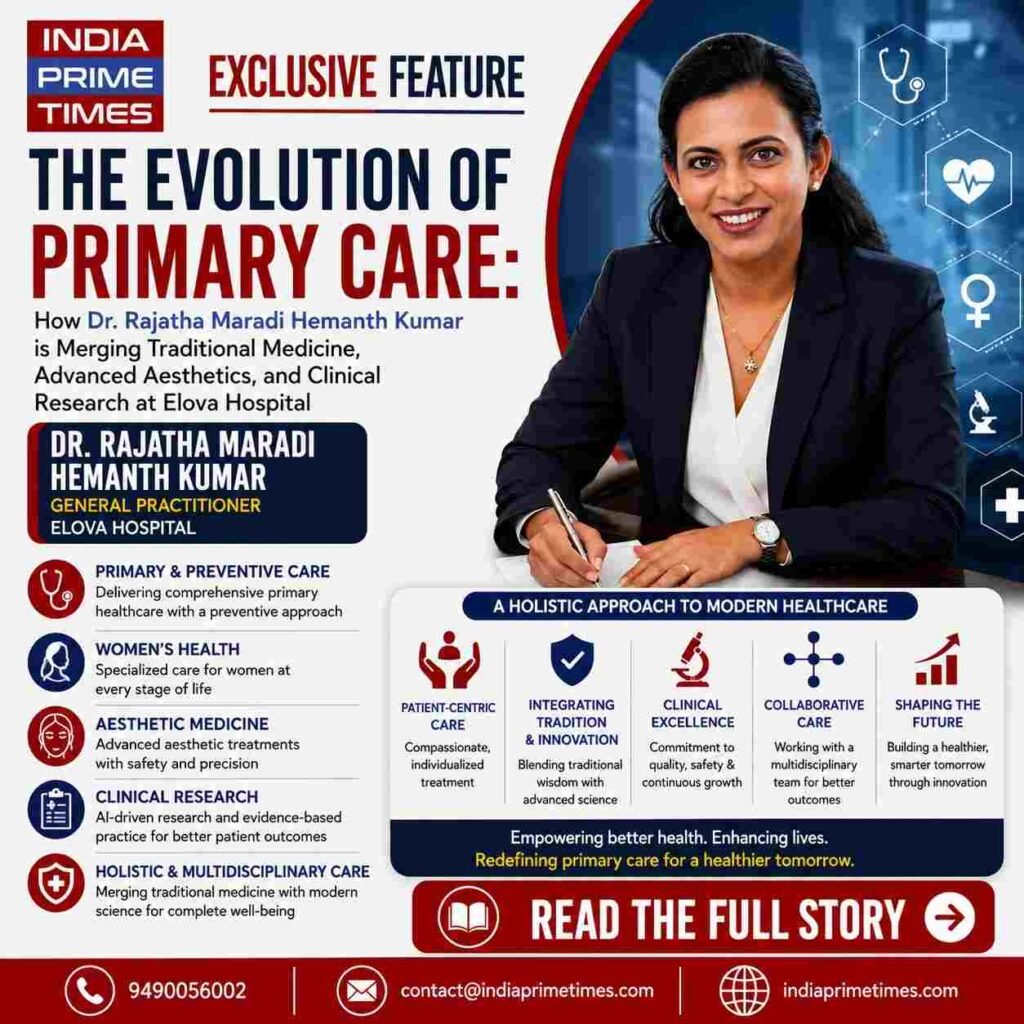
The landscape of primary healthcare in India is undergoing a profound transformation. Historically, the neighborhood general practitioner was viewed solely as the first line of defense against seasonal fevers and minor ailments. However, the modern Indian patient’s expectations have evolved dramatically. Today, patients seek a holistic healthcare ecosystem-one that seamlessly integrates traditional medical diagnosis with lifestyle management, preventive oncology, and advanced aesthetic procedures.
To understand this dynamic shift in urban healthcare delivery, the India Prime Times editorial team recently focused its coverage on the evolving medical corridors of Bengaluru. Our objective was to observe how forward-thinking physicians are bridging the gap between foundational community health and highly specialized contemporary treatments.
During our on-ground reporting, our team visited Elova Hospital, a facility that perfectly encapsulates this new era of multidisciplinary medicine. While observing the clinic’s daily operations, we noted a remarkably diverse patient demographic. In one consultation room, elderly patients were receiving comprehensive geriatric care; in another, young professionals were consulting on advanced dermatological and aesthetic procedures.
At the center of this bustling, highly efficient medical ecosystem is Dr. Rajatha Maradi Hemanth Kumar. With over six years of rigorous clinical experience, she serves as a General Practitioner at Elova Hospital. Intrigued by her ability to effortlessly pivot between treating acute infectious diseases and performing precision aesthetic therapies, our editorial desk sat down with Dr. Rajatha for a comprehensive conversation about the future of modern medicine.
A Foundation Built on Frontline Resilience
During our interaction, it became evident that Dr. Rajatha’s versatile medical canvas is rooted in intense frontline experience. She earned her MBBS from the Vydehi Institute of Medical Sciences and Research Centre in Bangalore in 2018. However, it was the unprecedented crucible of the global pandemic that truly forged her clinical and logistical resilience.
Serving as a Covid Medical Officer at the BBMP’s Adugodi Urban Primary Health Centre, Dr. Rajatha was at the absolute epicenter of Bengaluru’s pandemic response. Our team was astounded to learn the sheer scale of her public health contribution: she successfully administered and oversaw the vaccination of over 130,000 individuals while organizing critical community health campaigns.
“Public health crises teach you that medicine is not just about writing a prescription; it is about community mobilization, analytical problem-solving, and sheer endurance,” Dr. Rajatha explained to the India Prime Times team.
This deep commitment to community welfare extends to her earlier tenure at the Karuna Trust, where she played a pivotal role in the Non-Communicable Disease (NCD) Program. There, she focused on diabetes, hypertension, and cancer screening. Showcasing her analytical acumen, she even supported software development for NCD research, proving that her approach to medicine is as data-driven as it is empathetic.
The Convergence of Women’s Health and Aesthetic Medicine
What makes Dr. Rajatha’s profile highly newsworthy is her refusal to be siloed into a single medical category. Recognizing that modern patients desire comprehensive well-being, she expanded her horizons by pursuing specialized fellowships in Aesthetic Medicine (ILAMED) and Obstetrics & Gynecology (Medvarsity).
At Elova Hospital, this dual expertise allows her to offer an incredibly broad spectrum of care. She is equally adept at conducting crucial cervical cancer screenings and providing nuanced antenatal and postnatal care, as she is performing high-end aesthetic procedures like Botox, dermal fillers, laser therapy, microblading, and advanced scar reduction.
“There is a lingering misconception that aesthetic medicine is purely superficial,” she noted during our conversation. “In reality, how a patient feels about their appearance is deeply tied to their mental health and self-esteem. By offering these procedures in a clinical, highly regulated hospital environment rather than a commercial salon, we ensure absolute medical safety and anatomical precision.”
Pioneering AI and Clinical Oncology Research
Beyond her daily clinical practice, our team discovered that Dr. Rajatha is quietly pushing the boundaries of medical science. Her analytical problem-solving skills have recently propelled her into the cutting-edge realm of clinical research. Operating out of Elova Hospital, she has been actively involved in developing sophisticated AI-driven frameworks, including maternal-fetal oncology intelligence, which utilizes digital twin ecosystems to predict cancer progression and optimize treatment during pregnancy without compromising fetal safety.
This rare ability to balance heavy, data-driven oncology research with the daily demands of general practice and aesthetic medicine highlights a physician operating at the absolute peak of her intellectual capacity.
A Blueprint for the Modern Physician
As our time with Dr. Rajatha Maradi Hemanth Kumar concluded, the broader implications for India’s healthcare sector came into sharp focus. The modern physician can no longer afford to be one-dimensional. Patients today require doctors who can treat communicable diseases like dengue and typhoid with efficiency, advocate for mental health and psychiatric counseling with deep empathy, and execute aesthetic enhancements with artistic precision.
For industry analysts and medical professionals observing the evolution of clinical practice, Elova Hospital serves as a definitive case study. By masterfully bridging the traditions of grassroots community health with the innovations of aesthetic medicine and AI research, Dr. Rajatha is not just treating patients-she is actively redefining what it means to be a holistic healer in the 21st century