
“Did Not Target Nuke Facility”: Former CDS Anil Chauhan Explains How an Indian Drone Inadvertently Hit Pakistan’s Kirana Hills
3 min read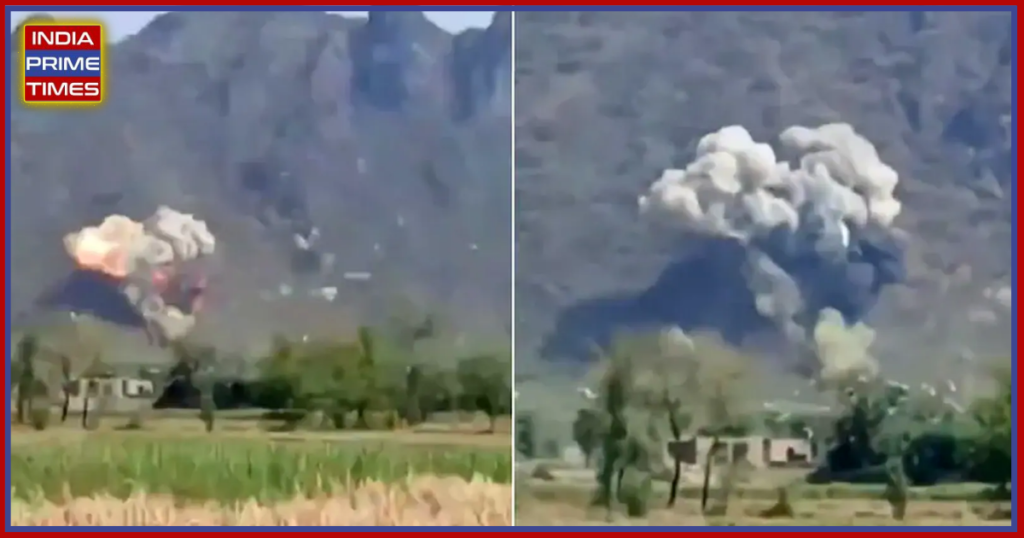
Ending months of intense speculation and social media rumors, former Chief of Defence Staff (CDS) General Anil Chauhan (retired) has clarified the mysterious explosion at Pakistan’s Kirana Hills-a known nuclear storage facility-during last year’s high-stakes “Operation Sindoor.”
Speaking at the Vimarsh event hosted by the Vivekananda International Foundation in New Delhi on Tuesday, General Chauhan confirmed that while an Indian loitering munition (suicide drone) did indeed strike the Kirana Hills region, it was entirely unintentional and not a deliberate attack on Pakistan’s nuclear assets.
The Mystery of the Kirana Hills Explosion
In May 2025, India launched Operation Sindoor, a massive, tri-service military counter-offensive targeting nine terrorist infrastructure sites across Pakistan and Pakistan-Occupied Kashmir (PoK). The operation, which killed over 100 terrorists, was launched in direct retaliation for the devastating April 22 terror attack in Pahalgam, Jammu and Kashmir, which claimed 26 lives.
During the intense air campaign on May 10, Indian forces struck the Mushaf Airbase in Sargodha. Shortly after, Pakistani media and social media were flooded with images showing thick smoke billowing from the nearby Kirana Hills-a vast, rocky mountain range stretching between Rabwah and Sargodha, widely known to house underground Pakistani nuclear storage facilities.
The images sparked global alarm, with rumors spreading that India had deliberately targeted a nuclear site.
At the time, Air Marshal A.K. Bharti (then Director General of Air Operations) vehemently denied the rumors, stating, “We have not hit Kirana Hills, whatever is there.”
The Truth Revealed: A Drone Out of Fuel
Backing Air Marshal Bharti’s 2025 statement, General Chauhan has now provided the exact technical explanation for the explosion.
According to the former CDS, prior to the main airstrikes on Sargodha, the Indian Air Force (IAF) had launched swarms of loitering munitions-highly likely to be Israeli-designed Harop “suicide” drones-into Pakistani airspace to hunt down and destroy enemy radar systems.
“Before those strikes, we had sent a lot of loiter ammunition at Sargodha, and Kirana Hills is about 10 km north of Sargodha,” General Chauhan explained. “So the loiter ammunition was looking for radars in and around Sargodha. It has a lifetime; it will loiter for about two hours, and if it doesn’t find a target, it will come and hit somewhere.”
He concluded, “It must have come and hit one of those hills. That could be one of the reasons why Pakistani media showed images with smoke coming out from Kirana Hills. Bharti had rightly clarified that we did not target Kirana Hills.”
The Scrubbed Strike on Skardu
Providing further unprecedented insights into the tactical decisions made during Operation Sindoor, General Chauhan revealed that the IAF was fully cleared to launch an attack on Skardu, deep within PoK.
“The Chief had asked me whether he should strike Sargodha. I said, ‘Go ahead,’ and added, ‘Please identify two more targets.’ One of the targets he had identified was Skardu,” General Chauhan disclosed.
The military top brass greenlit the Skardu mission; however, the operation was ultimately scrubbed at the last minute due to severe bad weather over the region. The IAF was forced to pivot, changing their secondary target to the Bholari airbase instead.
The resulting assault on the Bholari hangar-executed by the IAF’s Gandhinagar-based South Western Air Command-became one of the most defining moments of the campaign. Satellite imagery later revealed a precise, jagged breach torn through the roof of the hangar, demonstrating the pinpoint accuracy of the Indian strike.
The Aftermath
The intense military conflict eventually de-escalated when the Pakistani military reached out to their Indian counterparts on May 10, resulting in a ceasefire understanding.
However, General Chauhan cryptically noted during his address that while the major, overt kinetic phases of Operation Sindoor have concluded, the broader strategic operation against terror infrastructure remains “still ongoing.”
Get in Touch with India Prime Times
For any updates, queries, or to publish a news article, please reach out to our editorial desk:
- Contact Number: +91 9490056002
- Email ID: info@indiaprimetimes.com
- WhatsApp Us: https://wa.me/919490056002