Bridging India’s Digital Health Divide: How P R Vishnu is Architecting Interoperable, ABHA-Compliant Platforms for Modern Healthcare
4 min read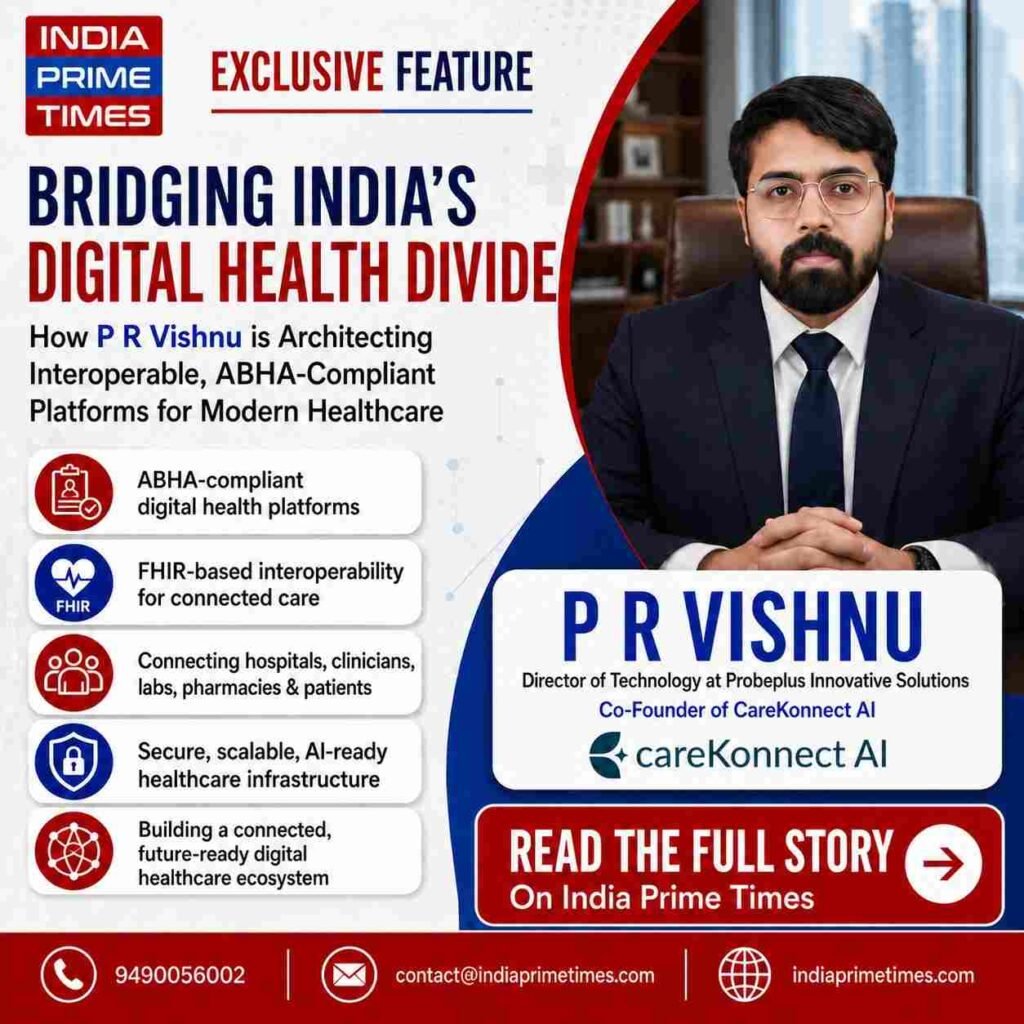
The Indian healthcare ecosystem is on the cusp of an unprecedented technological paradigm shift. Driven by the ambitious mandate of the Ayushman Bharat Digital Mission (ABDM), the country is actively building a unified, national digital health superhighway. Yet, despite widespread institutional willingness, the path toward a fully integrated healthcare network faces an entrenched structural hurdle: chronic data fragmentation.
For decades, patient medical histories in India have remained trapped within disconnected silos. Isolated Hospital Management Systems (HMS), disparate electronic health record (EHR) formats, offline diagnostic labs, and physical prescriptions create severe blind spots for clinicians and administrative bottlenecks for healthcare providers.
However, a new generation of enterprise architects and HealthTech product leaders is aggressively resolving these friction points by engineering unified, interoperable digital health pipelines. To understand how India’s digital health infrastructure is being operationalized on the ground, the India Prime Times editorial team recently traveled across Bengaluru’s technology corridors.
During our field reporting, our team observed live architectural demonstrations of next-generation digital healthcare pipelines designed to bridge legacy hospital systems with national registries. The elegance, speed, and strict regulatory compliance of the system immediately drew our attention. Intrigued by this operational precision, the India Prime Times team met and experienced the exceptional work of P R Vishnu, and had a comprehensive conversation with him regarding the future of connected healthcare.
As the Director of Technology at Probeplus Innovative Solutions and Co-Founder of Carekonnect AI, Vishnu provided our team with deep insights into the engineering complexities of national health data standards, the implementation of ABHA compliance, and the critical necessity of building scalable, interoperable healthcare architectures.
Tackling the Interoperability Challenge: Achieving ABHA M1, M2, and M3 Standards
During our discussion, the central challenge confronting modern HealthTech deployment became immediately apparent. In healthcare technology, creating a functional user interface is relatively straightforward; the true engineering challenge lies in secure, standards-compliant interoperability across disparate enterprise systems.
Under the ABDM framework, digital health platforms must navigate stringent compliance protocols to ensure privacy, patient consent, and seamless data exchange. Vishnu has spearheaded the development of digital platforms focused on achieving the mandatory ABHA M1, M2, and M3 certification milestones:
- Milestone 1 (M1): Creation and seamless verification of Ayushman Bharat Health Account (ABHA) numbers and digital health IDs for citizens.
- Milestone 2 (M2): Integration as a Health Information Provider (HIP), enabling healthcare facilities to securely link and share standardized medical records upon patient consent.
- Milestone 3 (M3): Functionality as a Health Information User (HIU), allowing registered doctors and medical facilities to view consolidated patient medical histories across providers.
“In healthcare technology, compliance cannot be an afterthought; it must be the foundational architecture,” Vishnu explained to the India Prime Times team. “Navigating the ABDM certification matrix requires building systems that strictly respect patient consent managers, data security protocols, and international messaging standards like FHIR (Fast Healthcare Interoperability Resources). By creating modular middleware, we enable hospitals, diagnostic centers, and clinics to become ABDM-compliant without dismantling their existing legacy infrastructures.”
Engineering Rigor Meets Strategic Execution
What makes Vishnu’s trajectory particularly newsworthy is his rare ability to bridge deep software engineering with enterprise-grade project governance. A Computer Science graduate from AMC Engineering College, Bengaluru, with an MBA in IT & Systems Management from NMIMS, Mumbai, Vishnu established an early benchmark by earning the globally recognized Project Management Professional (PMP®) certification at a remarkably young age.
Drawing from his technical foundations spanning full-stack frameworks-including Angular, React, Flutter, Android/AOSP, Java, and GIS-and past technical leadership tenures at global IT giants like Tata Consultancy Services (TCS), Vishnu approaches health technology with a disciplined systems philosophy.
“Technology must serve as a genuine catalyst for operational transformation rather than merely an expensive tool for basic automation,” Vishnu emphasized during our interview. “When an emergency room doctor can access a patient’s longitudinal medical history in seconds, that is not just workflow optimization-that is life-saving clinical enablement.”
At Probeplus Innovative Solutions Pvt Ltd, Vishnu directs end-to-end product definition, technology strategy, and enterprise system architecture. He expertly guides multidisciplinary teams across frontend, backend, mobile, DevOps, and QA, ensuring flawless delivery governance and scalable modernizations.
Building AI-Ready and Future-Proof Healthcare Infrastructure
Simultaneously, through Carekonnect AI, Vishnu has channeled this expertise into unifying hospitals, independent clinicians, pathology laboratories, pharmacies, and patients into a single, cohesive, and intelligent digital framework. Beyond basic digitization and compliance, our team’s discussion delved into the next frontier of medical informatics: AI-ready data architectures.
A major barrier preventing healthcare providers from deploying Artificial Intelligence effectively has been unstructured, fragmented data. By standardizing medical records via FHIR protocols and structuring digital health identities at the source, platforms engineered under Vishnu’s leadership are actively laying the groundwork for predictive analytics, clinical decision-support systems, and automated triage.
This approach ensures that as machine learning tools mature, healthcare institutions will possess clean, structured, and ethically governed data pools capable of driving precision medicine without compromising patient privacy.
The Road Ahead for Digital Healthcare
As our conversation with P R Vishnu concluded, the overarching trajectory of India’s healthcare modernization became unmistakably clear. The successful realization of universal digital healthcare will not be driven by siloed applications or proprietary walled gardens. Instead, the future belongs to open, interoperable, and regulatory-compliant digital ecosystems that prioritize patient outcomes and clinical efficiency.
For hospital boards, HealthTech enterprises, and policy observers tracking the digital health revolution, the architectural models developed by innovators like P R Vishnu offer a clear, definitive blueprint. By combining rigorous engineering discipline, certified project management standards, and deep alignment with national health missions, India’s tech leaders are not just building software-they are constructing the resilient, intelligent backbone of modern, connected healthcare.