Bridging the Gap Between Medicine and Management: How Dr Manesh Agarwal is Architecting India’s AI-Powered Healthcare Ecosystem
5 min read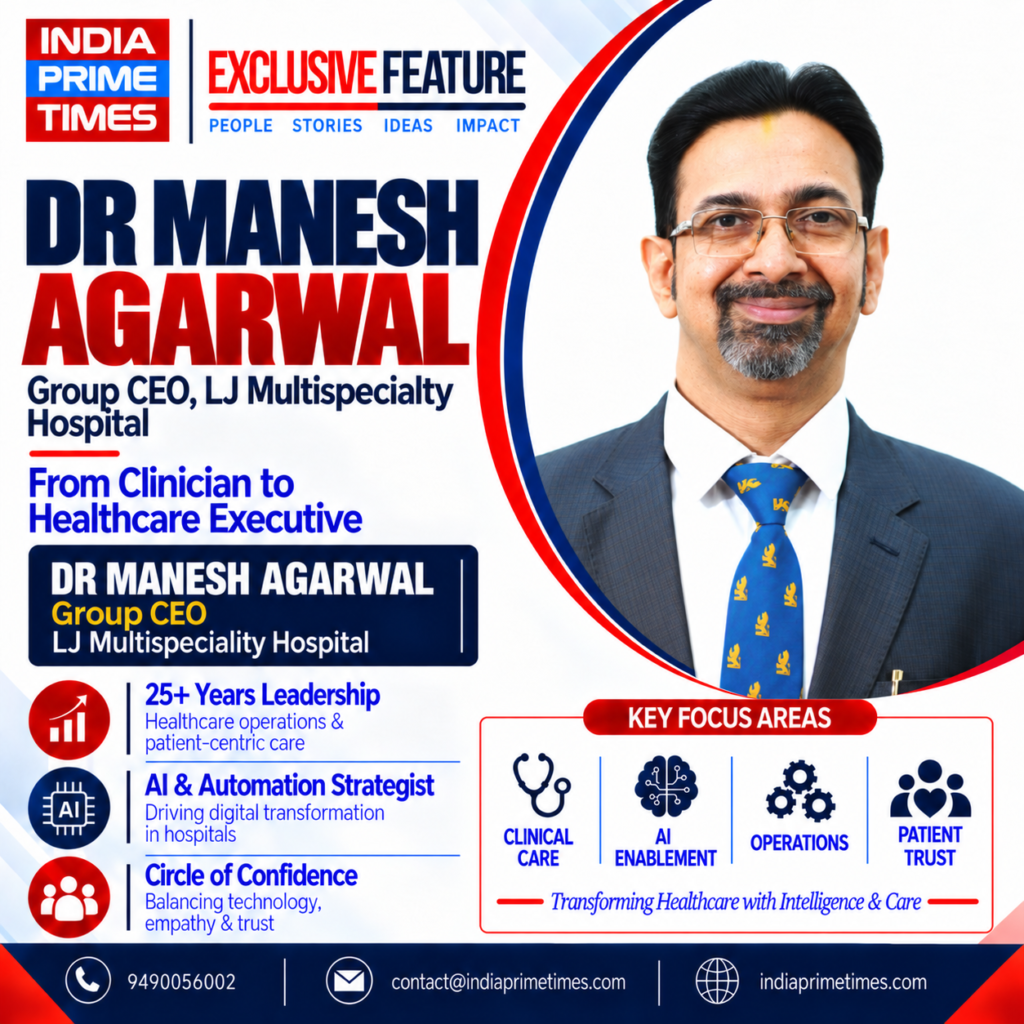
The Indian healthcare ecosystem is rapidly expanding. With the proliferation of new medical colleges, hospitals, tightening quality standards, and the aggressive integration of Artificial Intelligence (AI) and digital health records, the infrastructure of patient care is undergoing a massive structural shift. However, as hospital networks scale, a critical vulnerability is emerging in the boardrooms, a severe shortage of leadership that truly understands both the clinical realities of the operating room and the financial architecture of hospital administration.
While the nation focuses heavily on producing more doctors, an urgent question remains! who is going to manage the highly complex, living systems that these doctors operate within?
To investigate how elite healthcare institutions are solving this leadership deficit, the India Prime Times editorial team recently directed its focus to Gujarat, a state rapidly emerging as a central hub for medical modernization. During our field reporting, our team observed highly digitized hospital workflows where AI-assisted diagnostics, paperless administration, and rigorous quality control protocols functioned in total synchronization.
This operational precision led our editorial desk to a comprehensive, in-person interaction with Dr Manesh Agarwal, a rare doctor-turned-Group CEO and a leading AI and Automation Strategist for healthcare. With over 25 years of executive leadership across top-tier institutions, including Bombay Hospital, Narayana Hrudayalaya, Woodlands Multispecialty Hospital, Apollo Health City and Jivraj Mehta Hospital, he currently serves as the Group CEO of LJ Multispecialty Hospital. Over an extensive conversation, our team experienced his exceptional work firsthand, exploring how he is actively transitioning Indian hospitals from legacy models to intelligent, scalable ecosystems.
The Dual Perspective: From Clinician to CEO
A fundamental flaw in modern hospital administration is the disconnect between management and medical team. Administrators often prioritize financial metrics, while doctors prioritize clinical autonomy, frequently leading to operational friction.
Dr Manesh Agarwal circumvents this conflict through his dual perspective. He holds an M.Phil in Hospital Administration and Healthcare Management from BITS, Pilani, and a PG Diploma in Medical Law, Policy & Ethics from Gujarat National Law University, Gandhinagar. Having practiced from the clinician’s chair and led from the CEO’s chair, he possesses an intrinsic understanding of what both sides require to function optimally.
“A hospital is not just a workplace for doctors, it is a highly complex, living system,” Dr Manesh Agarwal explained to the India Prime Times team. “You have Consultant doctors, Medical officers, nurses, pharmacists, para medics, diagnostic departments like Pathology & Radiology, ICUs, Operation Theatres, security, housekeeping, Biomedical engineering, maintenance, legal compliance, and technology teams. A failure in any one of these departments ultimately reaches the patient. Hospital leadership is not just about running a facility; it is about engineering a system where thousands of daily micro-decisions align to deliver flawless patient care.”
Executing Large-Scale Hospital Turnarounds
This philosophy is not merely theoretical, it is backed by a formidable track record of institutional turnarounds.
During his tenure as the Chief Executive Officer at Jivraj Mehta Hospital in Ahmedabad, Dr Manesh Agarwal spearheaded the transformation of a 200+ bed multi-specialty facility into a digitally enabled, patient-first institution. His strategic interventions were highly quantifiable: he improved the EBITDA margin from -6% to +10%, drove a 30% revenue growth by expanding into new markets, boosted bed occupancy by 25%, and increased OT revenue by 46%.
Crucially, he initiated a hospital-wide digital transformation, rendering the institution fully paperless and securing vital NABH accreditations. His leadership earned him the prestigious Outstanding Contribution in Healthcare award from the Hon. Health Minister of Gujarat, as well as the Champions of NABH Digital Health Standards Award from QCI and NABH.
His leadership as Vice President of Operations at Apollo Health City in Hyderabad expanded the diagnostic footprint and increased corporate partnerships significantly.
The AI Mandate: Building the ‘Circle of Confidence’
Today, as the Group CEO of LJ Hospitals & Medical College, Dr Manesh Agarwal is leading the commissioning and operational launch of a massive 300-bed hospital. His mandate here is strictly focused on future-proofing the institution through AI-powered digital transformation.
“Most healthcare leaders recognize that AI is the future, but the challenge is bringing it to life smoothly without alienating the medical staff,” he shared during our interview. To solve this, he developed and deployed a proprietary AI adoption framework called the “Circle of Confidence.” This framework ensures that AI-assisted clinical care, intelligent operations management, and workflow automation are integrated seamlessly, empowering teams rather than replacing them.
Beyond his executive role, Dr Manesh Agarwal is a recognized TEDx Speaker, author of “Visionary Leadership Redefined,” and “The Intelligent Hospital”. He is a highly sought-after panellist on healthcare exellence. He actively advises healthcare leaders on how to implement automated workflows that improve clinical outcomes while ensuring sustainable financial growth.
Engineering a Culture of Empathy and Accountability
What truly sets Dr Manesh Agarwal apart in the highly corporate world of healthcare administration is his unwavering commitment to ground-level empathy. According to him Leadership is not always about dictating policy from the boardroom, it is often demonstrated in the hospital corridors.
He recounted an incident during a hospital round where an elderly patient had been waiting for hours to be admitted. After immediately resolving the bottleneck, Dr Manesh Agarwal folded his hands and personally apologized to the patient on behalf of his team. When his staff witnessed the CEO taking direct accountability and his humble approach towards patient, it instantly shifted the hospital’s culture. “If my apology restores a patient’s trust, I have no problem with it. But the system must be fixed so that the situation never arises again,” he noted.
As our interaction with Dr Manesh Agarwal concluded, the broader trajectory of Indian healthcare became strikingly clear. As the nation races toward a $1 trillion digital economy by 2030, building more hospitals will not be enough. The future belongs to institutions led by visionary healthcare leaders who can seamlessly merge clinical ethics with AI-driven operational excellence. For healthcare investors, medical professionals, and administrators navigating this complex transition, Dr Manesh Agarwal provides a living blueprint, the most effective medical intervention is often not treating a single patient, but curing the entire system.