From Satire to Street Protests: Will India’s Viral ‘Cockroach’ Party Shake the Political System?
4 min read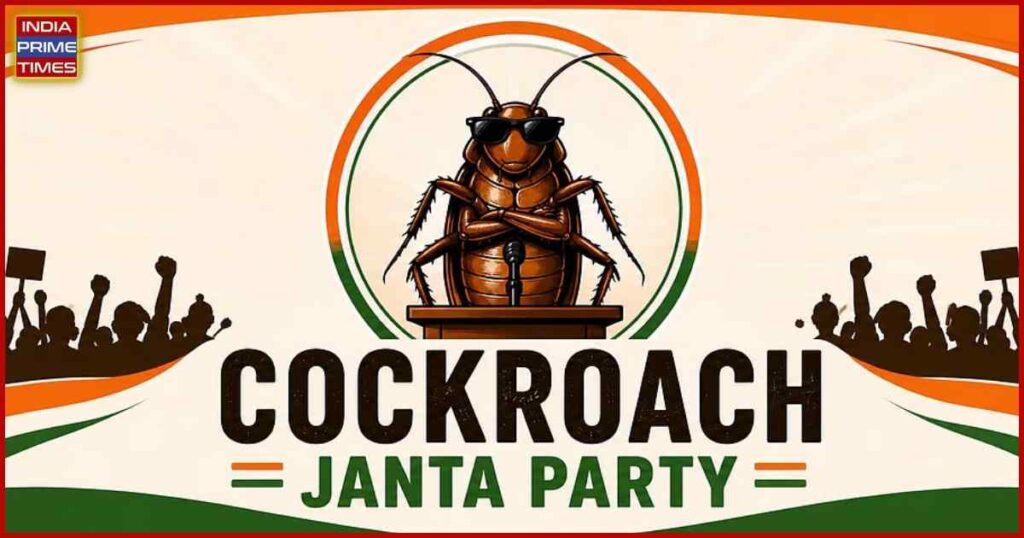
What began as a casual joke on social media has exploded into an unprecedented, viral youth movement across India. The pseudo-political entity known as the Cockroach Janta Party (CJP) has amassed a staggering 22 million followers on Instagram in a matter of weeks, transforming a derogatory judicial remark into a massive symbol of Gen Z defiance.
As the satirical movement prepares to step offline for its first physical protest in New Delhi this Saturday, investors, political analysts, and the ruling establishment are watching closely to see if this digital outrage can translate into real-world political upheaval.
Here is a complete breakdown of how the CJP was born, what they are demanding, and why the movement is making global markets nervous.
The Genesis: From Insult to Identity
The Cockroach Janta Party owes its existence to an open-court remark made by India’s Chief Justice, Surya Kant, on May 15. During a hearing regarding fake degrees, Kant controversially stated, “There are youngsters like cockroaches, who don’t get any employment or have any place in the profession… and they start attacking everyone.” Although the Chief Justice later clarified that his comments were aimed strictly at fraudsters and not India’s youth, the damage was irreversible. In a nation battling a profound youth employment crisis, the remark struck a raw nerve.
In response, 30-year-old Abhijeet Dipke-a public relations graduate from Boston University and former political communications strategist-took to X (formerly Twitter) and posted: “What if all cockroaches come together?” Dipke launched the CJP, its name a satirical riff on the ruling Bharatiya Janata Party (BJP), positioning it as the “voice of the lazy and unemployed.” Within days, the party’s AI-generated cockroach mascot flooded social media, and its Instagram following eclipsed that of mainstream national parties, surging past 22 million. According to Dipke, over a million people have officially “registered” as members, including prominent opposition figures like Mahua Moitra and Kirti Azad.
The Root of the Rage: The Demographic Dividend Gone Wrong
At its core, the CJP represents the mounting frustration of India’s youth-the largest Gen Z cohort in the world.
Despite India’s booming macroeconomic growth, job creation has stalled. According to a recent report by Azim Premji University, nearly 40% of graduates aged 25 and younger are unemployed. This rate is nine times higher than for individuals who never attended school. With the rise of generative AI threatening traditional IT jobs and manufacturing sectors failing to absorb the massive workforce, global equity firms like Bernstein have explicitly warned the Modi government of a deepening employment crisis.
Reema Bhattacharya, head of Asia research at Verisk Maplecroft, noted that the movement reflects “growing frustration over why the much-discussed demographic dividend has delivered uneven outcomes after more than a decade of political promises.”
The Trigger: Examination Scandals
While unemployment provides the underlying fuel, the immediate spark for Saturday’s planned protest in New Delhi is the recent string of catastrophic failures in national entrance examinations.
Systemic leaks and severe discrepancies in high-stakes tests, such as the NEET medical entrance exam, have allegedly ruined the prospects of over 2.2 million students. In a viral Instagram video announcing a new petition, Dipke directly blamed the government: “It was a systemic error that ruined the future of over 2.2 million students. It was a systemic error that led to NEET students committing suicide. No matter what happens, we want [Education Minister] Dharmendra Pradhan to resign.”
The “Protest Test”: Will Digital Anger Mobilize the Streets?
Saturday will mark the CJP’s first major offline test. While supporters have already engaged in minor real-world activities-such as dressing up as cockroaches to clean Delhi’s notoriously polluted Yamuna River-a mass political gathering is a different beast.
Experts remain cautious. Ronojoy Sen, a senior research fellow at the Institute of South Asian Studies, noted, “I don’t think India is at risk of political upheaval. India is a vast and complex country; for any political outfit to make an impact, it needs serious physical presence and ground mobilization. Only an online presence won’t do.”
However, market analysts are not entirely dismissing the threat. Similar disgruntled youth movements driven by social media have recently toppled governments in neighboring Bangladesh and Nepal. If Saturday’s protest manages to gather a million people in the capital, it will immediately transition from a satirical internet meme into a market-moving event that could rattle investor confidence in the region’s stability.
Government Pushback and Censorship
The establishment has not ignored the CJP’s rapid rise. On May 21, the original Cockroach Janta Party account on X was withheld in India following “national security concerns” raised by the Intelligence Bureau under Section 69(A) of the IT Act.
Unfazed, the movement simply launched a new handle, Cockroach is Back, gaining 144,000 followers in 24 hours with the defiant caption: “You thought you could get rid of us? Lol.”
Meanwhile, founder Abhijeet Dipke has publicly expressed fears of political retribution, stating in a recent interview that he expects to be arrested and taken to Tihar Jail the moment he lands at the Delhi airport next month.
Whether the CJP fades as a temporary internet phenomenon or evolves into a sustained political force, it has undeniably succeeded in dragging the dual crises of youth unemployment and educational mismanagement to the forefront of the national conversation.
Get in Touch with India Prime Times For any updates, queries, or to publish a news article, please reach out to our editorial desk:
- Contact Number: +91 9490056002
- Email ID: info@indiaprimetimes.com
- WhatsApp Us: https://wa.me/919490056002