
The Convergence of Capital, Code, and Governance: How Modern IT Enterprises Are Bridging Deep-Tech Execution and Financial Rigor
4 min read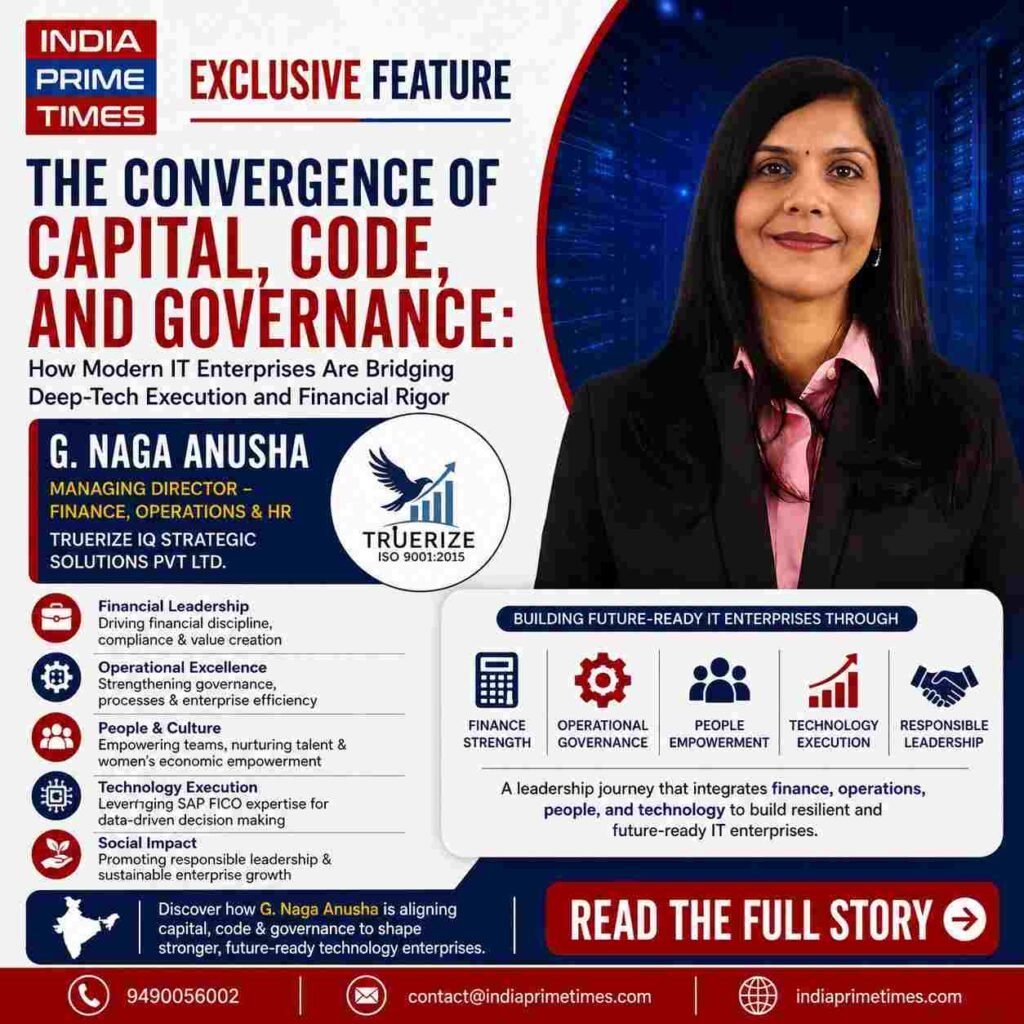
India’s information technology and product engineering landscape is undergoing a critical maturity cycle. For decades, the sector was driven primarily by rapid workforce expansion and linear software outsourcing. However, the contemporary digital economy demands a far more complex operational standard. Enterprise clients, government bodies, and research institutions now require IT product partners to demonstrate not only technical agility, but also institutional-grade financial discipline, compliance frameworks, and deep enterprise resource planning (ERP) governance.
As technology ventures increasingly take on high-stakes, research-oriented mandates-such as public sector digitization and national scientific initiatives-the traditional divide between corporate finance, human resources, and software delivery is disappearing. Industry analysts point to a growing need for multidisciplinary leaders capable of uniting complex financial architectures with scalable software engineering.
To investigate how mid-market IT enterprises are building systems to support this level of operational discipline, the India Prime Times editorial team recently conducted an on-ground assessment across the technology corridors of Bengaluru.
During our field reporting in the HSR Layout enterprise belt, our team examined high-governance technology delivery environments operating under CMMI Level 5 process maturity and ISO 9001:2015 quality benchmarks. The seamless alignment between financial control systems, resource deployment, and technical output in these environments immediately stood out.
This operational precision led our editorial desk to a comprehensive, in-person interaction with Ms. G. Naga Anusha, Managing Director – Finance, Operations & HR at Truerize IQ Strategic Solutions Pvt Ltd. Over an extensive conversation, our team explored how integrated financial systems, enterprise ERP frameworks, and sustainable talent models are transforming modern IT product companies into resilient institutions.
The Multidisciplinary Foundation: Integrating Human Capital and Enterprise Finance
A common vulnerability across emerging technology firms is structural imbalance: companies often excel at software development while struggling with cash flow optimization, human capital governance, or regulatory compliance.
During our interaction, Ms. Naga Anusha emphasized that long-term enterprise sustainability depends on treating financial engineering and organizational design with the exact same rigor as software architecture.
An MBA graduate from KL University (2010) specializing in finance and strategic management, Ms. Anusha built her operational philosophy across major corporate ecosystems. Her early career in human resource leadership at Power Mech Projects Ltd (2011–2014) and Reliance (2014–2016) provided hands-on experience in large-scale workforce governance, talent pipelines, and structured organizational design within complex infrastructure environments.
However, her decisive career pivot occurred in 2016 when she entered the core enterprise technology sector at Tech Mahindra as an SAP FICO Consultant.
“In modern enterprise management, finance and technology cannot operate in silos,” Ms. Naga Anusha explained to the India Prime Times team. “Working extensively with SAP FICO and ERP architectures revealed how critical financial process optimization is to actual business scalability. When financial transparency, ledger automation, and operational KPIs are embedded directly into a company’s operational DNA, the organization gains the resilience needed to execute large-scale projects without systemic strain.”
Scaling High-Stakes R&D and National Research Initiatives
What makes Ms. Anusha’s leadership profile particularly newsworthy is her transition from enterprise consulting to high-impact entrepreneurial execution. In 2020, she founded and spearheaded an IT product company focused on advanced engineering and research-driven initiatives.
Under her strategic and financial stewardship, the enterprise scaled to a workforce of over 110 skilled professionals and successfully completed more than 1,000 technology projects. Notably, this portfolio includes significant involvement in research initiatives supported by the Department of Science and Technology (DST), Government of India.
Executing government-backed research and deep-tech initiatives requires strict compliance protocols, audited project accounting, and uncompromising delivery timelines.
“Research-backed and public-sector projects do not permit operational shortcuts,” noted Ms. Anusha during our interview. “Every deliverable must be backed by transparent financial tracking, milestone-driven resource allocation, and audited quality frameworks. Combining disciplined budgeting with innovation ensures that technical teams have the stability they need to deliver high-impact results.”
At Truerize IQ Strategic Solutions Pvt Ltd, she continues to drive this standard, overseeing financial architecture, corporate governance, and cross-functional operations within an environment benchmarked against CMMI Level 5 and ISO 9001:2015 certifications.
Social Capital and Inclusive Workforce Models
Beyond balance sheets and software architectures, our team’s discussion focused on the broader socio-economic responsibility of corporate leadership. As India’s digital economy expands, the imperative for inclusive, equitable growth has become an urgent industry priority.
Ms. Anusha has positioned women’s economic empowerment and professional self-reliance at the center of her leadership agenda. Within the organization, she actively fosters an inclusive, merit-driven workplace culture that provides mentorship, technical upskilling, and executive growth pathways for female professionals.
Her corporate social responsibility (CSR) initiatives extend deeply into community welfare, collaborating with established charitable institutions such as the Mother Theresa Charitable Trust. These programs focus on providing education, healthcare support, and foundational skill development for underprivileged women and female children.
“Empowering women professionally and financially creates an undeniable multiplier effect,” Ms. Anusha shared. “When a woman achieves financial independence, it transforms her family, strengthens her local community, and drives broader economic resilience. Corporate leadership must extend beyond commercial metrics to create measurable social value.”
The Blueprint for Future-Ready IT Enterprises
As our conversation with Ms. G. Naga Anusha concluded, the overarching trajectory of India’s IT enterprise ecosystem became distinct. The next wave of value creation will not belong to companies pursuing growth at the expense of governance. Instead, sustainable market leadership will be defined by organizations that combine deep technological capability, audited financial integrity, institutional process maturity, and social accountability.
For enterprise stakeholders, technology investors, and corporate strategists analyzing the maturation of India’s IT landscape, the operational models executed by leaders like Ms. G. Naga Anusha provide a clear, definitive roadmap. By weaving enterprise finance, human-centric leadership, and cutting-edge digital execution into a unified strategy, modern innovators are establishing the structural benchmarks for India’s next generation of technology enterprises.