
The Enterprise AI Frontier: How Deep Learning Research and Agentic Architectures Are Modernizing Legacy Infrastructure in Regulated Global Markets
5 min read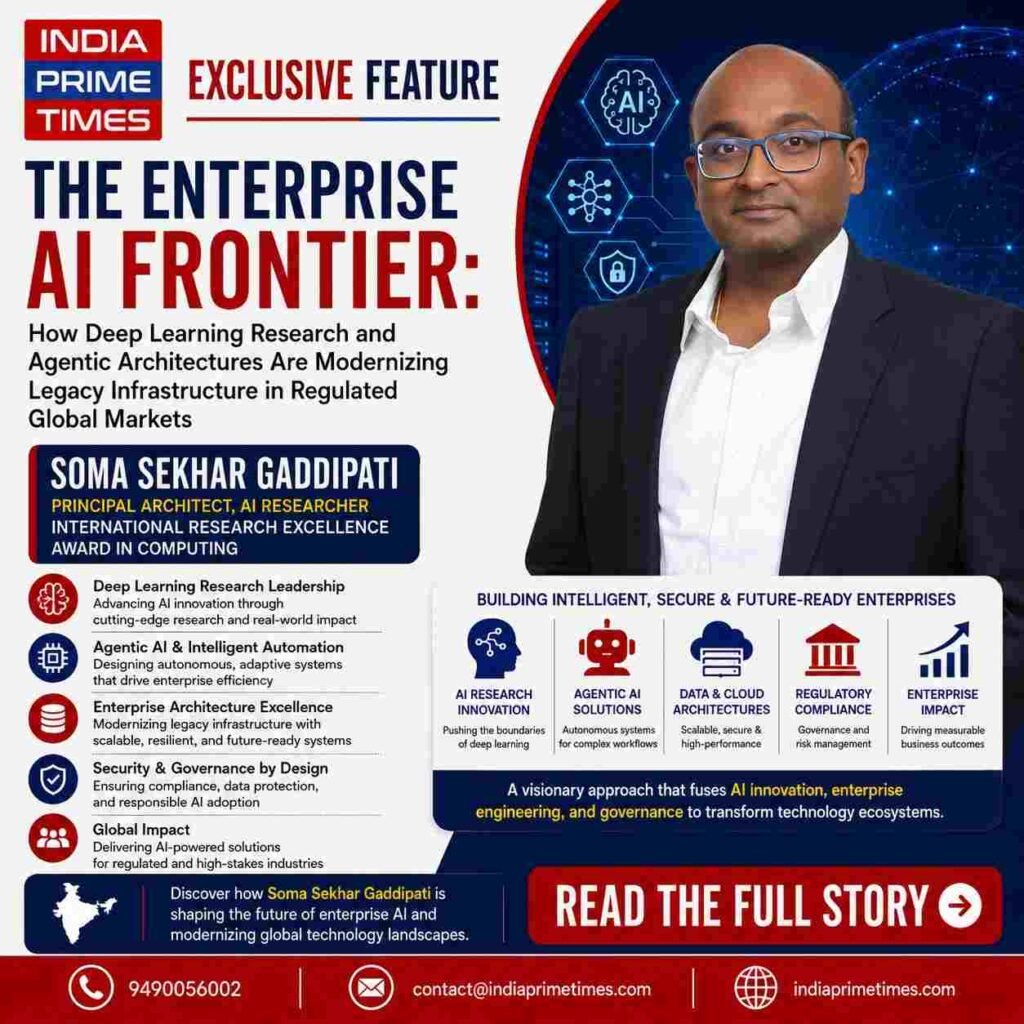
The global enterprise technology ecosystem has reached a decisive turning point in its adoption of Artificial Intelligence. Over the past three years, the corporate landscape was largely consumed by experimental generative AI deployments, proof-of-concept chatbots, and speculative venture investments. However, as global enterprises enter the second half of 2026, the era of experimental novelty has officially closed. Boardrooms, Chief Information Officers (CIOs), and enterprise architects are now confronting a far more complex and unforgiving challenge: operationalizing AI at scale within massive, mission-critical legacy architectures.
For heavily regulated sectors such as healthcare, banking, financial services, and cloud logistics, deploying artificial intelligence is not merely a software upgrade. These industries operate under strict regulatory mandates, requiring absolute data integrity, zero downtime, and ironclad compliance frameworks. Integrating cutting-edge machine learning models into decades-old mainframe systems and fragmented data lakes without compromising security or regulatory standing has emerged as the most critical bottleneck in enterprise digital transformation.
To understand how global technology enterprises are solving this high-stakes engineering puzzle, the India Prime Times editorial team recently expanded its investigative coverage into international enterprise cloud and artificial intelligence infrastructure.
During our technical field reporting, our team observed the deployment of highly resilient, large-scale data pipelines capable of orchestrating autonomous AI agents across legacy enterprise stacks. The structural stability, sub-second latency, and uncompromising compliance standards of these environments immediately stood out.
This level of architectural precision led our editorial desk to an in-depth conversation with the technologist behind these frameworks: Mr. Soma Sekhar Gaddipati, a distinguished Principal Architect, AI Researcher, and recipient of the International Research Excellence Award in Computing.
Our editorial team met with Mr. Gaddipati and observed his groundbreaking methodologies firsthand. Over an extensive discussion, we examined how deep academic research in neural networks is providing the architectural blueprint for modernizing global enterprise systems.
Bridging Academic Rigor and Enterprise Scale
A primary reason enterprise AI initiatives fail is the profound disconnect between theoretical machine learning research and real-world software engineering. Academic models are frequently developed in sterile, controlled compute environments, whereas global enterprises operate across messy, distributed, and highly scrutinized infrastructures.
Mr. Gaddipati represents a rare class of industry leaders who bridge this divide. Holding a PhD specializing in Image-based Deep Learning Applications, his foundational career has been dedicated to translating complex, theoretical mathematical models into high-throughput, enterprise-grade digital ecosystems.
“In academic research, the goal is often to optimize model accuracy on static benchmarks,” Mr. Gaddipati explained during our conversation. “In global enterprise engineering, however, accuracy is only the entry ticket. An algorithm is useless if it cannot scale horizontally, withstand continuous data drift, comply with strict privacy laws, and integrate seamlessly into existing enterprise resource planning and database architectures.”
His pioneering work in advancing the practical applications of deep learning and computer science was formally recognized on the global stage when he was awarded the International Research Excellence Award in Computing (Category: Research in AI and Computer Science). This academic rigor forms the bedrock of his architectural philosophy.
The ‘Intelligent Upgrade’: Deploying Agentic AI on Legacy Systems
A central theme of our discussion centered on legacy modernization. Fortune 500 enterprises cannot simply dismantle and replace multi-billion-dollar core systems that have powered their businesses for decades. The modern mandate is the “intelligent upgrade”-layering advanced AI/ML capabilities and autonomous Agentic AI workflows directly onto existing enterprise backbones.
Mr. Gaddipati specializes in architecting these intelligent layers. Rather than relying on simple, passive prediction models, his frameworks utilize autonomous agentic workflows capable of executing multi-step reasoning, automated data reconciliation, and intelligent decision-routing.
“The modern enterprise does not need more isolated point solutions; it needs cohesive, cognitive infrastructure,” Mr. Gaddipati noted to the India Prime Times team. “By embedding Agentic AI into legacy frameworks, we eliminate manual operational friction, optimize compute costs, and unlock massive scalability-all while keeping core transactional systems completely stable.”
This approach enables large enterprises to modernize their operations incrementally and cost-effectively, bypassing the immense financial and operational risks associated with total system overhauls.
The Gold Standard of Security-by-Design and Governance
While performance and throughput are paramount, the defining boundary of enterprise AI deployment in regulated industries is security. With the rapid expansion of global data protection regulations and escalating cybersecurity threats, AI systems must be built with uncompromising governance.
Mr. Gaddipati champions an unyielding “security-by-design” architecture. His implementations ensure that large-scale cloud data engineering, deep learning pipelines, and multi-region database migrations comply rigorously with international regulatory standards, including SOC 2 Type II, HIPAA (Health Insurance Portability and Accountability Act), and ISO 27001.
“Security and compliance cannot be treated as post-deployment checklists,” Mr. Gaddipati emphasized. “When dealing with sensitive patient health records or high-frequency financial transactions, data encryption, anonymization, deterministic access controls, and ethical AI auditing must be baked directly into the data ingestion layer. Trust is the only currency that matters in enterprise technology.”
Strategic Leadership Across the Technical-Executive Divide
Beyond technical design and cloud engineering, our conversation highlighted the critical role of strategic human leadership in digital transformation. Large-scale enterprise migrations routinely falter not from algorithmic failure, but from poor alignment between executive vision and engineering execution.
Operating as a Principal Architect, Mr. Gaddipati has consistently demonstrated the ability to unite diverse global engineering teams, cross-functional stakeholders, and C-suite leaders around cohesive technology roadmaps. By translating complex neural network behavior and infrastructure ROI into clear, quantifiable business outcomes, he ensures that digital transformation initiatives deliver measurable bottom-line value.
The Road Ahead for Enterprise Intelligence
As our conversation with Mr. Soma Sekhar Gaddipati concluded, the overarching trajectory of the global AI industry came into sharp focus. The future of technology will not be defined by speculative models or isolated laboratory breakthroughs. Instead, the market leaders of the next decade will be the organizations that successfully anchor artificial intelligence within secure, resilient, and ethically governed enterprise foundations.
For enterprise CIOs, cloud architects, and technology strategists navigating the complex intersection of deep learning and industrial scalability, the methodologies executed by leaders like Mr. Soma Sekhar Gaddipati provide an indispensable roadmap. By uniting deep academic research with disciplined enterprise engineering and rigorous governance, modern technology architects are not merely upgrading software-they are building the resilient, intelligent backbone of the future digital economy